Showing posts sorted by relevance for query NWrrds. Sort by date Show all posts

Wednesday, April 23, 2025

Water Utility Adds Another $12 Million Loan To Complete NWRRDS Project

Council approves new WIFA loan
In an article posted a few weeks ago, we anticipated that the Oro Valley Water Utility would soon ask the Town Council to approve borrowing more money to complete the Northwest Recharge, Recovery and Delivery System (NWRRDS) project. That happened last Wednesday when the Town Council unanimously approved borrowing $12 million from the Water Infrastructure Finance Authority of Arizona (WIFA).

Loan will fund final project components
The loan will help pay for the final two independent components of the NWRRDS project: the Twin Peaks Booster Station and about seven miles of water transmission main. With this funding, the project is expected to be completed by the summer of 2026. Most of the system is already built and funded through impact fees, groundwater preservation fees, a previous $6 million private loan, and a water conservation grant.

Water utility—not the town—is responsible
The loan is not a debt of the Town of Oro Valley’s general government. It will be repaid entirely by the Water Utility, using only its own revenues. No taxpayer funds or general fund dollars will be used, and the loan is not backed or guaranteed by the Town. According to the loan agreement, the debt will be repaid from net revenues of the water system—revenues that come from ratepayers. This arrangement keeps the obligation strictly within the utility’s enterprise fund.

Hard To Read? 
Click To Enlarge
NWRRDS costs have escalated over time... Total Cost Today $47.4 million

The NWRRDS project began in 2017 as a joint effort between Oro Valley, Marana, and Metro Water to bring additional Central Arizona Project (CAP) water into the region. Initially, Oro Valley's share was projected at approximately $12–$13 million. However, over time, costs have increased due to factors such as inflation, design modifications, and construction challenges. As of 2025, Oro Valley's share has risen to about $21 million, with the independent portion of the project now estimated at $12 million, doubling the original estimate. This escalation in costs has necessitated  financing to ensure the project's completion.

Loan terms and financial impact
According to Water Utility Director Peter Abraham, this additional funding need was projected years ago. “It’s nothing new,” he told the council. “It’s been in our water rate reports since 2019.” Finance Director David Gephart added that the utility would be responsible for repaying just over $11 million, since about $1 million of the principal is forgivable. The estimated interest rate is 3.45%, with an annual debt service of about $797,000. No water rate increases are needed to cover the payments.

This, the last of two loans totaling $18 million, completes utility’s NWRRDS outside funding
With last week’s approval of the $12 million WIFA loan, the Council has now authorized a total of $18 million in borrowing to complete the NWRRDS project. In March, it approved a $6 million private placement loan to fund the town’s share of jointly constructed facilities. This WIFA loan covers the final two independent components. Together, the two loans are intended to ensure that the project is fully funded and completed by 2026.
- - -
You can read more on NWRRDS here.

Wednesday, March 26, 2025

Oro Valley Financing NWRRDS Project Cost Overruns— $6 Million Loan Approved, $12 Million More Coming

Oro Valley approves $6 million loan for NWRRDS water project
Last week, the Oro Valley Town Council unanimously approved a $6 million senior lien water revenue obligation. This new loan will help fund an overrun on the town’s share of the partnered Northwest Recharge, Recovery, and Delivery System (NWRRDS) project — a multi-agency effort to deliver some of Oro Valley’s Colorado River water allocation directly to the town, rather than routing it through Tucson Water. The project’s partners are Marana and Metro Water.

As it turns out, NWRRDS is a very expensive project
The project has turned out to be far more expensive than town staff envisioned in 2017. Partnered costs have grown from $30 million in 2017 to $49 million today. Oro Valley’s share was projected to be around $12–$13 million in 2017, based on its contractual capacity of 4,000 acre-feet per year. Today, that share is about $21 million. The independent portion of the project, which Oro Valley funds entirely, was originally estimated at $6 million. The town now plans to seek a $12 million WIFA loan in April 2025, doubling that initial estimate as well.

Concerns about project management... and total project cost

This ballooning cost should have prompted discussion by the council last week. Questions like: Are our Oro Valley Water engineers competent in bidding, managing, and, most importantly, reporting to their customers on complex projects where risk and inflation will inevitably revise the initial estimate? — have never been asked. Instead, councilmembers praised the town’s strong finances and debt management during the meeting. But no one asked why this overrun exists, how realistic future funding assumptions are, or whether Oro Valley residents are being asked to pay for mismanagement or avoidable cost increases.

The loan to fund the partnered portion overrun is a private placement
The council approved the $6 million loan to help fund the overrun on Oro Valley’s portion of the partnered project. The funding will come through a private placement loan at an interest rate of 4.085%, repayable over 10 years.

Town is paying a premium interest rate for convenience
Town staff and advisors called the 4.085% tax-free interest rate “favorable,” but not all residents are convinced. One knowledgeable reader pointed out that the town may be paying a premium — less than 1% above what would be typical if they were able to borrow in the public market and exercise early payoff flexibility. Over a 3–10 year window, comparable borrowing rates would range from approximately 2.79% to 3.17%.

The private placement route offered convenience: no underwriting costs, no credit rating expenses, and a simplified process with six institutional bids. However, residents are left wondering whether the town thoroughly explored a public offering. While a $6 million deal is small by municipal standards (where issuance costs can be significant), the absence of comparative analysis leaves questions unanswered. As one resident put it: “It would be helpful if they provided more numbers as a comparison to the private placement.”

More borrowing ahead — and more questions
The $6 million private placement loan is only part of the picture. On April 16, the council will be asked to approve an additional $12 million WIFA loan for the independent portion of the NWRRDS project, bringing the total new borrowing to $18 million. The plan, according to staff, is for 60% of that debt service to be paid by future impact fees and 40% by the groundwater preservation fee (GPF).

But residents are asking: Where will the approximately $11 million in needed impact fees come from? According to the town’s 2022 fee schedule, the residential water impact fee for a standard 5/8" meter is $6,387 per home. That translates to roughly 1,700 new homes needed just to cover the planned impact fee share. Given current market conditions, including a growing apartment surplus in Tucson and slowdowns in new development, that target may be unrealistic.

One concerned resident wrote: “It appears to me that the 60/40 Impact Fee/GPF split can't be maintained. Our impact fee per house yet to be built is far too low to cover 60% of NWRRDS cost overruns. The GPF will possibly need to cover far more than 40% of the new debt service.” In other words, existing residents — not future growth — could end up footing more of the bill than originally planned.

What’s next?
The $6 million loan will close on April 22, giving the town the funds needed to cover project overruns and continue construction. But with another $12 million loan request coming next month and serious questions about funding sources and cost management, residents are left wondering: How much more will they be asked to pay — and when will the town council start asking hard questions of its own?
- - -

Wednesday, June 23, 2021

As Things Stand Today, Oro Valley’s Growth Depends Solely on CAP

Two things struck us as different
…during last week’s Special Study session on potential changes to Oro Valley’s Water Conservation Code. You can see Monday’s post to read our report on that session.

There were two comments by Oro Valley Water Director Peter Abraham, a person who is bullish on Oro Valley’s water situation. Abraham was responding to questions from council.

Water conservation efforts have yielded all they can
First, Abraham stated that total water use has been increasing the past three years. This, after years of decrease due to resident water conservation efforts. This during years when Oro Valley added lots of new residences and water connections. Abraham said that it looks to him like resident conservation efforts have yielded all the water saving results they can.

Yes. We agree. That is possibly true. But we also think that the Hiremath years of rampant residential growth have overtaken resident ability to use less and less water. Abraham said he is going to “keep an eye” on the situation. We hope so.

Abraham sees NWWRDS as the solution to Oro Valley’s water needs
The second thing, one that is the first time we heard this from Abraham, is that an added “source” of water to the town’s water supply is needed to safely accommodate growth in users. This added supply will come “online” in 2024. It will come from the Northwest Recharge, Recovery, and Delivery System (NWRRDS). That is a joint project with Marana that is led by Metro Water. NWRRDS will deliver up to 4,000 acre feet of water per year to Oro Valley water from a new reservoir. Turns out that that reservoir is a transfer of more CAP water from one of the CAP reservoirs in Avra Valley that store CAP water.

NWWRDS is CAP water… It’s not a new source
Yes. CAP water. So it’s not a new source.

It’s the same water source that the State’s CAP water Czar thinks will be restricted at level 2 or 3 by 2024 or 2025. Just when NWRRD comes on line. These are levels that will reduce Arizona’s CAP water allotment further and eventually Oro Valley’s water allotment from CAP.  

Abraham is counting on NWRRDS to accommodate the growth in population. But this is hardly a long-term, reliable supply of water.

A real, sustainable alternative source must be developed
We’ve studied the CAP water situation for years. We were the first to report on possible restrictions of CAP water. We concluded long ago that the Oro Valley water future is far from bright if this drought continues (which experts suspect it will) and if Oro Valley continues its path of hell-bent growth (which we believe it will).

So, as agreements on CAP water allocation stand today, CAP is not long term solution to how to supply the big growth plans Oro Valley (and the rest of the Southwest) has.

“Desal” can make the Southwest water sustainable… but will politics derail it?
The Southwest and Oro Valley can become water sustainable by moving toward Desal plants. These plants can take the brine out of brackish underground water. They can take the salt out of the ocean. But they are many political barriers that will prevent this from happening until the water crisis is so dire that something simply must be be done. By then, many of us will be “long gone.”

Friday, November 5, 2021

Bits and Pieces

Funding for Golf Course Irrigation Approved
Wednesday, The Oro Valley Town Council authorized the Town Manager Mary Jacobs to engage the services of Wadsworth Golf Construction Company to replace the irrigation on the town owned E; Conquistador and La Canada Courses. We reported about this project and the various options that were considered also on Wednesday. The town will fund the project using Parks and Recreation Bond Funds and Federal ARPA funds. The motion to approve was 6-1.  Council Member Bohen voted against the measure because he believed there are more important parks and recreation initiatives that serve the greater community that should be funded from the bond funds. 

Oro Valley To Manage A Portion of the NWRRDS Effort
The town has crafted an agreement between itself, The Town of Marana, and Metro Water to manage the construction and inspection of  the booster stations and discharge piping of the Northwest Recharge, Recovery, and Delivery System (“NWRRDS”). [See panel]. 

This is a 15 month project that will cost the three partners $65,500 each. The town will save itself and its partners more than $100,000 each because it will do the work that a consultant would be employed to do.

When completed, that project will recover Central Arizona Project (CAP) water stored underground at various locations in Avra Valley and deliver that water to the Northwest Recharge, Recovery and Delivery System (NWRRDS). From there, the water will be transported to the Oro Valley Water Service Area. It will increase the amount of Oro Valley  Water delivered to the town.
---
Town of Oro Valley launches new Adopt-A-Road/Trail website
"The Town of Oro Valley has launched a new website for the Town’s Adopt-A-Road/Trail programs, designed to save volunteers time and alleviate wait times with several new improvements. 

The Adopt-A-Road/Trail website is now a one-stop shop for volunteers to fill out forms and watch training information. In fact, volunteers no longer need to travel to Town buildings to watch a safety video or fill out paperwork. The process is 100% paperless, and the training video is available on the website." (Source:Town of Oro Valley Press Release)

Wednesday, May 14, 2025

It's Budget Time: Council Questions Whether Proposed Capital Spending Is Balanced and Justified

Council digs into details of capital spending
At the April 30 budget study session, Council members questioned several aspects of the Town Manager’s recommended capital budget for fiscal 2026. The discussion focused on major areas of spending: water, public safety, streets, parks, and town facilities. Mayor Winfield presided over the session but did not ask questions. Staff answered each question and said that the current proposal reflects priorities identified in the Council's strategic plan.

Water spending and NWRRDS funding
Several questions focused on the largest area of capital spending: the Water Utility, which accounts for 62% of the $45.6 million recommended CIP. Vice Mayor Melanie Barrett asked for clarification on how much of the Northwest Recharge, Recovery, and Delivery System (NWRRDS) project is new spending versus carryover from the current year. Staff responded that approximately $8 million is carryover and $16.7 million is new funding.

Barrett also requested that future reports distinguish between groundwater preservation fees, which are paid by all water users, and water impact fees, which are paid by developers. “It would be helpful to have those separated out, since they are different sources of funding,” she said.

Community center project costs and equity

Multiple councilmembers commented on the large share of parks funding being spent at the Community Center. Vice Mayor Barrett raised concerns about over-concentrating capital spending in one part of town, saying: “It kind of feels like we just keep putting more and more and more money onto this one area… I hope that [residents in that area] will also support funding other areas of our town.”

Councilmember Mary Murphy and Councilmember Mo Green supported the proposed $950,000 to resurface the Community Center parking lot, citing safety concerns and visible deterioration. Staff explained that the pavement is crumbling and poses trip hazards. Councilmember Joyce Robb added that the older part of the lot “definitely seems like there are trip hazards,” noting that she observed them during a recent site visit.

Traffic, streets, and intersections
Vice Mayor Barrett asked whether a traffic warrant study had been completed for the $750,000 traffic signal proposed at Tangerine Road and Musette Drive. Staff responded that traffic counts had been collected and a warrant analysis was underway. She also questioned the long-term deferral of the Moore Road and La Cholla Boulevard intersection improvements, a project she said residents continue to raise concerns about.

Councilmember Robb asked about the sidewalk program and whether $100,000 annually is enough. Staff responded that the program began two years ago and that the request for next year is intended to “catch up” on backlogged repairs before scaling down to $25,000 in future years.

Parks projects and equity concerns
There was strong support among councilmembers for moving a proposed $250,000 Naranja Park shade structure from the contingent project list into the funded budget. Councilmember Nicolson said he hears frequent complaints about the lack of shade, and Councilmember Jones-Ivey asked whether drainage issues might interfere with construction. Staff said drainage is being monitored but is no longer a barrier to building shade structures.

Barrett also questioned the proposed $350,000 multi-use path near Lambert Lane, asking whether it serves the highest-priority need in the town’s trail system. Councilmember Robb suggested earmarking the funds generally for multi-use paths, to be directed to the top priority identified in the updated trails plan.

Police facility planning and project timing
Vice Mayor Barrett urged caution on the $36 million police facility project currently listed in future years of the CIP. She supported the $400,000 in the FY 2026 budget for continued planning but said, “It seems a little optimistic to me to say that in next year’s budget we’ll have something ready for $18 million.” Staff responded that the project is still in the contingent list and that scope and funding are yet to be defined.

Operations yard and long-term use
Councilmembers discussed whether to remove a $50,000 project for decommissioning the Municipal Operations Center (MOC), given that the Town also proposes spending $450,000 on fencing and other upgrades at the same location. “If you’re going to go in one direction, you wouldn’t do one of the other,” said Barrett. Councilmembers agreed to remove the decommissioning project from the long-range plan, since there are no plans to relocate Transit or Water Utility operations.

Next steps
This was the first of five public meetings on the FY 2026 budget. A follow-up session on the operating budget is scheduled for tonight. Public hearings are set for June 4 (tentative adoption) and June 18 (final adoption). Councilmembers may continue to refine budget priorities as those dates approach.
- - -

Friday, September 27, 2024

Bits and Pieces

Tonight, Marana visits CDO in "Tangerine Road Battle" 
Undefeated Marana High School visits Canyon del Oro (CDO) tonight in what is shaping up to be the biggest game of the season for CDO. Led by new head coach Scott McKee, CDO has turned things around after an opening loss, going on a three-game win streak to bring their record to 3-1. What’s remarkable about CDO’s performance this season is that only a handful of seniors from last year’s state championship team have returned and they have a new coach. Go Dorados!

Council approves seeking $18 million in funding for NWRRDS

The Oro Valley Town Council has approved seeking a loan from the Water Infrastructure Finance Authority (WIFA) to fund the Northwest Recharge, Recovery, and Delivery System (NWRRDS) project. This project will enable Oro Valley to bring CAP water from the Avra Valley reservoirs directly to the Town. Currently, that water is delivered to Oro Valley through the City of Tucson water system.

The loan will cover some this fiscal year’s expenditures, which are budgeted at $22.3 million. To date, the project has been funded through a combination of impact fees, groundwater preservation fees, and a previous WIFA grant. This approval allows the town to proceed with the loan application process to secure the necessary funding to continue the project.

The total project cost is estimated at $47.6 million, with $10.2 million anticipated to be spent in the final year of the project in fiscal 2026. The loan being sought will only cover some of this fiscal year’s expenditures, ensuring the project can continue without disruption. We anticipate that the final year’s spending will also need to be funded through a future loan.

Town receives two awards for communications and marketing

The Town of Oro Valley received two national awards for its communications and marketing efforts from the City-County Communications & Marketing Association (3CMA). The first award, a Silver Circle Award for Best Use of Humor, was for a social media video promoting the town's shred event using a "Star Wars" spoof. The second award, an Award of Excellence in the Digital Interactive – Media, Radio, Podcast category, was for the *This Is Oro Valley* podcast series, which provides updates on town services and events. Both projects were recognized for their success in increasing community engagement.

Bark in the Park at Steam Pump Ranch tomorrow
"Calling all dog lovers! Join us this Saturday, Sept. 28, 2024, from 5 to 8 p.m. for Bark in the Park, a free community event hosted by Town of Oro Valley Parks and Recreation at Steam Pump Ranch, 10901 N. Oracle Road. Bring your family, friends, and furry companions for an evening of fun-filled activities dedicated to our canine friends! Enjoy a dog costume contest and plenty of opportunities for your pups to make new friends. Participants register on-site for the dog costume contest, with prizes provided by the Southern Arizona Animal Food Bank for the best-dressed dogs." (Source: Town of Oro Valley Media Release)

Today is the last day to register for Community Academy
Today is the last day to register for Oro Valley’s 27th Annual Community Academy. This program offers residents the chance to learn about important topics such as water use, growth, and traffic while helping to shape the town’s future. The academy runs from October 3 to November 4, 2024, with both in-person and online participation options available. Don’t miss this opportunity to get involved in planning Oro Valley’s next 10-year action plan. Register by the end of the day at orovalleyaz.gov.

No council general planning liaisons will be assigned this time around
In 2014, two council member liaisons were assigned to the *Your Voice, Our Future* general plan effort, though their exact role was unclear. We asked Mayor Winfield if he planned to do the same for the current *Path Forward* planning cycle. Mayor Winfield told us that no specific council liaisons would be assigned. Instead, all council members can participate in the general plan process as they choose, and updates on the plan’s progress will be presented to the council periodically.
-  -  -

Monday, May 2, 2022

Town Manager Recommends $56.1 million In Capital Spending in 2023

"A conservative projection"
Oro Valley Town Manager Mary Jacobs is recommending capital spending in 2023 of $56.1 million. Jacobs says that this is a conservative projection of spending. Two programs dominate this spending: Almost half is for Parks and Recreation facilities; while one quarter is for water facilities.(See panel below, right)

Parks and Recreation: $26.1 Million
Spending for Oro Valley Parks and Recreation facilities is the centerpiece of this year’s capital budget portion of the Town Manager's Recommended Budget ("TMRB").

$10 million is budgeted for spending on the buildout of Naranja Park. 
We’ve noted in a previous article that the specifics of exactly what amenities are going to be built at the park have yet to be defined. The town is moving forward with grading the remaining undeveloped portions of the land and installing needed infrastructure.

Spending on municipal golf is almost $7.8 million. 
That includes spending of $7 million on golf course irrigation for the town’s two 18-hole golf courses. There is also money planned for golf path repaving, for turf replacement, and for equipment replacement.  $142,000 is set planned for reconfiguring the Pusch Ridge facility parking and pedestrian approach to meet ADA code requirements, resurfacing of roof and replacing roof drains.

From what we can tell, no money is targeted for improving the Pusch Ridge golf course. As we noted recently, the group Friends of Pusch Ridge believe that more needs to be done at their course.

The TMRB calls for spending approximately $1.9 million on the Community Center
Almost 80% of this relates to mobility access. That has two components. One is spending $750,000 on “Various accessibility modifications and improvements to the Community Center.” The other is a "placeholder" for an elevator that also costs $750,000. We call it a "placeholder" because it has been included in the past three town capital budgets. 

Water Department: $15.1 Million
There are two components to the Water Department capital funding amount. Approximately one third is planned to be spent to maintain the existing water system. This includes a host of projects. The remainder is a continuation of a project to bring water directly from one of the Avra Valley reservoirs that hold CAP water to Oro Valley. (Currently, Oro Valley gets CAP water through connection to the City of Tucson water system.) The project is called NWRRDS. It is a project in which the town is partnering with the Town of Marana and Metro Water.  We think that some of the cost included in the budget are partially reimbursed from those entities. NWRRDS spending is planned at $10.4 million this year.

Public Works: $8.0 Million

The town's Public Works Department takes care of the roads on which we travel, the facilities the town uses, the vehicles it uses, and the town’s public transportation interface. There are seventeen public works projects planned. The largest proposed projects include pavement preservation ($1.9m), two road repaving projects, ($1.2m) and vehicle replacement ($.5m).

General Administration: $5.8 Million
Approximately 60% of TMRB general administrative capital spending is a project that will establish a fiber optic network for expanded broadband services. This will provide a faster internet network. The town believes that having such is"... critical to Oro Valley's ability to attract, grow and retain primary employers and expand job opportunities. (TMRB, p 114). Most of this project is funded by a grant.

Police: $1.2Million
We identified two capital projects that relate to the police department. One is to replace police vehicles ($1.1m). The other is for a traffic camera video recording system. 

Whats' Missing?
The TMRB's schedule of capital projects includes spending for all projects anticipated over the next ten years. Two items which LOVE has been following are not included in this schedule. One is funding for a new police facility. According to our discussion with Chief Riley, one will be needed within five or six years.  The other is funding for bringing reclaimed water to the southern section of the town. Such would save millions of gallons of drinking water by converting the Pusch Ridge Golf Course, Kreigh Park, and CDO High School to its use.
- - -
About The TMRB: "Capital spending conservatively projected"

"Costs for capital projects have been projected conservatively and are higher than predicted just a year ago. The Town’s experience, as well as that of our regional and state counterparts, is that availability of contractors and subcontractors is unpredictable and continues to significantly impact the cost of capital investments. The Recommended Budget includes additional project contingency funds budgeted in the Capital Fund, Water Utility Fund, and Community Center Fund to ensure capital projects can still move forward if the Town’s updated estimates do not align with future market conditions." (Source: TMRB 2023, P.iii).
- - -
About the numbers
The numbers we have presented by program are based on the detail information by department presented in the TMRB.  This detail does not tie to the summary presented by the town manager. The summary for capital spending per the town manager is $59.5 million. The detail provided by program is $56.1 million. We have not identified why there is this difference. However, regardless of the reason, the data we have presented in accurate at the program level.
- - -

Wednesday, April 30, 2025

It’s Budget Time — Council Considers $46 Million In Capital Spending For 2026

Over 60% of the spending is Water related
Tonight, the Town Council will discuss the Town Manager's recommended capital budget for fiscal year 2026, which starts July 1, 2025. The total recommended capital budget is $45.6 million. Of this amount, 62% is for Water Utility projects. Within that, 88% is allocated to the Northwest Recharge, Recovery and Delivery System (NWRRDS) project. As previously reported, the Town has borrowed $18 million to fund a large portion of the NWRRDS project. The Water Utility operates as a separate enterprise from the rest of the Town.

Focus on $17.5 million of town projects
Our focus is on the $17.5 million of proposed capital spending outside of the Water Utility. Most of this spending is allocated to streets, public facilities (including vehicles and equipment), and parks. Together, these areas account for over 90% of the Town’s recommended non-Water Utility capital expenditures.

Hard to read?
Click to enlage
Street projects total $5.8 million

The largest portion of street spending supports the Town’s pavement preservation program, which seals and resurfaces roads to extend their lifespan. If residents have not seen work recently in their neighborhood, it is likely to occur soon because pavement preservation is an ongoing process. The recommended street budget also includes $750,000 for a new traffic light at the Tangerine Road entrance to Naranja Park. The primary funding source for these projects is the Highway Fund, which receives revenue primarily from state-shared highway user taxes and impact fees.

Public facilities, vehicles, and equipment projects total $5.1 million
The Town Manager is recommending $5.1 million for public facilities, vehicles, and equipment. More than 60% of this is for the Town’s vehicle replacement program. This program funds the annual replacement of aging fleet vehicles to help control repair and maintenance costs. Funds for the vehicle replacement program come primarily from the Capital Fund, which is supported by transfers from the Town’s General Fund and anticipated grants from the Arizona Department of Transportation (ADOT). This category also includes $800,000 to complete the court expansion project, including the construction of a secured sally port.

Parks projects total $5 million
The parks budget is dominated by spending on the Town’s golf and community center facilities. Approximately $2.8 million is allocated from the Community Center Fund for projects such as a 36-hole pump station, an exterior restroom at the Community Center, and resurfacing of the Community Center parking lot. The Community Center Fund is supported by dedicated revenues, including sales tax.

The parks budget also proposes $2 million for the reconstruction of the pond at the Vistoso Trails Nature Preserve. The funding source for the pond project is the Capital Fund, which in this case is supported by the Town’s General Fund.

New police facility planning project proposed

Public safety vehicle maintenance is included in the public facilities category. However, there is a separate public safety project proposed for fiscal 2026: $400,000 for police facility programming. This project would fund consulting services to design solutions for future police facility needs, based on a prior space needs assessment. Construction of a new police facility is not included in the fiscal 2026 capital budget. Instead, it appears in a contingent projects list for future years, with an estimated construction cost of $36 million starting in fiscal year 2027.

Summary
The Town Council will discuss the recommended capital improvement projects for fiscal year 2026 at tonight’s meeting. We will report on any major discussions or changes of interest in a future LOVE article.
- - -

Wednesday, March 5, 2025

It Happens Every Year…Another Water Rate Increase In Progress

Tonight: Oro Valley starts the process of increasing your water bill
Oro Valley residents will likely see an increase in their water bills in August as the town’s Water Utility Commission recommends increases to both base rates and commodity rates. According to the recently released Water Rates Analysis Report, the changes are necessary to maintain financial stability while funding operational costs, infrastructure improvements, and debt obligations. The report states that the rate increases will help the utility recover fixed and variable costs while ensuring compliance with financial policies and bond covenants. The report, along with a request for the Town Council to approve notice of a water rate increase, will be presented to the Oro Valley Town Council tonight.

Base and commodity rates will increase
The report proposes an increase in the drinking water base rate and a commodity rate hike per 1,000 gallons used. For residential customers with a 5/8-inch meter—the most common size in Oro Valley—the monthly base rate would increase by $1.11, while the commodity rate would rise by $0.10 per 1,000 gallons. This means that a household using 7,000 gallons per month would see their bill increase by $1.81 per month, a 3.8% increase over current rates. However, the actual impact on water bills will be greater because sales and utility taxes are added, further increasing the cost.

Rate increases driven by rising costs, financial planning, and department philosophy

According to the Water Rates Analysis Report, water rate increases are attributed to rising operating costs, inflation, and the need to maintain adequate cash reserves in the utility’s operating fund. Additionally, Water Utility Director Peter Abraham advocates for annual rate increases, believing this approach smooths out financial impacts on residents. However, this philosophy failed residents last year when the Town Council approved a significant increase [See panel right]. 

The Water Utility Commission and town staff defend the increases also citing the need to meet debt service coverage requirements and maintain financial reserves at a safe level. The current proposal projects that the water utility operating fund will retain a cash balance of over $5.4 million by the end of the five-year period, exceeding reserve requirements. They claim this financial stability will allow Oro Valley to continue funding capital improvements while keeping rate increases “modest.”

And NWRRDS project requires more funding
Another key driver of future costs is the Northwest Recharge, Recovery, and Delivery System (NWRRDS) project, which will deliver Central Arizona Project (CAP) water directly to Oro Valley from the Avra Valley ponds. The estimated cost of this project has increased significantly since its conception. According to the report, the town plans to issue $17 million in new debt to support this project this fiscal year, with debt service payments funded through the Groundwater Preservation Fee and the Water Resource and System Development Impact Fee Fund.

Public hearing to be set before final decision in June

The Town Council will review the water rates report tonight and is expected to approve the posting of a notice of a water rate increase. Following this, the council will hold a public hearing before they approve the new rates in June. Approval is virtually a certainty. Very few, if any, speak at the public hearing and water rates are comparable to other communities [Panel left]. This Council has never altered a request for nor denied a water rate increase request. Once approved, the new rates will take effect in August 2025.
- - -
About the Oro Valley Water Utility
The Oro Valley Water Utility operates as an enterprise fund, meaning it is financially separate from the town’s general operations and funded solely by water service charges rather than tax dollars. It provides potable and reclaimed water to residents and businesses while managing infrastructure, conservation efforts, and long-term resource planning. The utility’s revenues cover all operational costs, debt service, and capital improvements, ensuring that water-related funds are not used for other town services. The town does provide the utility some administrative and vehicle maintenance services for fees that are "negotiated" between the utility and the town itself.  Oversight is provided by the Oro Valley Town Council, which reviews and approves rate adjustments and financial plans to maintain a stable and sustainable water supply for the community.

Monday, December 12, 2022

Council Rejects Using ARPA Funds To Extend Reclaimed Water System

Council votes "No" on using $5.4 in ARPA funding to extend the reclaimed water system
Last Wednesday, the Oro Valley Town Council rejected, by a vote of 5-2, using $5.4 million in ARPA funds to bring reclaimed water to Riverfront Park and to the town's town public facilities (Kreigh Park and Pusch View Golf Course) south of the CDO Wash.  

Council Member Solomon, who proposed the measure, and Council Member Green were the only two who voted in favor of it. They did so on the basis that it is "right" to save drinking water in these drought times.

Extending reclaimed water system is not on the town's list of capital improvement projects
The most common council member objection to designating the ARPA funds to extending the reclaimed water system is that the project is not a current project. Indeed, it is not even a project listed in the town's then year capital improvement plan.  As reported in LOVE, the need to eliminate the used of drinking water on town property never rose to council visibility until last June. At that time, the issue was tabled until this spring for "strategic" consideration.

Town staff has no idea of what that project will cost and how long it will take
According to Oro Valley Water Director Peter Abraham, town staff is in the process of determining what it will take to extend the system. Staff has developed a preferred route for the reclaimed water system extension. The challenge, according the him, is deciding how to bring the water across the CDO wash. (Our suggestion is that the town run the water lines attached under the Pusch View Bridge. This is a common practice for bring utilities across a river. It is far less expensive than crossing the wash or digging under the wash.) 

Required deadline of ARPA spending a major consideration
A second concern of those who voted against the measure regards the timing of the spending. It is a federal requirement that the ARPA funds be spent by December 31, 2026.  Thus, any project to which the funds are designated must be at least in major progress by then.  As a result, Water Director Abraham would like to spend the money on existing projects. An extension of the reclaimed water system is, at best, in the planning stage. It is yet to be approved by council. Thus, it is highly unlikely that the ARPA funds could be spent on a reclaimed water system extension before the spending deadline.

For those opposed, the better ARPA funding option is the NWRRDS project... but that project has been delayed
The project they specifically identified for ARPA funding is the Northwest Recovery and Recharge District (NWRRDS) project . This project is going to bring CAP water from the northernmost CAP storage pond in Avra Valley to Oro Valley through Marana. According to town Water Director Peter Abraham, that project is currently paused because the cost estimates for continuing to build it have increased substantially. The three partners on the project (Marana, Metro Water, and Oro Valley) are seeking ways to simplify the project and reduce cost. Construction on the project won’t start again for another 18 months at most according to Director Abraham. 

The result: No decision has been made on how to apply the ARPA funds
The Council continued the decision on what to do with the money to a future session.They did so because Council Member Tim Bohen wants to get a "better" understanding of what LOVE has defined as a money laundering loan scheme proposed by the town's former town manager and the town's outside accountants. This has nothing to do with how the ARPA funds are applied. It has to do with how the funds are transferred to the water department.

Use of drinking water on town outdoor facilities still needs to be addressed
The fact is: 715 homes worth of drinking water are being used every day by the town's three outdoor facilities that are south of the CDO wash. Add to this, the drinking water that is being used for outdoor watering by two non town owned facilities that are located south of the CDO wash.  Extending the reclaimed water system south to them plus some clever negotiating could provide enough water to supply almost 2,000 homes [panel above right]. That is a lot of homes.... possibly almost half the size of Rancho Vistoso.

The drinking water saving opportunity of extending the reclaimed water system south is huge.
- - - 

Monday, March 13, 2023

Parks and Recreation Projects Dominate Initial Cut At Oro Valley 2023-24 Capital Improvement Program

2023-24 Oro Valley Capital Budget-first cut- is almost $47 million
This Wednesday, the Oro Valley Town Council will study a $46.9 million capital budget for fiscal 2024. It is the largest capital budget (CIP) in Oro Valley history. Significant capital spending is being driven by the requirement to spend Parks Bond Funds and Government ARPA funds within the next few years. The result is that much of the spending is on parks and recreation and on water projects.

Parks projects are almost half of all spending
There are twenty-one proposed parks and recreation type projects that total $22.9 million. Two-thirds ($15.1m) of this spending is for continuing the buildout of Naranja Park. Even with this investment, future year capital investment plans call for continuing to add to and improve this facility with two additional fields, restrooms, and an asphalt roadway.  Other proposed parks projects for 2024 include doing the LaCanada Golf Course irrigation at a cost of $2million and adding a $1.7million elevator to the Community Center.

$12 million in proposed water related projects to add efficiency and operating flexibility
There are fifteen proposed water projects that focus on the operations and maintenance of the water utility. These are investments in the the storage and distribution of water. Generally, the cost of each project ranges from $100,000 to $200,000. These estimated total cost of these projects is $2.2 million. Generally, this cost stays the same for each of subsequent nine years. 

There is an added $10million in capital investment that appears to be for one-time projects such as the expansion of the booster station on La Canada ($3.7 million) and continued spending to bring water directly from Avra Valley to Oro Valley (NWRRDS). This will allow the town to reduce its dependence on Tucson Water for getting the town's CAP water allocation. We are guessing that the $5.4 million in ARPA funds are being used for the NWRRDS project.

Proposed spending to keep Oro Valley's roads the best in the county
Oro Valley's roads are the best in the County.. probably in the State. The proposed capital budget would spend $6.2 million on roads. A third of this is spending on the town's pavement preservation program. Also, there are several proposed pavement overlay projects, one road reconstruction and "annexation promised" road improvements at Westward Look.  There is also a budget item of $750,000 for "something" to be done at the very busy Rancho Vistoso and Woodburne Ave intersection  (perhaps a traffic light?).

Remaining capital improvement spending is primarily for public safety
There are two other areas of proposed capital spending. One area is public safety. There is proposed capital spend on an expansion of the town court office ($1.5 million) and on vehicle replacement ($1.9 million). The town court project is proposed to continue into 2025 for the same amount.  The vehicle replacement program also continues at about $2million annually for all of ten years included in the proposed CIP plan.
- - -


Monday, June 21, 2021

Oro Valley Water At 70-80% Capacity Today, But Total Water Use Increasing

Water system running between 70% and 80% capacity
The Oro Valley water system is running at 70%-80% capacity today, according to Oro Valley Water Director Peter Abraham. “We have excess capacity. We have lots of reserviors. Every night we fill them up.” The excess capacity is because of investments made since 2018 to upgrade the entire system. 

No imminent water use restrictions forseen
Speaking at last week’s council meeting, Abraham said that he does not foresee a situation in the immediate or even near term where mandatory water restrictions would be needed. Oro Valley is currently in a Level 1, Voluntary Water Conservation situation. According to Abraham, it has been so for at least a decade. 

The only time Abraham thinks a significant water restriction would happen is if there is a breakdown to a part of the system, such as a major water break in a portion of the water system that does not have sufficient redundancy to switch to an alternate supply. Every year, the department works to reduce areas where this might happen.

Water wasting not an issue
Abraham also noted that “water wasting” is not much of an issue in Oro Valley. He attributed this to the high level of water conservation ethic among the town’s residents.

Uptick in water use since 2018
The town’s total potable water use decreased annually through 2018, accommodating both existing and new users. Total water use has increased since then. “What I’ve noticed in 2019, 2020 and so far in 2021, we’ve been increasing.” Abraham is studying the data. He thinks that some of this increase is because more people were at home in 2020 because of the pandemic. Some this increase may also be because of hotter, drier summer. He plans to keep an eye on it.

Water for growth depends on NWRRDS
As for supplying water for future connections, Abraham stated that the town needs the Northwest Recharge, Recovery, and Delivery System (“NWRRDS”) to be completed. That is a project that Metro Water is leading. Marana  and Oro Valley are participating. It will bring Avra Valley CAP stored water to a reservoir that is closer to Oro Valley.  The project will annually add 4,000 acre feet of water to Oro Valley’s current 10,000 acre foot capacity starting in 2025. 

Wednesday, May 13, 2026

2027 TMRB: Where $130 Million Is Going To Be Spent...$74 Million On Essential Operations

This is the second of LOVE’s articles on the Town Manager’s Recommended Budget. Last week, we focused on six key revenue and forecasting variables that could determine whether the budget succeeds financially during the coming year. This week, we focus on spending: Where does the Town plan to spend the approximately $130 million budget next year?

Capital spending is the largest budget item: $26.6 million
The Town plans to spend about $26.6 million on capital projects next year, about 20% of the total budget. Finance Director David Gephart told Council the focus this year is on “established needs for the community… not a list of wants.” Much of the spending reflects projects already approved and underway. The capital plan is significantly smaller than in recent years because several major projects have already been completed.

Most capital spending is focused on water and roads
According to Finance Director Gephart, about 31% ($8.2 million) of the Town’s $26.6 million capital budget is planned for water infrastructure and another 31% ($8.2 million) for streets and roads. Parks and Recreation accounts for about 13% ($3.5 million) of planned capital spending, public facilities another 13% ($3.5 million), public safety projects about 9% ($2.4 million), and stormwater projects about 3% ($800,000).

Public safety functions total about $23.3 million
The Police Department, Town Court, and Town Attorney’s Office report directly to Council. Together, they account for about 18% of the budget. Police spending alone totals about $21.2 million. Police Chief Kara Riley told Council the proposed budget maintains current service levels and was prepared with a fiscally conservative approach. Chief Magistrate Hazel stated confidence that the court can continue operating within its proposed funding. The Town Attorney’s approximately $1 million budget was not reviewed during the study session.

The water utility represents another 13% of spending
The Water Utility operating budget totals about $17 million, roughly 13% of total spending. Unlike most Town operations, the utility is financially separate and supported through water rates and fees rather than general taxes. Water debt, including borrowing for the Northwest Recharge Recovery Delivery System project (NWRRDS), is repaid through water revenues. Those costs are not included in the operating budget. Instead, debt payments are included in Debt Service and NWRRDS construction spending is included in the CIP budget.

Public Works and Highway Operations account for about 12% of spending
Public Works and Highway Operations total about $15 million and include streets, drainage, transit, fleet maintenance, and related operations.

👉
Most residents consider public safety, water, and roads to be high priority essentials. This year's budget reflects that. Together, these three areas represent about 71% ($18.8 million) of the Town’s capital program and about 43% ($55.4 million) of the Town’s total planned spending next year. Combined, spending on essential services in this year's budget is $74.2 million. That's 57% of the budget.

Parks and Recreation accounts for about 13% of spending
One of the things that stands out in this budget, and in reviewing earlier Town budgets, is how much Parks and Recreation spending has grown over the past decade. Ten years ago, Parks and Recreation spending was about $2 million, accounting for roughly 2% of the Town’s approximately $92 million budget. Today, Parks and Recreation operating expenditures total about $16 million. This includes parks maintenance, recreation programming, aquatics, the Community Center, and tennis and golf operations. About $9 million of these costs are offset by user fees and related revenue, much of it from golf operations. That leaves net spending of roughly $7 million. Compared to ten years ago, that represents an increase of about 350%, equal to a compound annual growth rate of approximately 16%. (Note: Ten years ago, some park maintenance functions and related expenses were budgeted in Community Development and Public Works rather than Parks and Recreation.)

Other departments account for about 11% of spending
The remaining spending is spread among other Town functions. Information Technology totals about $5.9 million, Community and Economic Development about $4.2 million, and Town administration and other departments about $4.2 million. The balance includes Finance, Human Resources, Town Clerk functions, elections, insurance, and other support activities needed to operate the Town.

Debt service and contingency total more than $16 million
The Town plans approximately $8.7 million in debt service payments next year, along with about $7.7 million in contingency funding. Combined, those two items total more than $16 million, or approximately 13% of the total budget.  

Budget categories overlap in some areas
Exact budget by department is are is challenging because the Town budget includes fourteen separate funds. Transfers among those funds, totaling more than $14 million, make the budget difficult to follow. However, the departmental spending categories as we have presented them appear to be reasonable approximations of where the Town plans to spend its money next year. As a result, our analysis could not identify $3.3 million in spending of the $130 million total.

Next week, LOVE will take a closer look at 2027 TMRB personnel spending and staffing levels.
- - -
Note: A Town budget chart included in the staff presentation to Council and LOVE’s chart categorize debt repayment differently. LOVE shows total debt service as a single category. The Town, however, allocated some debt repayment to the operations that incurred the debt, such as the Water Utility and Parks and Recreation. While that may be technically correct from an accounting standpoint, we believe it understates the amount being spent on debt repayment and overstates the amount that will be spent on Town operations.
- - -

Friday, October 17, 2025

Bits and Pieces

Council approves plan to recruit new Town Attorney
Wednesday night's meeting, the Oro Valley Town Council approved the process for recruiting a new in-house Town Attorney. Human Resources Director Andy Votava outlined a plan modeled after the one used earlier this year to hire the Town Magistrate — posting the position quickly, advertising statewide, and having Council make the final hiring decision. Council members agreed the process should move forward without delay, citing the recent retirements of Legal Services Director Tobin Sidles and Chief Civil Deputy Joe Andrews. Staff was instructed to post the position immediately and return to Council with progress updates as the search advances. (See our previous report on this form more information)

Council approves Parks and Recreation fee increases; begins process to increase stormwater rate 
At Wednesday night’s meeting, the Oro Valley Town Council approved an update to the Parks and Recreation fee schedule and authorized a Notice of Intent to consider future changes to the stormwater utility base rate. The Parks and Recreation action updates fees for facility rentals, programs, and memberships beginning in January 2026. The stormwater item does not raise rates now but begins the required public process to review a possible increase from the current $4.50 monthly fee per household. The Council will hold a public hearing on January 14, 2026, before deciding whether to adopt the proposed stormwater rate changes.

Northbound lane closures on Oracle Road begin Monday 
The Town of Oro Valley’s Street Operations team will close portions of the northbound inside lane on Oracle Road from just south of Suffolk Drive to north of Big Wash Overlook Place between 9 a.m. and 1 p.m. daily, Oct. 20–24, with possible extension through Oct. 29. Crews will perform biannual median maintenance, including tree trimming, weed control, and trash removal. Traffic control and signage will guide motorists, and all lanes will reopen outside work hours. The Town maintains the medians under a longstanding agreement with the Arizona Department of Transportation. (Source: Town of Oro Valley Media Release)

Oro Valley's “mystery water line” project on State Lands
At Wednesday's Oro Valley Town Council meeting, Dan Scott, who lives in the Tortolita neighborhood just outside town limits near Tangerine and Thornydale, told the Council that heavy construction equipment had damaged his property from workers claimed to be installing a water line for Oro Valley. The water line is going into the state lands that were later discussed in the meeting. Scott said crews from contractor K.E.&G. entered the area about two weeks earlier, blading a wide path across State Trust land between Thornydale and Shannon Road and removing vegetation without any prior notice to nearby residents. He said neither he nor his neighbors had been informed of the project and asked the Town to explain what was happening. After his comments, no clarification was provided about the purpose or authorization of the work. However, we did see town Water Director Peter Abraham quickly moving to talk to Scott. Wonder what he said? We suspect that the water line is part of the NWRRDS project.  More to follow....

The no parking signs are mostly up
In early September we reported that the Town Council established no-street-parking zones on two major streets where the Oro Valley Church of the Nazarene is located. This week, we noticed that “No Parking” signs have been installed along Concordia and the southern portion of Buena Vista. Signs have not yet been placed on Buena Vista north of Concordia. The signs are small—but there are many of them [see panel right]. If you are a member of OVCN, please park in the church parking lot. We’ve been told there is sufficient parking for all parishioners, with overflow parking available at CDO. Street parking during church hours has been a long-standing concern for nearby residents. We don’t yet know when the remaining signs will be installed.

Chamber uses Gen-Zers to push for more apartments in Oro Valley
The push for higher-density housing seems to have become a mission for the Oro Valley Chamber of Commerce. Earlier this year, the Chamber’s Gen Z Committee met with young professionals who concluded that the Town’s housing policies make it difficult for them to live where they work. The group sent letters to Town officials urging more apartments, townhomes, and mixed-use developments, and their views were featured in an article titled “Gen Z Seeks Housing Focus.”  Wednesday night, several supporters, one who works for the Chamber and leader of the Gen Z group, appeared before the Town Council again, repeating those same arguments and asking that Oro Valley’s draft general plan be changed to remove what they called “bias” against apartments and high-density housing. 

Town accepts Sierra Wash easement but avoids responsibility for broader maintenance
The Town Council approved an easement from the Canada Ridge Homeowners Association allowing the Town to access and maintain recently constructed drainage improvements at the Sierra Wash crossing under Naranja Drive. Staff said the action was necessary to protect the public roadway and underground utilities from erosion caused by storm runoff. Town officials made clear that the Town’s maintenance obligations apply only to the newly installed protective armoring around the culvert—not to the natural wash itself. Several council members noted that other HOAs must continue maintaining their own washes and that the Town would not assume those responsibilities unless a wash directly affects public infrastructure. (Source: The Oro Valley Town Council Meeting, October 15, 2025)
- - -

Wednesday, December 8, 2021

Six Percent Drinking Water Rate Increases Being Discussed

Consultant: Future Water Rate Increases Needed
The town council will consider a drinking  rate increase in June. This will be the result of a process that started in October, with a consultant's study of the cost of water service. It continued Monday night when the Town of Oro Valley Water Commission will review a report prepared by the consultant,  Willdan

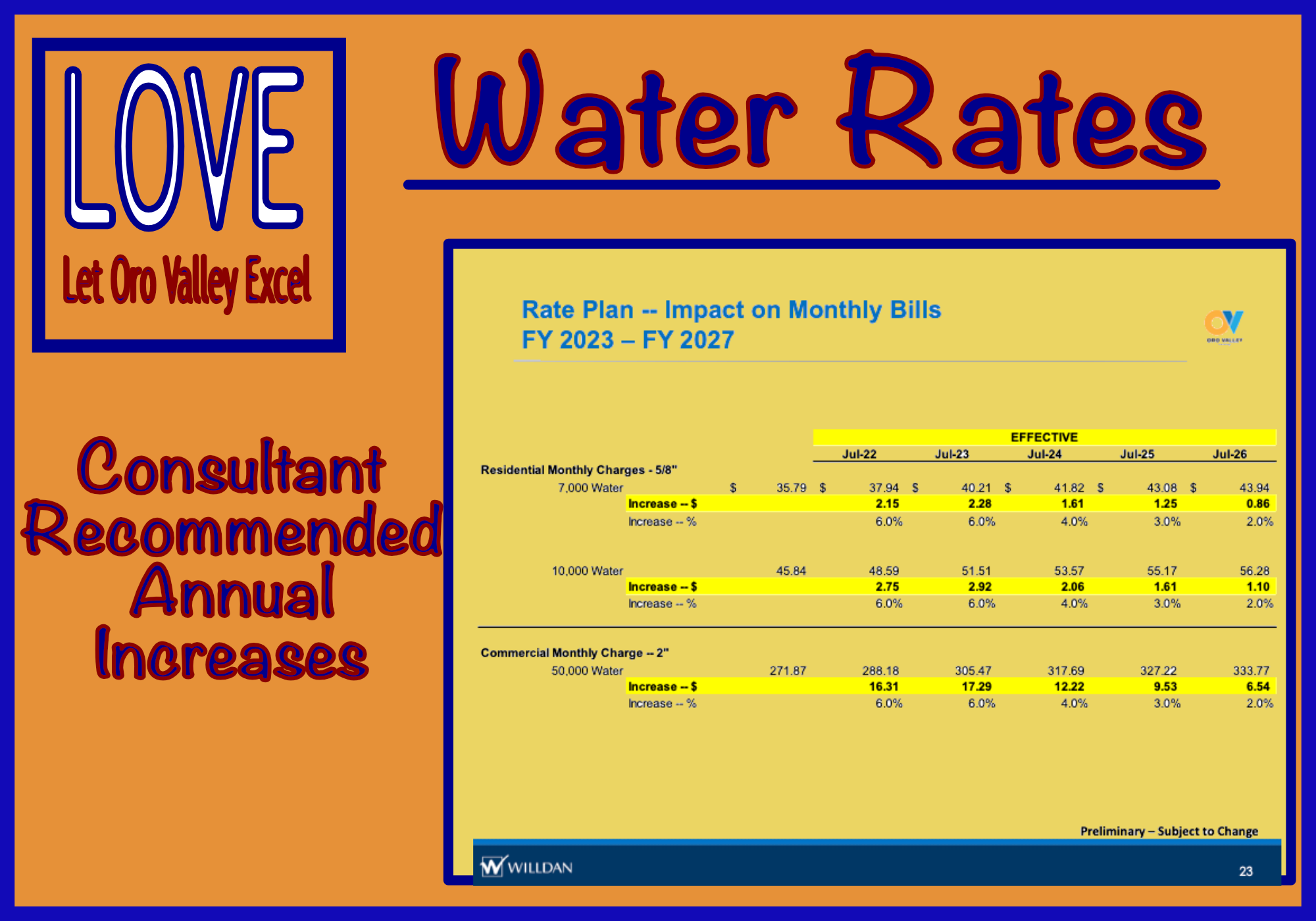
The study, “Water Rate Study and Long-Term Financial Plan”. recommends that the town implement water rate increases each July from 2022 through 2026. The rate of increase this year and next would be 6% (See panel right). This would be a 

... to cover increase cost and investment
According to the study, the increases are needed to cover expected personnel and operating expense increase, increases in the cost of CAP water and funding of $18.9 million in capital improvements during these years. Two thirds of the capital improvement spending is for the NWRRDS project that will bring and added $4,000 acre feet of CAP water to Oro Valley.

Most of the improvements will be funded either by the add on tax, the Groundwater Preservation Fee, and through $8million bond issuance in 2023.

Would result in a 6% increase next July
A residential user of 7,000 gallons per month would see an increase of $2.15 on their water bill in 2022. That is a 6% increase over their current billed used at this level.

Four reasons the increase benefits the community
The consultant provides four reasons why the 6% rate increase will be beneficial to Oro Valley:
  • Will enable utility to continue operating on a stand-alone basis and independent of general fund assistance
  • Will result in financially-healthy utility that has ability to fund operations and capital needs
  • Ensures that ratepayers pay only what it costs to provide water service
  • Will allow $18.8 million of capital investment to improve quality of service and provide a well-functioning system for future generations

Wednesday, June 1, 2022

2023 Town Manager Recommended Budget Reduced to $148 million... Hearing Tonight

Town Public  Hearings Tonight
Tonight, Town Manager Mary Jacobs will ask the Oro Valley Town Council to approve a spending limitation of $147.7 million for fiscal 2023. This request is part of the first public hearing that the town is holding on the 2023 Town Manager Recommended Budget (“TMRB”). 

Requested amount is less than previously reported
The amount being requested is about $11.5 million less than was submitted in the TMRB on which we have reported.

Reduction in the request is the net result of changes in the funding requested of three items
  • The General Fund request was reduced by about $600,000. That reduction is the net result of two items: An estimated increase of $2.7 million in state shared income tax revenue; and an increase in recommended personnel spending. The town manager is adding funds to provide for additional capacity for implementing the classification and compensation study currently being performed by an outside firm. 
  • One of the largest recommended capital expenditures this year was in the water resources fund. This request was reduced by $10.3 million due to adjustments in the spending on partnered portions of the Northwest recovery project (NWRRDS). That is a project the town is doing in cooperation with the Town of Marana and with Metro Water to bring water more directly from a CAP Reservoir in Avra Valley to Oro Valley.
  • The Town Manager  reduced her requested capital fund monies by $3 million. This reflects two items. One is a shift in the source of the funding; the other is changes in the estimated cost of some road projects.  
Spending requested for town operations remains the same
The operating portion of the TMRB (with the exception of the personnel cost spending increase noted previously) remain the same. So let’s take a look at those personnel costs. 

TMRB request is for staff to grow to 414
This year’s TMRB includes 414 personnel. That is an increase of nine full-time and four part-time positions. TMRB personnel spending is $89.3 million. 
 
Two departments are 52% of total personnel cost and 43% of all personnel (panel right)
Police
The Police Department is asking for funding of 139 positions. This adds two police officers and a civilians public information officer. An additional telecommunications position is also sought. The addition of the public information officer frees a sergeant position for field work. According to Oro Valley Police Chief Kara Riley, these staff position additions fulfill all staffing needs for 2023.
 
Water
The water utility has one-third of the town's personnel spending.  The utility currently has forty full-time and 1 part-time position. The department has no TMRB request for added staff.   

Public Works and Parks and Recreation
Public Works and Parks and Recreation are seeking to add four positions each. Public Works is responsible for building all the planned parks facilities. That will be a huge focus of their activity this year. The Parks Department itself wants to add staff at the aquatic center. The TMRB also seeks to add one Park monitor to help cover hours in special events of town parks.
 
Big raises due?
The town is undertaking a competitive wage study. As previously reported and as noted above, the result of the wage study will have a major impact on personnel cost. “The recommended budget includes $1.3 million in the general fund set aside for implementing the final pay plan which is yet to be brought to council. [The TMRB] also includes funds to continue normal step increases for all eligible town employees.”
 
According to Town Manager Jacobs, Oro Valley has fared better than other organizations when it comes to employee turnover and resignations.

Also tonight...Water rate hike!
Tonight's town council agenda includes a public hearing on the proposed 2022-23 water rate price increase. The council will likely approve the rate hike once the public hearing is closed.