Showing posts sorted by relevance for query rooftops strategy. Sort by date Show all posts

Monday, July 18, 2022

Mayoral Candidate Danny Sharp: “We Need More Rooftops”

Mayoral Candidates Danny Sharp and current Mayor Joe Winfield have different approaches to “Development”
This was noted at the Greater Oro Valley Chamber of Commerce Candidate Forum of June 28. 

Sharp advocates for the “rooftop strategy”. Winfield does not
Danny Sharp stated at the Forum that Oro Valley needs to bring in on-site retail business in order to grow sales tax revenues.  According to Sharp: “We have to bring in more retail. We don’t have the retail because we need to bring in more rooftops.”

Winfield believes that the General Plan should guide whether variances and general plan amendments should be approved. The Winfield Council abided by the General plan during the past four years. Winfield promised to do so when he ran in 2018 and he did so. Only one general plan amendment was submitted and it was rejected because it did not fit the concept for that area.
The “rooftops strategy” is a revisit to the Hiremath Years
The “rooftops strategy” is a revisit to the Mayor Satish Hiremath years (2010-2018) of leadership. It was his strategy. Hiremath was eager to grow rooftops because he felt it would attract retail business and increase the town’s sales tax revenue. His council, which included current council candidate Bill Rodman and current Council Member Steve Solomon, approved a slew of general plan amendments, converting land into high density residential zoning. His council was so eager to increase rooftops that they approved several general plan amendments before the citizen vote that approved the 2016 “Your Voice, Our Future” general plan was ratified by the Secretary of State.

The “rooftops strategy” added to congestion but did not foster retail business success
As LOVE reported, the Hiremath Council left Oro Valley with a large pipeline of residences to build. As a result, the town’s population has and will continue to grow substantially.  Still, onsite retail struggles in this town before, during and now after the Pandemic. One merely needs to look at the vacancies at the Oro Valley Marketplace and the need for complete revisioning as an example of the failure of this strategy. Indeed, one could reasonably question the feasibility of the “rooftop strategy” in today’s retail world, a world where on-line retailing, a lack of personnel, and huge supply chain issues are plaguing brick and mortar retailers. 

We believe it was the rejection of the “rooftops strategy” that propelled Winfield, Barrett, Jones-Ivey and Nicholson to win the 2018 election, defeating Hiremath and his team. Voters were tired of the congestion that the rooftop strategy has caused.

Sharp will be more aggressive in pursuing growth.
For example, Sharp would have approved the Oro Valley Marketplace revisioning as presented 
Sharp blames Winfield for not approving the Oro Valley Marketplace revisioning as presented to council.

Sharp stated at the Forum: “When people propose projects we need to be sensitive to the fact that this costs them money. We need to be sensitive…We should have told Town West years ago that what they were proposing would not be approved and that they needed to come up with something that fits within the town’s framework.”

What was presented to council was vetted by town staff in detail, vetted at neighborhood meetings, vetted by the Planning and Zoning Commission, and vetted at a public hearing before council. This is the town’s process. There was no opportunity for the Council to tell Town West anything because the council can only discuss the project together in public at a hearing after this process has been completed. 

After all this, however, what was presented to council-15 exceptions to code, 75 foot tall buildings, and minimal road setbacks- was “not in character” with the town. Still, the council wanted to shape this project because the Oro Valley Marketplace is a commercial disaster; so they continued the application as opposed to rejecting it.

We believe that it is reasonable to conclude that Sharp would have approved the project as presented because the developer had invested so much into it and because the project had gone through a long process.

Sharp does agree with Winfield in one area. According to Sharp, speaking at the forum: “If [a developer] brings in something that is not in character with the town, we need to find a compromise to get to ‘Yes.’”That is exactly what Winfield did. In June, Town West, the owner of the Marketplace, presented a new plan that is more in line with existing codes and the character of the town . It is a revised plan that both Sharp and Winfield said they would support.

 "The properties currently under consideration for annexation
by the Town of Oro Valley are the two State Land‐ owned sites
indicated on the map below, referred to as Tangerine North
(302 acres), and Tangerine South (550 acres)."
Sharp will vigorously pursue the annexation of the Tangerine State Lands
Both Sharp and Winfield agree that town should annex the Tangerine Road State Lands. This is 852 acres, split into two portions (panel left). Sharp asserts that it should have happened long ago because he worked on it with State Lands when he was interim town manager (June 2016 to September 2017). 

However, as stated by Winfield and as reported in LOVE, the State discontinued conversation with the town in July of 2019 because State Lands was short of staff. They were to continue discussions in November of that year but failed to do so. Sharp would seek to restart these discussions immediately. The town’s annexation plan calls for seeking this annexation in the near term.

…Though not all residents want this annexation
It is not at all clear that residents want the town to annex these lands and open them for development. Annexation and development of these lands met significant opposition from residents when presented at neighborhood meetings.
- - -

Tuesday, August 9, 2022

Oro Valley Council Election: Voters Rejected “Big Money Politics”

David clobbered Goliath
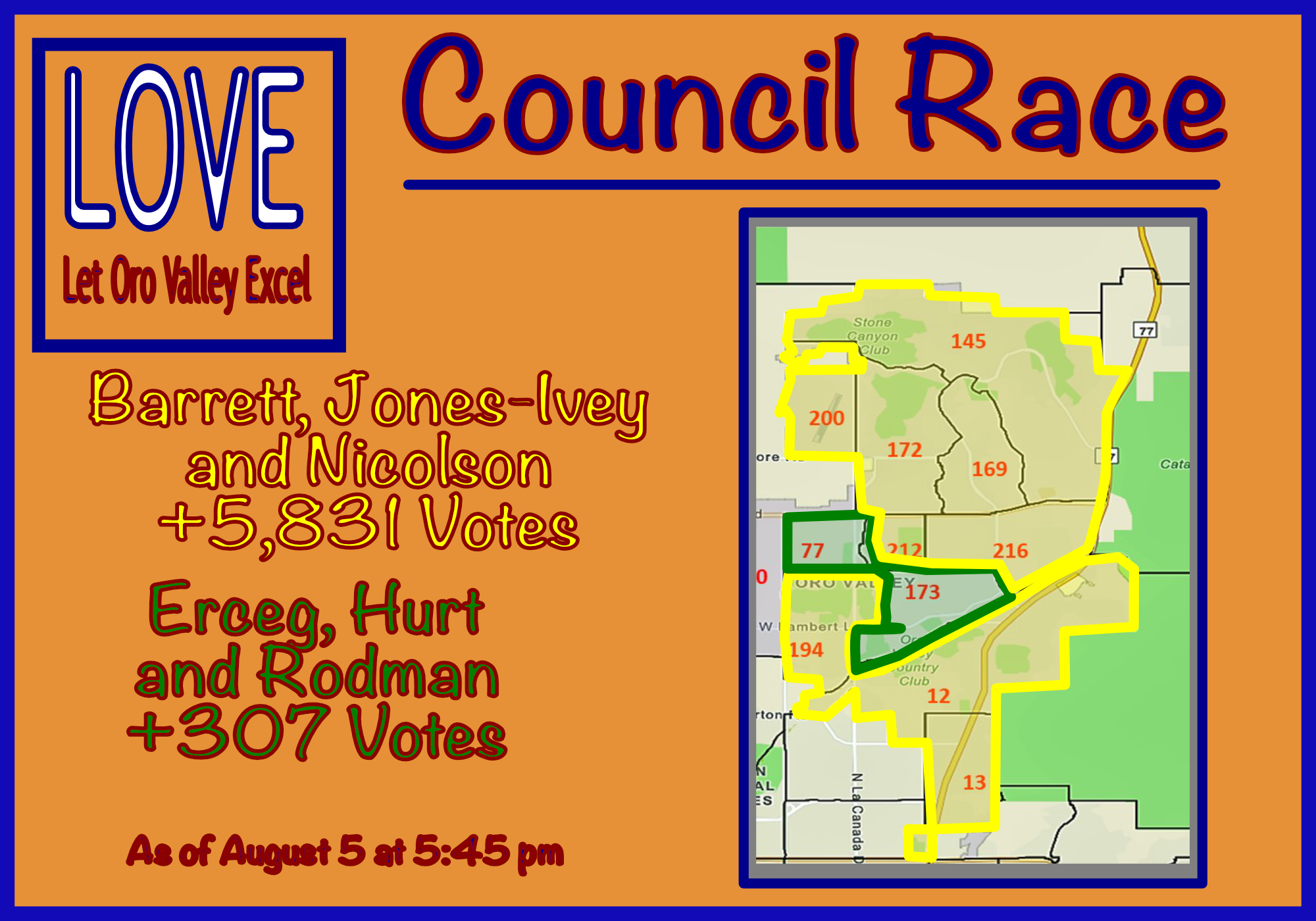
Oro Valley voters rejected the politics of “big money from special interests” in the 2022 council election. Just like they did in 2018. Incumbent Barrett, Jones-Ivey, and Nicolson earned 56% of the 45,750 council candidate votes cast in this election. This is comparable to the 58% they earned in 2018. They earned a majority of the votes in nine of the eleven Oro Valley voting precincts [See panel below right]. They got two of every three votes from Rancho Vistoso residents. The only place they earned less than a majority were in the two precincts that comprise the 36-holes of municipal golf. Even there, they earned almost 48% of the vote. 

Challengers got the same vote count result in 2018 when residents voted out “Special Interests”
The campaigns of challengers Joe Erceg, Charlie Hurt and Bill Rodman were financed by developer and real estate special interests, most of whom do not live in Oro Valley. You can read more on their financing in our report of July 25. They earned the same voting results as Joe Hornat, Mary Snider and Lou Waters got in 2018. These three had their campaigns financed by the same sources.

Sharp had no “coattails”
Erceg, Hurt and Rodman were running as an informal slate with mayoral candidate Danny Sharp. Unlike Sharp, whose mayor race with Joe Winfield, was tight, their race for council wasn’t close.

Sharp did well at the polls because he is Danny Sharp: A former Chief of Police who earned the respect of the community after 20 years of building the State’s top police force. That’s a reason for people to vote for Danny. It is not a reason to vote for his running mates.

Coattails are created by what the lead candidate says. It is what Danny Sharp said that caused problems for his candidacy and for that of the three challenging council members.

Sharp advocated for a “Rooftops Strategy” that was rejected by the voters in 2018
Sharp doomed his candidacy when, at the Greater Oro Valley Chamber of Commerce Candidate Forum, he announced that he was for Hiremath’s “Rooftops Strategy.” This is a strategy to build business in the community by increasing housing substantially. Hiremath tried it for eight years. It did not bring business. It brought congestion and the need to substantially increase town services. Hiremath lost the 2018 election because of this.

Whether they subscribed to this strategy or not, the candidacies of Erceg and Hurt were damaged by it. They were painted as “rooftop guys”, willing to do anything to make home growth happen. Add to this the fact that they were running with Bill Rodman, a former council member during the Hiremath days. Rodman approved all but one of the many General Plan and zoning plan amendments that he saw. Voters know this. Rodman was never going to win. Erceg and Hurt had no way to separate from him or the rooftops strategy even if they wanted to do so.

Labeling the work of the town’s police chief as severely lacking was never going to be a winning strategy in this election
Sharp did not attack Chief Riley directly. Rather, he attacked what he perceived to be the result of her three years of effort. It cost him votes. It cost the council challengers votes. He said that the Oro Valley Police Department is no longer good enough: That Chief Riley and her team, people Sharp groomed to take over, have let the department fall apart. Sharp’s claim was not believable. He had no evidence to back it up. He only had his opinion based on his observations.

Erceg did not follow suit on this in any material way; but Hurt did. From Hurt’s website: “Oro Valley is presently 14 full-time officers below the level it should be in order to maintain and ensure it continues to be the safest place to live in Arizona.” Hurt provided no basis for this statement nor does he have the skill in the area of public safety regarding what should be the staffing level. Rodman also echoed the same thoughts in his first glossy postcard to the community.

They never proved that Oro Valley is in financial trouble
Sharp and the three challenging council candidates alleged that the town is in financial trouble because it has debt and an alleged deficit. You can say it. But you have to prove it. Proving it in this instance was going to be difficult because it’s the first time residents would’ve ever heard that the town is in financial trouble. One would think that the press would’ve covered this, including LOVE. We haven’t seen it. In fact, the town has been flush with cash from the federal government. It has been pressed to spend it all.

They alleged a lack if “transparency” but they couldn’t prove it
Transparency in government is far too vague an issue. Most people don’t even know what it means. Most people don’t know how to measure it. Sharp and the challengers tried to make their case that the Winfield Council has not been transparent. Yet, they couldn’t provide any data to demonstrate that’s the case. They had one case of an alleged open meeting law violation that wasn’t an open meeting law violation.

The fact that the town has had to conduct executive sessions over the years is merely because of the nature of what is being discussed in those sessions, not because anything is being hidden. Indeed, the biggest “hiding of all” was former Mayor Hiremath’s purchase of the El Conquistador courses and the clubhouse. Nothing that any councilmember has done since that date has ever been so duplicitous.

They gave no vision of a better future under their leadership
None of the candidates presented a clear concise vision of the future under their leadership. Rather, they chose to focus on the inadequacies of the current administration and how they would not do “those bad things.” That is not really a winning strategy. Danny Sharp, the three town council challengers, and the PAC created to support them proved that in this election.
- - - 

Wednesday, October 30, 2024

Inside Oro Valley’s Economic Playbook: What’s Working, What’s Not, and What’s Next (Part 2)

The current economic development strategy is a departure from the past… it's a targeted approach
The current Oro Valley Comprehensive Economic Development Strategy (CEDS) represents a targeted approach, marking a clear departure from past economic strategies. It is a strategy of which LOVE and his readers have been critical. It is a strategy that was developed under the leadership of prior town manager, Mary Jacobs.

Though we have a new town manager, Jacobs' community and economic development strategy is still the prevailing strategy of the town is the prevailing strategy of the town. In fact, its implementation is a major objective of the town council's most recent strategic plan. This is the last year of its planning horizon, and a new or updated economic development plan will be required as the town also develops a 10-year general plan. 

The current CEDS seeks to achieve the following:

Attract Bioscience and Technology employers through partnerships and incentives
The CEDS takes a unique approach by targeting specific business sectors for employment growth, focusing on emerging industries such as electronic vehicle battery storage, think films technology,  optics, and destination marketing.  This aligns with previous efforts to collaborate with the University of Arizona on talent development while offering incentives to attract primary employers.  There has been success in this area with companies such as Sigma Tech, Polycharge, Nikon Research Corporation and Simpleview locating in Oro Valley.

Align residential development with workforce requirements
Aligning residential development with workforce needs is a new concept. When this was discussed with the Council, there was much debate about whether a bioscience and technology-focused workforce would prefer homeownership or apartment living. During those discussions, the council was repeatedly informed that younger workers, seen as the primary target group, often favor apartments over homes. A larger question however, was one that was never discussed.  

There is some question as to whether the employees of these companies want to live in Oro Valley. It's not that Oro Valley is not a great place to live. But let's face it. There really isn't any nightlife here and young people, especially those who are single, may well prefer to live in Tucson.

This CEDS strategy element may reflect an effort to justify increased apartment development.

Leverage natural and cultural resources to stimulate tourism
To boost retail and tourism, CEDS seeks to leverage Oro Valley’s natural and cultural resources, linking tourism with retail and the arts in a cohesive strategy. This broader approach contrasts with past efforts, which primarily emphasized sports and outdoor activities to attract visitors. The current strategy includes a broader range of community activities and seeks to create economic benefits for both residents and tourists. There are no metrics that we found can be used to determine if the strategy element is working.

Annex selectively to attract high-tech businesses
The CEDS employs a selective annexation approach, focusing on parcels that support economic development goals in technology and innovation. This approach includes infrastructure initiatives, such as dark fiber and utility expansions, to attract high-tech businesses. This strategy is a shift from past annexation strategies, which were more general, incorporating both residential and commercial areas to increase revenue. However,  the only annexation that has taken place in the past five years is the annexation of the Westward Look resort. This is an extension of a past strategy to annex areas that bring commercial business revenues to the town.

Streamline development approvals and update zoning codes for predictable business processes
The CEDS includes measures to streamline development approvals while retaining resident input. The strategy aims for zoning adjustments, form-based codes, and procedural modifications to improve efficiency across departments, with some updates already presented to the council. Unlike the previous Economic Expansion Zone (EEZ) approach, which was limited to Innovation Park, this CEDS element applies updates town-wide, aiming to maintain community standards while enhancing predictability for businesses. .

Is there an OV Factor when it comes to construction question?
Perhaps some streamlining is necessary. Although we hate to use anecdotal information, about a month ago a comment appeared on the social media platform Reddit. It was entitled: “Are Construction companies refusing to work in Oro Valley?” Two contractors—a home builder and a remodeling company—independently stated they avoid working in Oro Valley due to the building department’s inspectors, who allegedly demand costly requirements beyond the building codes. They claim these demands add thousands of dollars to project costs, which they hesitate to pass on to clients, resulting in lost sales. Contractors say they would need to overcharge to account for what they call the “OV factor,” making Oro Valley projects financially unviable.

Has CEDS Worked? 
The CEDS marked a significant departure from Oro Valley’s previous economic development plans. Past strategies focused on rooftops, shovel-ready lots, broad annexations for growth, and public safety as an economic driver. In their place, CEDS introduced a targeted, industry-focused approach and we have seen some success and attracting target sector businesses.

The questions now are: What tangible results of the CEDS strategy has Oro Valley experienced in the past five years in other areas? Second, should Oro Valley continue with this strategy or is it time to develop a new approach?  

What's next?
These are questions that will be answered as the Town begins to plot its financial future, a future without substantial bond funding, without outlandish federal giveaways, and [hopefully] without the luxury of seeing increases in sales taxes because of inflation. 
- - -

Tuesday, March 5, 2019

Johnston Brings A Focused Approach to Oro Valley Economic Development

Johnston brings fresh approach to Oro Valley economic development
With council approval, Oro Valley will head in several new community and economic development directions. Oro Valley's economic development plan for the past eight years was what LOVE termed "The Rooftops Strategy." Build as many rooftops as possible to so that business will come to Oro Valley. Business will generate sales tax revenue.

Residents saw the result of this policy. The rooftops were built. Lots of rooftops. Even today, there are many more rooftops coming, rooftops that were approved by former Mayor Hiremath and his council majority, which includes current council members Pena, Rodman, and Solomon.

Perhaps sensing that Oro Valley needs to move in new directions, Town Manager Mary Jacobs hired now town Development Director J.J. Johnston last May. Johnston, a long-time economic development professional brought public sector economic experience in the West. He interviewed more than 90 people and spent more than 450 hours identifying and laying our possible future directions in a draft comprehensive economic development strategy. We spoke with Johnston last week about his strategy.

Oro Valley needs "smart" economic development
Johnston believes that “It is incredibly important to get this right. To get as close to as we can to having a smart plan that is very focused on protecting the environment, protecting all of the community assets and adding value to those.”

The challenge as Johnston sees it is that “We have some great employers here already. We just don’t have enough diversity. If we did we wouldn’t have 13,000 adult workers who live in Oro Valley driving out of our community every day to work somewhere else.”

Last week, we listed 11 economic development focus areas that his plan identifies. All are worthy of discussion, but three strike us as particularly creative. Here's the first.

Battle empty storefronts with a "smart retail plan"
Johnston believes that Oro Valley needs to attract retailers who target the demographics of the community. He terms this a "smart retail plan."

"Every retailer has said we need three things to exist: Density, traffic and household income. We’ve got one of the three in spades. We have a very high disposable income. We just don’t have enough people spending the dollars in our stores and there’s Amazon and other things."

Johnston would like to retain consultant to define the smart plan.

The consultant will identify the types of retailers that fit Oro Valley's demographics. Then, the town can use this information to create materials for discussion with lessors and others to encourage them to seek out these types of retailers.

It is Johnston's way of battling the increasing problem of empty storefronts in Oro Valley.

The consultant will also examine other factors that may be causing empty storefronts. "Are our lease rates too high? Is that one of the factors..." causing empty storefronts? "We want an expert to come who has deep experience and understands the thought process..." that lessors and lessees use in making their decisions.

Johnston's approach is proactive and not reactive
Once the consultant completes the work, Johnston will meet with key players in Oro Valley's retail space. This would include Oro Valley Marketplace owner Vestar. "We're preparing for a meeting with Vestar after we have a consultant come in and give us a hard look on where our challenges and where our opportunities are. We very much want to. Mary, in particular, needs to be in front of their executive team."

They have already had conversations with other important players in Oro Valley's retail space, including Neil Simon of Venture West. According to Town Manager Jacobs "We work with him all the time." Simon's company operates the center on the southeast corner Oracle and Magee. They have been successful in attracting tenants. Simon "...is one of the 90 people I interviewed early on... We consider him a great partner."

Next Up: The Oro Valley Innovation Lab
Venture West owns innovation park, a key subject in our second very economic development focus area. Innovation Park is going to house: The Oro Valley Innovation Lab. We'll discuss it in a future posting.
---

Wednesday, January 6, 2021

Publisher's View: Say "No" To The Kai-Capri General Plan Amendment

The same old story...
We’ve seen a “ton” of general plan amendment requests during our 27 years of living in Oro Valley. Almost every request has passed. Almost every request was justified based on two factors: An increase in economic activity and the need for a change based on the petitioner’s perception of market demand.

Once again
Tonight, the Oro Valley Town Council will consider and then vote on the proposed Kai-Capri General Plan Amendment, an amendment that will convert commercial property to residential property. The request is being justified using the same old basis: The change will bring more people to Oro Valley and, thus, will add to economic activity; and the market really does want apartments, or casitas, or small homes or whatever the developer wants to put on the property… but not that for which it is planned and zoned… commercial use.

 
Failed "rooftops strategy"
Yes. More people do mean more economic activity. Yes. They will generate more sales and utility tax revenue for the town. But at what cost? More rooftops do not add to quality job growth. More rooftops do not bring the kind of high quality businesses the town wants. More rooftops do not add to our "small town feel."

That was why former Mayor Hiremath's “rooftops strategy” failed. Instead of attracting quality employers, more rooftops lead to more traffic on Oracle Road as people commuted to work. Retailers like Dick’s Sporting Goods and Big 5 closed up shop. Empty storefronts remained empty. Many still are empty. Just look at the Oro Valley Marketplace. All this happened while town population grew 10%. No. A bigger population is not going to save stores like World Market that are going to die anyway.

Market demand is always shifting back and forth
The second argument, a shift in market demand, is equally specious. The real estate market is always shifting. Residential is hot today because people are nesting in place due to the pandemic. Commercial is not hot because “people are nesting in place due to the pandemic.” A year from now it could all turnaround. And it likely will.

Two controls residents have over what happens in Oro Valley. 
One is the General Plan.
The General Plan is the vision of what residents want the town to be. The town spent hundreds of thousands of dollars to create it. Residents spent a million combined hours working on it. It took two years. It was overwhelmingly approved by the vote of the people in 2016. That plan includes a land use map that specifies how each area of the town will be used. The Kai-Capri property is designated for “commercial use.” It is ideal for commercial use. Unless there is some egregious error in this land designation, and there is not , there is no pressing need, no council imperative to turn over the will of the people.

The other is who residents elect to council
There is only one other way residents can control the future of the town. That way is by electing people to council who will uphold the general plan, protecting the wishes of the people as expressed in that plan. The residents elected those people in 2018, tossing out a Hiremath led majority that never rejected a general plan amendment. That council’s behavior was outrageous. That council approved two general plan amendments to the current general plan before the State ratified the election approval vote. To them, the general plan was merely a guide to be ignored as they wished. And they did ignore the plan countless times.

The will of the people as expressed in the general plan should over ride the will of a developer and town staff
It does not matter that town staff thinks that the plan should be approved because they think that it satisfies the five criteria for general plan amendment approval. That is their judgment. There are no hard and fast rules when it comes to the five criteria. A handful of unelected town staff members and a landowner should not be allowed to overrule the will of the people. The new majority, led by Mayor Winfield, and newly elected council person Tim Bohen, promised to uphold the general plan. We expect them to do that tonight by rejecting the Kai-Capri request. It is the right thing for them to do. 

Our message to council: Just say “No”.
---

Monday, October 22, 2018

Expansion: A Daunting Oro Valley Challenge

In 2016, the residents of Oro Valley approved a general plan. There is a map that is part of the general plan (adapted below). This map shows the current boundaries of Oro Valley. It is within these boundaries that all of us are neighbors. And it is within these boundaries that the town must provide essential services, such as water and police protection. It is within these boundaries from which Oro Valley collects sales taxes, the primary source of town operating revenues.

The map also shows an area that extends beyond the boundaries of the town. This area is unincorporated Pima County land. It is land which Oro Valley can attempt to annex to our community. The "State Lands Annexation and Rezoning" is one example of land that is not part of Oro Valley but is within it's planning boundary. The resort, Westward Look is another example. All the businesses on Oracle Rd, from Orange Grove north are also examples of properties included in the planning area.

The planning area is huge
Oro Valley Town Limit and Planning Area
Attempting to bring unincorporated Pima County land into Oro Valley presents both a challenge and an opportunity to the new council.

Mayor Hiremath's theory was that business will locate in Oro Valley if Oro Valley has more rooftops. Thus, the community saw many general plan amendments and zoning changes that did, indeed, enable more rooftops. As we will discuss Wednesday, there are many more rooftops to come.

A change in direction provides many options
The people of Oro Valley clearly stated in this past election that they don't like the rooftops strategy. They want Oro Valley to have a "small town feeling."

Why expand at all?
If Oro Valley no longer has a "rooftops strategy", then getting more buildable land through amendments or through annexation is no longer a sole reason for change.

What, therefore will the new council do regarding expansion of Oro Valley's boundaries?

The General Plan does not mandate expansion.

It's up to council.

So, the first question the council must answer: Why expand at all?
--

Monday, April 10, 2023

Councils Have Done Much To Build The Oro Valley Business Base But Results Have Not Happened

Economic Development continues at a slow pace
In March, the town issued seventeen single family residency permits. Also in March, there were few new business projects listed by the town. In total, businesses that are coming to Oro Valley are the same types of businesses that we reported in February.  We concluded then that most businesses that are opening in Oro Valley are focussed on serving the adult community (Read: "Oro Valley is an Adult Community")

Town Councils have tried to do much over the years to bring businesses to Oro Valley
"Rooftops strategy"
The Hiremath led councils embarked on a "grow the rooftops" strategy. The result of that strategy can be seen today with La Posada, a senior living that is is being built north of the CDO Wash, behind Home Depot. Yes. That project will bring more people to our community. But will it bring more businesses to the community or will it simply add to traffic in the area?

Two Economic Development Directors
The Winfield Council now has its second Oro Valley Economic Development Director. Neither the first Director nor the current Director have brought any significant business to our community with one exception, that being Leonardo Electronics. That company, however, has yet to break ground, though the project was announced in December of 2021. (Source: March Town of Oro Valley Economic Development Status Report.)

Easing requirements in economic enterprise zones
The Council, at the urging of former town manager Mary Jacobs and the then current Economic Development Director, eased the permitting codes ("EEZ"). That council approved blading the desert in Innovation Park to create "shovel-ready lots." The hope was that businesses would come to Oro Valley. After all, Oro Valley has an easier permitting process and land that is ready for construction. Well, that hasn't happened either.

A friendlier Planning and Zoning Department
Jacobs, under the Winfield Council, attempted to make it a bit easier for Developers to build in Oro Valley by putting the Planning and Zoning Department under the Director of Economic Development. The goals of Economic Development Department and Planning and Zoning Department are not the same. The Economic Development Department  seeks to build the commercial base of our community. The Planning and Zoning Department is supposed to make sure that whatever is built is built within code specifications. Their job is to protect the community, not to grow it.  Today, the Planning and Zoning Department tries to negotiate between residents and developers, rather than simply doing their code [and Genera Plan] enforcement job.

An example of this relates to the request of the Oro Valley Church of the Nazarene [OVCN] to rezone land next to the church at Concordia and Buena Vista so that they can build a major sports complex. The residents are united against this proposal. They have been steadfast in their position that there is no compromise that will result in their supporting that facility in that area. Yet, many times, the Planning and Zoning Department has talked with the residents, urging some sort of compromise. That is not the Planning and Zoning Department's job. Their job is to process the application in the same manner in which all such applications are processed. 

"Choose Oro Valley" Website
The town created a website that won an award from the Arizona Association of Economic Development. That website is chooseorovalley.com. The focus of that site is to attract bioscience companies, like Roche. It is quite comprehensive. One can see available sites and buildings and tax incentives. It displays Oro Valley's key industries.

The site falsely states that "the population of Oro Valley is balanced across all age segments." We know it is not balanced. Any business with a serious intent is going to look at the 2020 Census Data, like we did, and see that that statement is false. Indeed, even the town’s own Parks and Recreation Master Plan acknowledges that “…the town exhibits an unbalanced distribution among major age segments.”  We are an over 55 community.  Putting false information on the web sit reduces the credibility of all the information on the site.

Shovel ready sites
The first of the two Economic Development Directors convinced the Council that the reason Oro Valley was not being selected by companies was that the town had no “shovel ready sites.” These are sites that are graded without a specific site plan.  So, the town approved blading the desert in Innovation Park to do just that. This happened in September 2020.

Working with the State of Arizona
The town also receives leads from the State. None of these have panned out to date. Many of these leads seem to have more of an industrial need. Something Oro Valley doesn't want. It's important to face reality. Everybody wants clean businesses in technology. What makes Oro Valley unique? We don't know.

From Oro Valley Marketplace to Oro Valley Village Center
Last year the Council approved a bold revisioning of the failed Oro Valley Marketplace. It is call the Oro Valley Village Center. It is being revisioned on the premise that the area needs to build its own population density in order to support businesses in the center. The vision is for hotels and apartments, adding more density to the town. Nothing has happened to the Center since the approval.

The “Business Incubator”
In December of 2020  the University of Arizona opened a “business incubator” in Innovation Park to house startup companies . The hope is that one of the startups will take hold and flourish in Oro Vally, It is too soon to tell if this initiative will pay off.

Council's recent "Economic Vitality" revisit produces nothing new
Last week the Town Council held a study session on its strategic plan. "Economic Vitality" is one area they discussed. As Vice Mayor Barrett noted, the study session was an update of the existing strategy. The session was not a discussion on how to replace it.  The focus of the plan is to do the same things that the town has been doing to meet the following goals:
  • Support local businesses
  • Attract employers in key business sectors
  • Attract commercial businesses to our centers
  • Increase visitors (Via $400,000 annually given to  "Visit Tucson" to generate 28,000 hotel room nights. That's $14.29 per night.
To date, these actions have failed to produce significant tangible results
Town Councils have done much to build the business base in this town. Perhaps it is the impact of the Pandemic. Perhaps it is the impact of the three-year economic meltdown that has happened since the Pandemic. Regardless, the town has yet to see results in their efforts to bring significant new business to the community.
- - -

Wednesday, January 20, 2021

Jones-Ivey Asks Council to Reconsider Kai-Capri General Plan Amendment... After Rejecting It

Jones-Ivey asks town to reconsider   
Council Members Joyce Jones-Ivey and Mo Greene have asked the town council to reconsider its rejection of the Kai-Capri amendment. The reconsideration will be discussed tonight.

Sponsoring reconsideration does not mean that Jones-Ivey supports that this general plan amendment.  Rather, it may mean that she is offering support to a fellow council member who wants the motioned reheard.  A reconsideration requires one council member who voted against the plan to sponsor reconsideration.

The following are the two reasons Jones-Ivey voted against the amendment at the January 6 meeting.

Voted "No"for two reasons
Council Member Joyce Jones-Ivey voted “no” on the Kai-Capri general plan amendment at the January 6 council meeting. She joined Council Members Barrett, Bohan, and Nicolson in rejecting the amendment. You can read their remarks here. Jones-Ivey did not say why she voted "no" at that time. So we asked her. There were two reasons.

First, the existing land use provides a key alternative commercial site and should remain such
Jones-Ivey has been looking at the property for a long time. She considered its present land use when the council made changes to encourage economic development.  “I was looking a commercial properties and cataloguing in my mind what could be possible.” The Kai-Capri property “...was right on the top of my brain, mainly because of where it was located.” She concluded that is was properly zoned for neighborhood commercial given its easy access to Oracle, via First Avenue; and access on the newly widened Tangerine Road.

“If we are going to attract employers we are going to need some different locations for them to be able to look at.” In addition, Jones-Ivey noted, the property as zoned will be less disturbing to the habitat. “Leaving it as is just made sense.”

Second, the argument that the town needs more rooftops to support retail has not worked out over time
Jones-Ivey never thought that the amendment request, which changed over time, would come back to request housing on the property.

This presented a new challenge. 

“My other issue” became the high density of the land use.” The residential options the amendment sought ranged from single family housing to apartments. (Panel above). “That just seemed to be a repeat of the previous council’s position of ‘rooftops...rooftops...rooftops'. It just didn’t seem to address the issue of bringing in additional revenues.”

During her deliberations, Jones-Ivey spoke with Oro Valley Planning Director Bayer Vella. Vella emphasized that apartments bring in additional revenues. She wondered though: What kind? Reflecting on the result of the “rooftops strategy” she concluded that significant new primary employer jobs did not happen from more rooftops. Rather, Oro Valley got more eateries. “More eateries is nothing substantial in my mind. How many eateries can we have?"
---

Tuesday, May 26, 2020

Oland: Town Needs More Rooftops

Kai Amendment justification: Oro Valley needs more rooftops
The narrative that “more rooftops” are needed to justify more retail presence continued as the justification for approving a general plan amendment. This is an amendment of a commercial parcel located near the first avenue and Tangerine Intersection. We call this the Kai Property because it, like the entire Silverhawke area, is owned by the Kai family.

The justification was stated a last week's zoom.us public meeting by Paul Oland of Paradigm Land Design, the land engineering company representing the owner.

Request at odds with town's "economic development strategy"
The owner is presenting this general plan amendment to reduce commercial land at a time when the town's economic development strategy is to increase commercial land and to speed its development.

There are many uses for commercial property other than the neighborhood shopping center that the developer presented in 2015, when the entire Silvehawke land mass was amended. The property could be used for a variety of non retail commercial needs as currently zoned. Some of these could be very specific to the area such as medical offices or a workout facility.

Lots of rooftops proposed
This latest proposal shows a road connecting First Avenue and Tangerine Road.  As for the land use, Oland presented five alternatives, none of which are binding if and when the amendment is approved:
  • 10 apartments, 2-stories each, a gated community
  • 100 plus 1-story casitas with a tiny recreation area
  • Senior care facility and independent senior living housing
  • A  cluster of townhomes
  • 55 single family homes like Silverhawk
Terrain has not changed since 2015 amendment
Tim Bohen: "What's really happened since 2015 to require this amendment?"
There were two audience questions.  Oro Valley Town Council candidate Tim Bohen referred to the slide at right. The slide highlights the area north of the property. Its hilly nature, according to Oland, blocked the line of sight  from Tangerine Rd, making the property unsuitable for retail use.

Bohen had asked what has happened between 2015 and today to cause the need for a change in land use. After all, the terrain was the same in 2015 as it is today.  Oland did not respond directly to that question. Rather, he repeated his assertion that Oro Valley needs more rooftops. 

The second question from an attendee was about Kai Drive being connected to Tangerine Road. Could a traffic-safe connection to Tangerine Road be made? Town Engineer Keesler said that the town will look into this as part of the application process.
--


Monday, November 23, 2020

Town Council Directs Staff To Better Reflect Towns Needs In Parks and Recreation Master Plan

Plan must reflect resident needs
Last Wednesday, The Oro Valley Town Council directed town staff to better reflect resident needs in the Parks and Recreation Conceptual Master plan. That plan is being developed by PROS Consulting.  Council noted that the conceptual plan  does not properly match the priorities of the community. 

The town developed these priorities after five months of community input gathering by PROS Consulting. They gathered information from community meetings, an input survey and a statistically valid online survey. 

High Priority "Trails and Conservation Areas" ignored in plan
Council Members Barrett and Bohen observed that the conceptual plan relied too heavily on comparisons of what Oro Valley has to overall national statistics; and that it did not adequately reflect what residents said they want. In particular, high priority items, such as trails and open space were generally ignored while low priority items such as basketball courts were emphasized.


Even more astounding is that the conceptual plan has no facilities for the town north of Tangerine. Yet, 40% of Oro Valley residents live in there. 

Winfield : The plan must emphasize resident defined top priority items 
Speaking at length, Mayor Winfield expressed disappointment that the community needs were not reflected in the conceptual plan. Referencing the needs assessment: “With that community input we are going to pivot. It’s going to be included. I am confident of that. I agree. The rankings are critical foundational information to the development of the master plan.” Community input "...simply can not be ignored…. We are going to give greater emphasis to those three priority items.” 

Winfield: North of Tangerine needs a community park
Speaking specifically to the residents north of Tangerine, Winfield observed that PROS equity mapping of facilities has clearly shown the need for a community park north of Tangerine… a park of 10 to 75 acres.  "I believe that the master plan should reflect that need.” 

Winfield's approach to Oro Valley Parks Planning is resident, not commerce focussed
Winfield’s comments are one of those times that clearly differentiate the Winfield Council from the Hiremath Council. 

Hiremath’s goal was to use Parks and Recreation facilities for sports tourism and to focus on building facilities for younger families. The emphasis on attracting younger families was part of his failed “rooftops strategy.” 

Winfield, on the other hand, is focussed on the needs of those who live in the community now and who will likely want to live here in the future. A multi use trail will not bring thousands of people into Oro Valley to spend their money; but it will bring happiness to those who live here.
---

Tuesday, December 5, 2023

Town Staff Supports Super High Density Housing Project....Hearing Tonight

Staff wants to bring "Super High Density Housing" to Oro Valley 
The Oro Valley Planning and Zoning staff are recommending approval of two developments that will bring significant changes to the Rancho Vista Boulevard and Tangerine Road intersection. The plan involves repurposing open commercial acreage into high-density rental residential space, specifically for 207 tiny rental homes, thus transforming the area into "schlock city.".  It is the rooftops strategy on steroids (Previous LOVE reports on this project).

A supposed “free fix” to a traffic nightmare
Staff has vetted the request of developer NexMetro in three neighborhood meetings. Residents have repeatedly expressed concerns regarding traffic safety implications in the area. This intersection is a "crash" problem that the town has failed to fix over many years, despite the intersection being the town's second most accident-prone area. It is a fix over which the town has complete control.

Town has neglected to fix this long-standing self-inflicted wound
For years, the town has been aware of crash issues at this intersection but has taken minimal action, hoping that a developer would address the problem. Recognizing the significance of the issue, ADOT independently alerted the town about the necessity for traffic signal modifications, which will be funded by $570,000 in federal funds. In addition, town staff has long had the opportunity to propose improving this stretch as a Capital Improvement Project. It is not required that a developer fix the town's Town’s self inflicted wounds in exchange for an entitlement.  
207 Tiny Homes at
Rancho Vistoso Blvd and Tangering Rd

Now, as a condition for approval, staff sees this as a way to get the "fix" done for free
Staff approval of the project requires that the developer complete a reconfiguration of the intersection. It is staff’s conjecture, without proof, that this proposed fix will enhance safety. The NexMetro "fix" will work, according to staff, even though what will look like tiny homes will add almost 1,500 additional trips daily to the intersection.

Staff says their support is consistent with the General Plan
Staff also justifies their endorsement of the proposal by stating that, in their opinion, it aligns with the general plan. This new super high-density rental housing offers "transitional housing" between commercial property and the medium-density owner-occupied residential properties in the area. According to the 2015 General Plan, the town should have more "transitional housing." In fact, the project's ability to provide this transition is their primary reason for asserting that it complies with the 2015 General Plan.

What’s missing: No control over "true density"
Staff has not proposed restrictions on the number of residents that can occupy each unit or the allowable number of vehicles per unit. Consequently, the development could potentially expand into a "housing project.” Even if there were such restrictions, the town would have no way to enforce them.

Community action tonight?
We expect substantial resident turnout at tonight's meeting. Residents are against this proposal, expressing their objections at all three neighborhood meetings. This hearing is yet another opportunity for them to do so.

This hearing marks another progression in the overall process. The Planning and Zoning Commission, while influential, does not hold the ultimate authority to either approve or reject the proposal. The final decision rests with the Town Council, which will likely review the proposals either later this month or in January.
- - -
Note: The commission approved both of these measures by a 3-1-1 split vote (yes-no-abstain). 

Wednesday, September 21, 2022

Avilla Homes Proposal: The "Rooftops Strategy" on Steroids

There are two rezoning requests that are making their way through the town's vetting process. They are proposals to add 215 "tiny" rental homes near the intersection of Tangerine Road and Rancho Vistoso Blvd. 

Avilla East would add 90 homes in a commercial area just north of the Safeway Shopping Plaza. Avilla West would add 125 homes to the west of Rancho Vistoso Blvd. The panel below shows both of these proposed developments. 

The town held two Neighborhood Meetings on the East Project. Tomorrow the town will host the second Neighborhood Meeting on the West Project.

Both projects are listed on the town's web sites as "rezoning requests" from commercial property (C-1) to high density residential. The projects are not also being proposed as general plan amendments or amendments to the Rancho Vistoso Planned Area. They should be because the 2016 General Plan has these lots designated as commercial. The use of this land for residential purpose requires a general plan amendment.

"Big Dollars" at stake
It is obvious why the project makes sense to the applicant. It will put the properties into a revenue generating position. The very high density residential use of the property will guarantee a sustainable revenue stream for years to come.

Unanimous resident objection to project
It is obvious why residents don't want to see the properties developed.  The land is currently zoned for commercial use. The applicant does not believe that anything commercial will be built on it. According to the applicant, the land will remain "open desert" for years.  

When the applicant's representative Paul Oland of Paradigm Land Design discusses the land use he refers only to retail store use.

The current land use could be used for a host of non retail store purposes within the current commercial land designation. For example, there could be an office building, medical offices, or a school on the property.

The hook: Town Staff thinks that the projects will alleviate an existing traffic problem... One they have wanted to fix forever!
The "hook" is that the Town Engineer Paul Keesler, though not endorsing the project, believes that its creation will be a solution to a current accident prone situation in the area. 

As seen in the panel below left, the project will use a portion of the applicant's land to create a more favorable traffic flow. Speaking at the August 28 second neighborhood meeting on the East Project: "I endorse the design as better [for safety and level of service] than is there now." 

According to Keesler: "We modeled it for working flow and it decreases wait time." There is no solution without the use of private land. Here's why...

Two new roads and a traffic light
The projects would create two new roads. Both involve Woodburne Ave. Traffic heading east on Woodburne would be able to travel west on Tangerine without having to access Rancho Vistoso Blvd. Woodburne travelers would also be able to more easily access the Safeway Shopping Center. 

The plan uses the alleyway north of the center as the major access into the Safeway Plaza.

The two new roads are being built on the developer's land.

Lots of reasons residents don't want this
Residents believe that there are many reasons why these projects are a bad idea:
  • Avilla Homes has a bad reputation
  • Using an alleyway for travel makes no sense
  • There will not be enough parking for residents of the tiny homes
  • Very high density housing makes no sense for Oro Valley 
  • The high density of the homes will add significant auto and foot traffic to the area
  • The property owner knew they purchased commercial property. The fact that it is not currently developable is their problem
Time for you to be involved
This is a major intersection used by many in our community. It's the first impression people will get as they visit a premier area of our community. If you travel though it, this project will impact you. On broader perspective, do you want Oro Valley to set a precedent with very high density housing? Weigh in tomorrow or at future meetings as they develop.

Tuesday, October 29, 2024

Inside Oro Valley’s Economic Playbook: What’s Working, What’s Not, and What’s Next (Part 1)

Economic development is essential to the long term financial viability of Oro Valley 
On Thursday, Mayor Winfield will deliver a “State of the Town” address. We suspect that a key focus of his remarks will be on the town’s economic viability.

Oro Valley cannot simply raise sales taxes to boost revenue. This makes economic development and careful fiscal management essential to the town’s long-term financial health. Over time, Oro Valley must continue to revitalize its economy to sustain the revenue needed for its services.

Oro Valley has tried many things in the past to spur economic development. Some things have worked. And some have not.
Oro Valley has long pursued diverse strategies to drive economic development, in its efforts to sustain financial viability. From accelerating business approvals to expanding housing options, the town has explored multiple pathways to attract businesses and residents alike. Some approaches, like developing sports tourism and maintaining a strong public safety record, have shown tangible benefits.  Others, such as efforts to streamline planning or create shovel-ready business sites, have encountered challenges. Here's what's been tried over the years. Click the links to learn more about each.

1. Streamlining development approvals
The EEZ (Economic Expansion Zone)
This strategy aimed to speed up development in Innovation Park by simplifying the approval process for businesses in Innovation Park; notably removing neighborhood meetings and Planning and Zoning Commission reviews. Although intended to reduce delays, it hasn’t led to noticeable new developments in Innovation Park, suggesting limited effectiveness.
Integrating the Planning and Zoning Department with Economic Development
Former Town manager Mary Jacobs made an organizational change that attempted to allign planning and zoning and economic goals by placing the Planning and Zoning Department under the Economic Development Department. This has created a situation in which planners also become mediators between developers and residents.

2. Preparing infrastructure for building
Shovel-Ready Lots in Innovation Park
By preparing land for quick business setup, the town hoped to attract companies ready to establish themselves. Despite the investment, the initiative hasn’t drawn interest from businesses, partly because available lots don’t meet the scale or accessibility requirements many businesses desire, such as highway access or larger parcels. After all, in reality, more of all is 10 miles from interstate 10 whether you travel west or south.

3. Housing expansion
Increasing rooftops
Based on the idea that more housing would attract businesses to serve a larger population, this approach has expanded Oro Valley’s residential community but hasn’t attracted significant business diversity beyond healthcare and other personal services. This trend highlights that more rooftops alone do not meet business attraction goals.
Adding multifamily dwelling units (apartments)
A similar approach focused on increasing rental options to attract employees for potential high-paying jobs. However, demand is currently lukewarm; For instance, the Linda Vista rentals have had substantial vacancies, suggesting that the need for upscale apartments may be overestimated.

4. Tourism and sports attractions
Use Parks and Recreation facilities to attract visitors to the town
Oro Valley has invested in sports venues to attract visitors, and while there’s limited town data, activities like aquatics events do bring non-residents to the area. Sports facilities have had success in driving local economic activity, particularly in hospitality and dining sectors.
Make Oro Valley a destination or visitors
Recently, Oro Valley took over as its own Destination Marketing Organization, aiming to bring more tourists directly rather than relying on regional efforts. Early efforts, including partnerships for sports events and planning public art tours, are underway, but it’s too soon to assess the overall impact.

5. Expansion through annexation
Annex for growth
Oro Valley has used annexation to incorporate nearby areas, both residential and commercial. Commercial annexations bring tax revenue and support public services, while residential expansions provide initial fees but may add long-term service costs without corresponding revenue.

6. Developing a knowledge economy
Incubate businesses
Through a partnership with the University of Arizona, the Oro Valley Innovation Center serves as a business incubator. The aim is to foster startups that remain and grow within the community, though progress is gradual due to the incubation timeframe and risk of external acquisitions relocating businesses.

7. Public Safety as an economic incentive
Maintain strong public safety
Oro Valley’s reputation for safety is a draw for both residents and businesses, exemplified, years ago, by Rancho Vistoso’s willingness to be annexed for dedicated police coverage. Public safety remains a foundational element of Oro Valley’s appeal.

8. Digital promotion and policy adjustments
Build an award-winning website for businesses to explore the town
The “Choose Oro Valley” website serves as a digital face for the town’s economic efforts, recognized for excellence in design and functionality, aimed at attracting potential investors and residents. We have no idea if this generation significant leads. But it appears to be a good start.
Amend the General Plan to switch from residential to a commercial and back
Historically, General Plan amendments allowed for changes in land use. These are changes that allow the land to be used in a manner that was not approved by the voters. These changes are made in response to whatever the current market supposedly supports. The approach has shifted under different administrations, with fewer amendments in recent years, reflecting an adherence to the voter approved 2016 general plan.

Here's what's really worked
Over the past decade, Oro Valley has experienced notable population growth. Combined with significant inflation and the taxation of internet purchases, this population growth has increased town sales tax and state shared revenues. Yes. We think that many people moved here did so because of the Town's terrific public service presence.  We have not seen, however any significant new businesses that offer . What we have seen is something that should've been anticipated: An increase in medical and personal service businesses.

Tomorrow we take a look at Oro Valley's current community and economic development plan, a plan that was put in place five years ago. It is a bit different from what the Town did historically.
- - -

Friday, October 2, 2015

Mayor Hiremath: "The Town You See Today Has Been Intentionally Crafted Toward A Common Vision"

Mayor Satish Hiremath delivered his sixth annual "State Of The Town" address at the El Conquistador Country Resort and County club yesterday.

The address is a fundraising event for the chamber. Speaking to an audience of about 650 people, about a quarter of which were either visiting dignitaries or Oro Valley town employees, the mayor touted what he considers to be his key accomplishment during his term: Changing Oro Valley from a retirement community to a community for everyone.

Hiremath reveals the Oro Valley formula for success
According to Hiremath, Oro Valley faced a financial dilemma when he took office in 2010.  He adopted a bold strategy: Grow the town.

"State of the Town" Luncheon
In 2011, he sought passage of the environmentally sensitive land ordinance, an ordinance that encourages cluster homes and the set aside of contiguous undisturbed desert. This, he says, increased rooftops which drew retailers to the community. Increasing the number of retailers then resulted in increased sales tax revenues. The town also encourages sports tourism in Oro Valley. This adds more sales revenues. Growing sales tax revenues is important, according to Hiremath, because half of Oro Valley's general fund revenues are from the sales tax. Without sales tax growth, Mayor Hiremath believes the town would need a property tax.

Fact: In five years, sales tax revenues grew from $13.1 to $15.7 million, an increase of $2.6 million or 20%. This is a compound annual growth rate of 3.7%.

Hiremath wants to "accelerate" growth through a Pima County property tax increase
Mayor Hiremath points to an "understanding" between the town and Arizona State University as evidence that his growth strategies work. ASU will take space in a business accelerator. They will do so if and when one is built.

A business accelerator is a place for start-up companies. Its location in Oro Valley will bring jobs to Oro Valley, according to the mayor.

The mayor did not mention that getting this business accelerator requires voter approval of a property tax. The business accelerator building is included in the 2015 Pima County bond package.  Pima County voters will have to vote for this increased property tax in November's bond election in order to get the funds to build the facility.

Mayor Hiremath also points to a commitment by the University of Arizona to house a doctoral in veterinary medicine program in Oro Valley. This program is not yet operational. It requires that the State of Arizona fund it.

Hiremath stated that it was necessary to approve the building of almost 1,000 apartments during his terms in order to accommodate the living needs of mobile professionals. He asserts, as we have previously reported, that younger people no longer want to own homes.

"Who would ever have thought that one day both Arizona State University and the University of Arizona would have a strong presence in our community?"

Oro Valley is a community by design
"Deliberate decisions were made to insure that we would have the infrastructure and momentum for a collaborative community of innovators. These things don't happen by accident. They are by design...Everything that we have done since 2010 has been done with intention."

The purchase of the El Conquistador Country Club is a "game changing milestone in Oro Valley history"
"Our boldest move yet was purchasing the El Conquistador country club this year and converting it into the Oro Valley community and recreation center. This acquisition includes... a 50,000 square foot building". (ed. note: This calculation is the total of the basement space [golf cart storage], the first floor space, and the second floor space [restaurant and meeting room])

Hiremath refers to the El Conquistador Country Club purchase as a designed action even though, according to him last year, it came about suddenly and had to be approved immediately.

We wonder: Is plunging Oro Valley into competition with local restaurants and private golf clubs by design? If so, then this may have been a "bad design".

The Hiremath goal: Transform Oro Valley
Hiremath's community by design is the implementation of a vision of the town; a vision that he asserts is "shared" by the people. It is a transformation of Oro Valley from a retirement community to a community for everyone.

Hiremath: "Some believe that their individual rights supercede the rights of the greater good"
Mayor Hiremath vision of how things should work is defined as "collectivism." "Collectivism" is a "system" in which individual rights are subordinated to the "rights" of some group.

Hiremath asserted that those who disagrees with the vision or its implementation simply do not understand the "big picture." If they did, one could surmise, he thinks they would most certainly agree.

Those who disagree should, he asserts, go along with his decisions in order to serve the "common good;" even if they think it would be wrong for them as individuals.

Hiremath: "Great communities are created when 41,000 people act as one."

Hiremath: "Your entire council should be pulling in the same direction."
"It has been said that disagreement on council is good. I don't accept that. Discussion is good but constant disagreement is not. It is not consensus. It is not compromise. And it is not cooperation.... Once a decision is made, your entire council should be pulling in the same direction."

We wonder if the Mayor would say the same thing if he were always on the short-end of a 4-3 vote. Because, when you are the council majority, there is never the need for you to seek cooperation and accommodation with the minority. In other words, you never have to go along with something you think is wrong.

You can watch Mayor Hiremath's speech on line.