Arizona Heroes Memorial Celebrates Kuwait Liberation Day Tomorrow at 1pmFriday, February 27, 2026
Bits and Pieces
Arizona Heroes Memorial Celebrates Kuwait Liberation Day Tomorrow at 1pmThursday, February 12, 2026
RTA Next: A 20-Year Transportation Decision Now Before Voters
Ballot includes two related propositionsIf you are a registered voter, you will receive a ballot by mail that includes two related propositions. Both measures concern something called RTA Next. One would authorize continuing the Regional Transportation Authority (RTA) program that has funded road and transportation projects across Pima County for the past 20 years. The second would continue the one-half-cent sales tax that funds those projects. Both propositions must pass for RTA Next to take effect. If approved, the new plan would begin on July 1. If either fails, the current RTA program will expire, and any future proposal would likely return to voters at a later date in revised form.
RTANext will build road and transportation projects throughout the county
The Regional Transportation Authority funds a range of transportation projects intended to address needs that extend beyond individual jurisdictions. Under the proposed RTA Next plan, funding would support roadway and multimodal corridor improvements, arterial and collector road rehabilitation, intersection and school safety projects, bicycle and pedestrian facilities, wildlife crossings, environmental mitigation projects, and transit services. Transit funding includes bus service, dial-a-ride and paratransit programs, express routes, and other regional transit enhancements. The plan also includes funding for debt service and administration. All projects are financed through a voter-approved one-half-cent sales tax collected countywide. If renewed, the tax is projected to fund approximately $2.67 billion in transportation improvements over the next 20 years.
Oro Valley’s participated in the 2005 RTA program
Within this structure, the Town of Oro Valley participates as one of the jurisdictions eligible to receive RTA funding for projects that meet regional criteria. Under the original RTA program, projects in Oro Valley included the widening of La Cholla Boulevard and major improvements along La Cañada Drive, both important regional corridors. In addition to roadway improvements, RTA funding supports regional transit services operating in Oro Valley, including dial-a-ride and other transit connections that supplement the Town’s locally funded transit system. The Town remains responsible for its own local transit services, neighborhood streets, and routine maintenance.
Proposed projects will affect Oro Valley
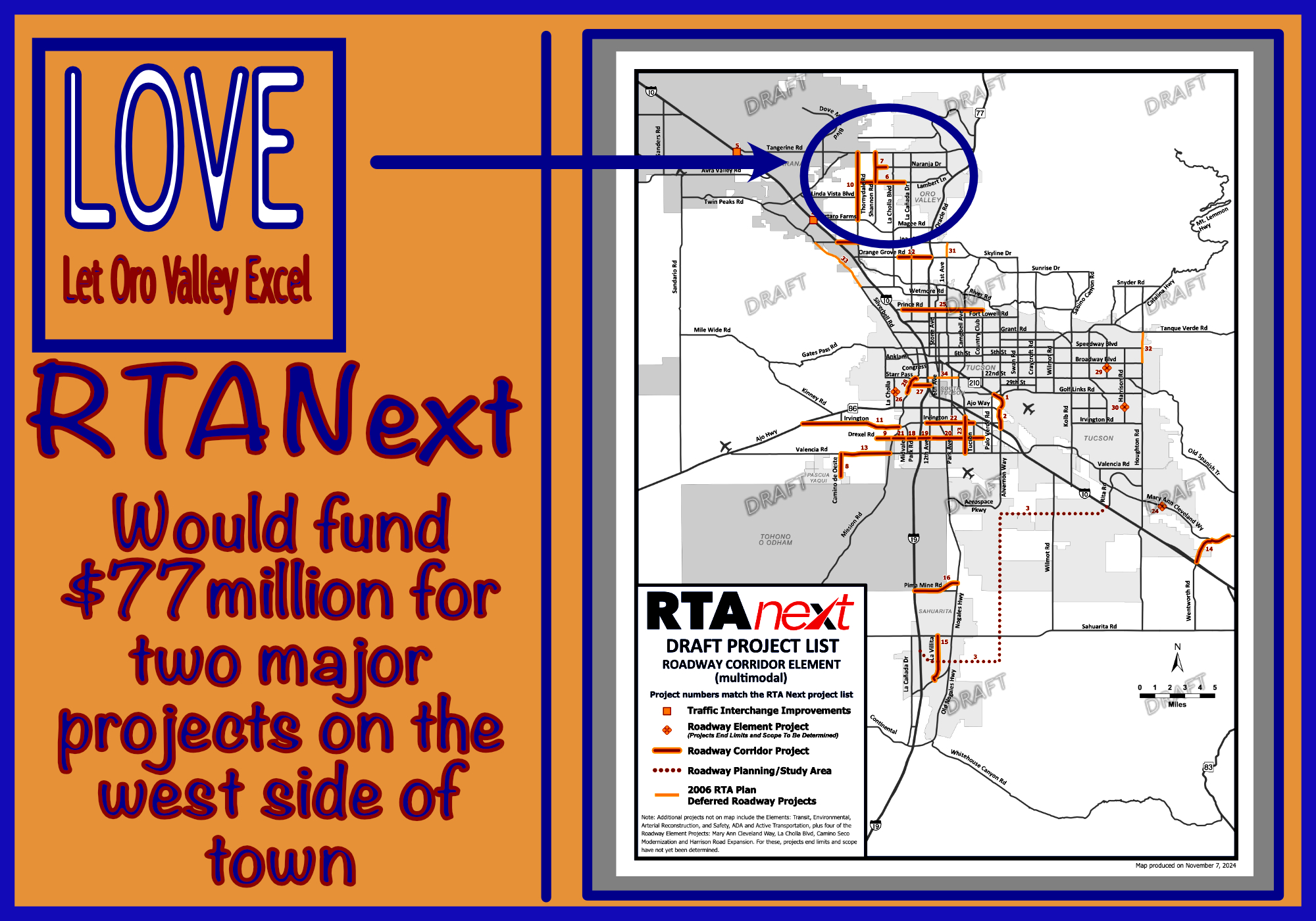
RTA Next identifies specific transportation projects to be funded over the next 20 years. Projects affecting Oro Valley include the proposed connection of Shannon Road to Tangerine Road. Other proposed regional projects that would affect Oro Valley residents include widening First Avenue between Ina and Orange Grove, constructing a new interchange at Tangerine Road and Interstate 10, and widening Tangerine Road between Oracle and La Cholla. Final scheduling and delivery of these projects would occur over the life of the plan.
Negative impact on Oro Valley and regional transit services if RTANext fails
Probably of greater immediate importance is the funding of certain transit services operating in Oro Valley. Currently, the Regional Transportation Authority funds most of the cost of Sun Shuttle dial-a-ride and other regional transit services serving the Town. If RTA Next is not approved, that funding authority will expire after June 30, and RTA-funded transit services would be required to discontinue. It is not known what it would cost for the Town of Oro Valley to replace those services, or whether it could do so quickly, as additional funding, vehicles, drivers, and state-level approvals would be required. No formal cost estimate has been released.
Expecting low voter turnout...so your vote will count
Turnout for the March 10 election is expected to be relatively low, with estimates suggesting that approximately 20–25% of eligible voters may cast a ballot. At that level, the outcome of the RTA Next propositions will be determined by a relatively small share of the electorate. Ballots must be received by 7:00 p.m. on March 10.
Friday, January 30, 2026
Bits and Pieces
Council links reported closure of Berger Performing Arts Center to potential Oro Valley Performing Arts Center
Last week, local media outlets have reported that the Arizona School for the Deaf and Blind will close the Berger Performing Arts Center on its Tucson campus effective June 30, citing funding and the closin of its Speedway location. That reporting came after the Oro Valley Town Council had discussed the potential impact such a closure could have during last week’s strategic planning study session. At that time, Council members raised concerns about the possible loss of Berger, noting that the theater is widely used by Oro Valley-based groups and would cost tens of millions of dollars to replace. They also linked the issue to Oro Valley’s own discussions about a performing arts center, saying that the loss of a regional venue could shift demand to Oro Valley and affect the urgency and scope of any local project. Council members emphasized that the Town is not pursuing its own feasibility study, but intends to stay engaged with a nonprofit conducting a study and remain part of the broader regional conversation.
Council hires town attorney with Prescott Valley experience
This past Wednesday, the Oro Valley Town Council approved the employment contract for its new Town Attorney, a position that now reports directly to the Council rather than through the Town Manager. The Council selected Steven Zraick, a long-time Arizona attorney whose career has focused on municipal and public-sector law. Zraick most recently served as Deputy Town Attorney for the Town of Prescott Valley, where he advised elected officials, staff, and boards on day-to-day legal matters. Public records indicate that his legal work has been centered on local government rather than private practice, a background that aligns with the Council’s stated interest in strengthening its direct legal oversight. The town attorney is responsible for providing legal advice directly to the Town Council, managing the Town’s legal department, representing the Town in legal matters, drafting and reviewing ordinances, resolutions, and contracts, and ensuring that Council actions comply with state law and the Oro Valley Town Code. In his role, he may or may not replace the outside legal council at council meetings.
Water impact fee shortfall flagged, changes to come before Council
Town water officials reported to the Water Utility Commission last week that the Water Resource & System Development Impact Fee, which is paid by new development to help fund growth-related water infrastructure, is projected to fall short in fiscal year 2026–27. Staff told the Commission that projected expenses of about $2.3 million exceed expected impact fee revenue of roughly $1.2 million, creating a gap tied largely to growth-related debt for major water projects. According to staff, current impact fees were set years ago and no longer reflect rising infrastructure costs. Staff said the next step is to prepare an updated impact fee analysis and bring a proposed fee adjustment to the Town Council later in 2026, following the state-required notice and public hearing process.
You can sign candidate nomination petitions online
Arizona voters can sign candidate nomination petitions online using the Secretary of State’s E-Qual system. Visit this link and select “Sign a Candidate Nomination Petition.” Log in with you Arizona driver license or state ID and date of birth to see which candidates they are eligible to support. The system allows you to review and sign petitions electronically, eliminating the need for in-person signature gathering and making it easier to participate in the local election process.
Stormwater Utility fee going up over three years
The Oro Valley Town Council approved a phased increase to the stormwater utility base rate on January 14. The increase will take effect July 1, at the start of the new fiscal year, and will be implemented over three years. The base rate will rise from $4.50 to $6.50 per equivalent residential unit (ERU) once fully phased in. Town staff said the additional revenue will support stormwater system maintenance, regulatory compliance, and flood control, noting that the stormwater rate had not been increased since 2016.
Water cost increase proposed for next July
At its January 12 meeting, the Water Utility Commission reviewed staff’s water rate analysis for FY 2026–27 and affirmed the recommended water rate changes for consideration by the Town Council. The recommendation includes an increase to potable water base rates only, with no changes to usage-based rates or reclaimed water rates; most residential customers with a 5/8-inch meter would see a $1.86 monthly increase. The Commission also reviewed the Groundwater Preservation Fee, for which no change is proposed. In addition, commissioners discussed the Water Resource & System Development Impact Fee, noting that projected expenses exceed revenues and that proposed changes would be brought to Town Council later in 2026 following the required notice and public hearing process. The amount of the proposed increase was not specified at the meeting.
November Financial Update: Town finances largely on track, construction sales tax trails budget
The town's General Fund revenues are tracking below budget through November 2025, largely due to weaker construction activity. Expenditures remain generally on budget due in part to vacancy savings. Community Center Fund continues to outperform expectations, the Highway Fund is tracking close to budget but may require continued capital fund support, and both the Water Utility and Stormwater Funds are trending positively. To address the General Fund shortfall, staff has taken cost-control measures including extended vacancies, reduced operating budgets, reconsideration of excess pension payments, and potential capital spending reductions, while noting that future transportation funding will depend on the outcome of the March RTA Next election [since the town is dependent on the RTA for public transportation] (Source: Budget and Finance Commission Meeting, 01-20-26)
- - -
Friday, January 16, 2026
Bits and Pieces
Council rejects two of three new taxes
Wednesday night, the Oro Valley Town Council took action on three proposed new taxes. Council approved a commercial use tax, but voted not to approve the proposed telecommunications tax or the proposed commercial rental tax. LOVE will provide a more detailed summary of the Council discussion and votes in next Tuesday’s article.
Arizona State School for Deaf and Blind to move to Copper Creek facility
It looks like the Copper Creek Elementary School Building, which Amphi is closing at the end of this school year, won’t be vacant for long. The Arizona State Schools for the Deaf and the Blind (ASDB) plans to move its Tucson campus into the Copper Creek facility under a proposed multi-year lease with the Amphitheater School District. ASDB officials have said the move would allow the state agency to rightsize Tucson operations moving to the existing school campus rather than maintaining the larger, older facility on Speedway in Tucson.
"The goal of this move is: (1) long-term sustainability of the agency and the Tucson campus, so that students continue to receive exceptional education opportunities; and (2) decrease operational/overhead costs, in order to have more resources for students and teachers."
According to ASDB, staff and students will move to the facility this summer. The fall semester will begin at that location. The site will be repurposed for specialized education. The move provides certainty to the town and to the residents of Copper Creek that the facility will continue to a well maintained facility. Read more about their decision to move to Oro Valley here.
Town receives land gift... will likely be added to trails system
Also Wednesday, The Oro Valley Town Council approved a gift agreement to accept two parcels of undeveloped desert land adjacent to Honey Bee Canyon Park. Deputy Town Manager Chris Cornelison explained that the donation consists of roughly 33 acres of natural desert, offered at no cost, with property taxes current. The land is zoned as open space under the Rancho Vistoso PAD and includes existing informal trails. The land will be held by the Town for possible future inclusion in broader parks and trails planning efforts. The next step is for staff to complete standard due diligence, including title review and preparation of the deed, with no obligation for the Town to make improvements or incur expenses related to the property. mmCouncil members expressed support, noting that the donation complements Honey Bee Canyon Park. The Council unanimously approved the resolution, with a 6–0 vote.
Police gain access to statewide investigative data system
Wednesday, the Town Council unanimously approved an agreement allowing the Oro Valley Police Department to participate in a state-supported law enforcement records management and analytics system. Police staff said the system will give OVPD access to data from other law enforcement agencies that do not share the same records platform, improving investigations and officer safety by providing more complete background and contact information. The system will be funded through a one-year state grant administered by the Arizona Department of Administration. In response to council questions, staff said the system meets all criminal justice data privacy standards and that the Town is not required to continue participation if grant funding ends
Council adopts state-mandated zoning code changes
Also Wednesday, the Town Council approved updates to the zoning codes required by recent State of Arizona law changes. We previously reported on these changes. Planning staff explained that the amendments formalize administrative approval for certain non-discretionary development and design review applications, clarify who may appeal administrative decisions and under what conditions, allow earlier submittal of grading and drainage plans, and correct minor code errors. The discussion also addressed a change requiring conditional use permits for building height increases in private school and parks and open space zoning districts, placing final approval authority with the Council. Council members noted that while many of the updates are state-mandated, staff worked to retain local oversight where possible. Changes had been previously approved by the Planning and Zoning Commission.
Phased stormwater rate increase approved... will support system maintenance
Later in the meeting, the Council approved a phased increase to the stormwater utility base rate, adopting Resolution R26-02. The increase raises the residential base rate by 67 cents per month, from $4.50 to $5.17, effective July 1, 2026. Two additional increases were also approved, another 67 cents effective July 1, 2027, bringing the rate to $5.84, and a final increase effective July 1, 2028, bringing the base rate to $6.50, a total $2 increase over three years. Commercial properties will see proportional increases based on impervious surface area. Staff said the stormwater base rate has not been adjusted since 2016, a point previously reported in LOVE, and that the phased approach was designed to limit impacts on residents while ensuring the utility can fund operations, meet regulatory requirements, and maintain required reserves. The storm utility fee is part of your monthly water bill.
Ballots for RTA Next all-mail election coming soon
An all-mail election is coming up on March 10 for Pima County voters to decide the future of regional transportation funding through the RTA Next plan. Proposition 418 asks voters to approve a new 20-year regional transportation plan covering roadway, transit, and safety projects across the region. Proposition 419 asks voters to continue the existing half-cent sales tax that funds the Regional Transportation Authority, with no increase in the tax rate. Ballots will be mailed automatically to registered voters beginning February 11 and must be received by 7:00 p.m. on March 10. There will be no in-person voting; participation is by mail only.
- - -
Thursday, November 20, 2025
Bits and Pieces
Free document shredding Saturday Friday, November 14, 2025
Bits and Pieces
Wednesday, November 12, 2025
RTA Next comes to Oro Valley
Winfield chairs regional transportation effortOro Valley Mayor Joe Winfield serves as chairman of Pima County’s Regional Transportation Authority (RTA), which has funded dozens of road and transit projects over the past 20 years. In Oro Valley, the RTA financed improvements such as La Cholla Boulevard and Tangerine Road. The RTA’s work is supported by a ½-cent countywide sales tax that voters approved in 2006. That tax expires this year, even though many transportation needs remain. RTA Next is a proposal to renew the funding for another 20 years, and voters will decide its future in a March 10, 2026 election.
Ortega outlines new 20-year regional transportation plan
Michael Ortega, Executive Director of the RTA, presented an update on RTA Next to the Oro Valley Town Council last week. He said the new $2.67 billion regional transportation plan is designed to fund roadway, safety, environmental, and transit improvements across Pima County beginning in 2027. Ortega said the plan includes funding specifically designated for projects and transit services benefiting Oro Valley.
Oro Valley projects included
The plan identifies two major Oro Valley projects scheduled for early construction:
• Lambert Lane — widening from Thornydale Road to Rancho Sonora Drive ($55 million).
• Shannon Road — paving from Lambert Lane to Tangerine Road ($26 million).
Ortega said the plan also provides $10 million for safety and active-transportation improvements and $5 million for arterial and collector pavement rehabilitation specifically in Oro Valley. In addition, it includes about $52 million regionwide for Dial-A-Ride and paratransit service, of which Oro Valley will receive a share. Ortega noted that while RTA Next includes funding for bridge and grade-separation improvements as part of regional projects, there are no new bridge projects identified within the town.
Ortega says Oro Valley will get its “fair share”
Responding to a question about how smaller towns benefit compared with Tucson and Pima County, Ortega said the RTA’s funding and project selection process is based on what he called “geographic equity.” The RTA’s half-cent sales tax is collected countywide, and the project list is structured so each member jurisdiction receives improvements reflecting both local priorities and regional use. Projects serving multiple communities—such as major road corridors and I-10 interchanges—are given higher regional value and more funding. In this way, all communities benefit from the regional tax, even if project amounts differ from town to town.
Ortega explains why RTA 1 fell short — and how RTA Next differs
Ortega said the original 2006 RTA plan did not generate enough revenue to complete all promised projects because the RTA used the University of Arizona’s “baseline” forecast, which assumed average economic conditions. That projection proved too optimistic after the recession, pandemic, and rising construction costs. For RTA Next, the Board chose the university’s most conservative, or “pessimistic,” forecast to create a financial cushion and avoid future shortfalls. A citizens’ oversight committee will present quarterly reports to the RTA Board to ensure revenue and expenses remain on track throughout the 20-year program.
RTA Next outreach coming to Oro Valley
Ortega said the RTA will continue community outreach in Oro Valley ahead of next year’s vote. On December 10, the RTA will host a public question-and-answer session in Oro Valley to give residents an opportunity to learn more about RTA Next. Ortega also plans to meet with the town’s Economic Development Committee and Bicycle Advisory Committee to discuss the plan’s potential impacts on local mobility and safety. He thanked Oro Valley staff for their work in coordinating these efforts and for “advocating on behalf of the community.”
Friday, September 12, 2025
Bits and Pieces
Wednesday, June 18, 2025
Will Oro Valley Get Caught Up In RTA Politics When RTANext Comes To A Vote?
![]() |
| Click To Enlarge |
- Shannon Road new roadway starting at Tangerine and continuing well beyond town limits to the south ($23.43 million)
- Widening Lambert Lane from La Canada to well beyond town limits to the west ($50.16 million)
- Intersection upgrade at Tangerine and First Ave ($3.13 million)
- Sidewalk on Naranja Drive, from La Canada to First Ave
- - -
Tuesday, December 3, 2024
Here's Your Chance To Shape RTANext
In November 2026, you will vote on whether to continue the Regional Transportation Authority (RTA). The RTA, approved by voters 20 years ago, funds major road projects in Pima County but cannot continue without your approval. Now is the time to get involved in deciding what the RTA will focus on in the future. Here's a brief overview of its role and how you can participate.
What is the RTA?
The RTA improves transportation infrastructure across Pima County. Funded by a half-cent sales tax approved in 2006, it has supported $2.1 billion in projects, including road expansions, safety improvements, and transit services. To date, over $1.6 billion has been invested, benefiting communities like Oro Valley with key projects such as the widening of La Cholla Boulevard and Tangerine Road. Both projects have improved traffic flow, safety, and accessibility.
What is RTANext?
RTANext is the proposed successor to the current RTA plan, expiring in 2026. This new 20-year plan will invest $2.46 billion in transportation projects, continuing to enhance safety, connectivity, and sustainability. Public input will shape this plan, ensuring it addresses the region’s needs. Oro Valley could benefit from projects like the proposed widening of Lambert Lane and improvements to Shannon Road, along with transit initiatives that expand accessibility.
How to Get Involved
Oro Valley residents can shape the future of the RTANext plan through the following actions:
- Attend Open Houses
Review and provide feedback on the draft plan. Visit the RTA Next Events page for details. - Complete the Draft Plan Survey
Share your input online via the Draft Plan Survey - Schedule a Presentation
Request an RTA presentation for your community group on the Schedule a Presentation - Submit Comments Online
Provide direct feedback through the [RTA Next Contact page