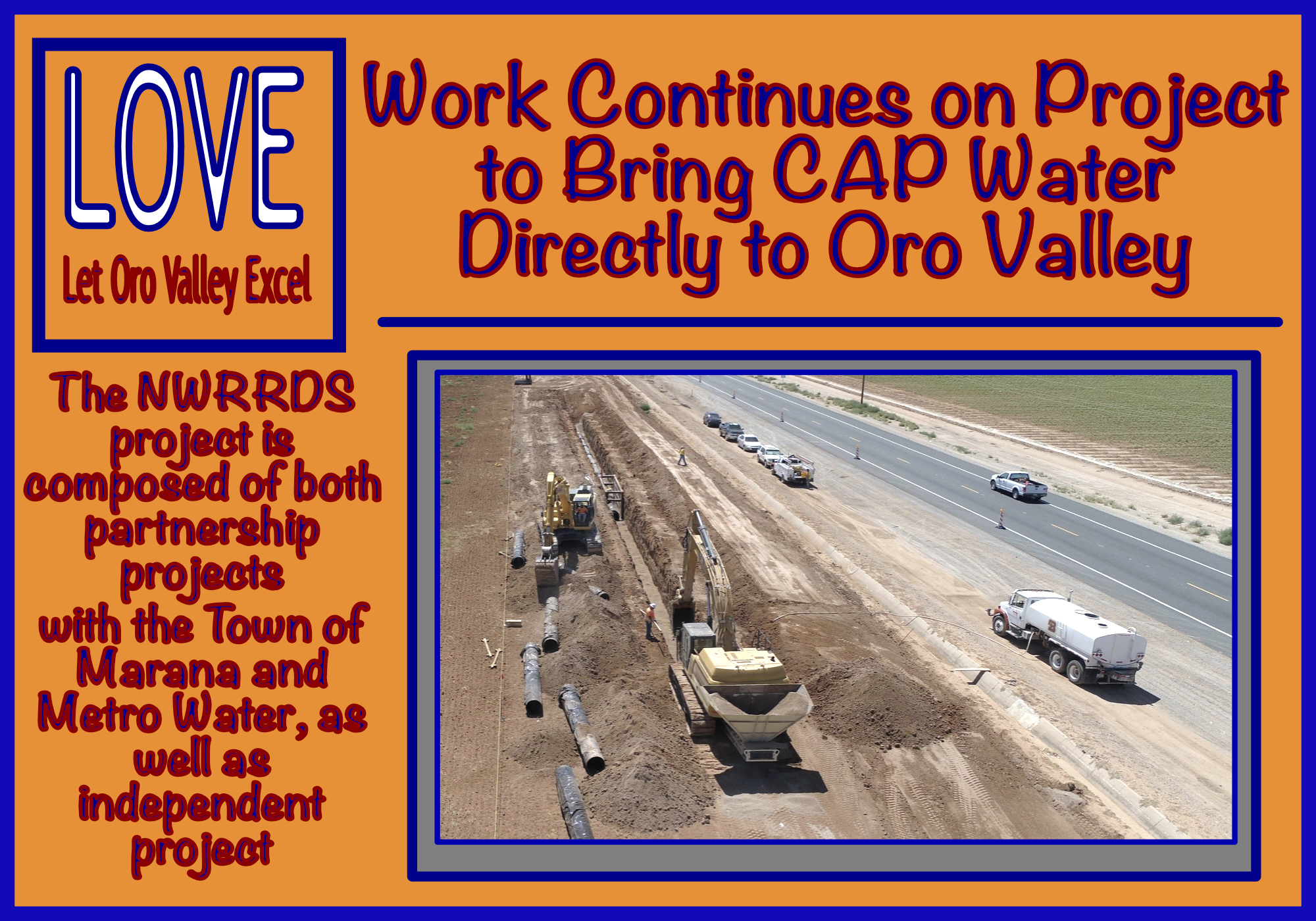
Showing posts with label Oro Valley Water Utility. Show all posts

Wednesday, September 30, 2026

Oro Valley Can Cover the 2027 CAP Cut. But Can It Cover Future Growth?

The 14% CAP 2027 and 2028 delivery cut can managed...
Last week, LOVE reported that the proposed State Trust Land annexation could eventually require roughly 1,000 acre-feet of water a year, about 10% of Oro Valley’s current CAP allocation. We also noted that CAP conditions have worsened since Water Utility Director Peter Abraham raised concerns last year about supplying that land. 

...but it requires a new water utilization strategy
Beginning in 2027, Oro Valley is expecting about a 14% reduction in CAP deliveries. At the September 14 Water Utility Commission (WUC)  meeting, Mitch Basefsky, Stakeholder Outreach Coordinator for the Central Arizona Project and Abraham explained how that reduction is expected to affect Oro Valley. Abraham said the Town anticipates losing a little more than 1,400 acre-feet of CAP deliveries in 2027. But he does not expect that reduction to create an immediate water shortage for current customers. Here's how Abraham plans to manage the reduction.

The Arizona Water Bank is expected to make Oro Valley whole
Oro Valley already has an agreement with the Arizona Water Banking Authority (AWBA) that allows the Town to obtain replacement water during shortages. Abraham said more than 600,000 acre-feet is stored in the Tucson Active Management Area and that Oro Valley has access to a portion of that water. His current plan is to use the Water Bank to offset the projected CAP reduction and effectively restore the Town to its full 10,305 acre-foot CAP allocation for planning purposes.

Oro Valley also has substantial stored water of its own and NWRRDS will help bring in more

Abraham said Oro Valley currently has just under 30,000 acre-feet of long-term storage credits in the Tucson Active Management Area and expects that amount to continue growing. The Northwest Recharge Recovery Delivery System is also expected to begin operating in early 2027, reducing groundwater pumping and giving the Town additional flexibility in how it uses its CAP supply. 

But NWRRDS is not a quick fix. First, NWRRDS does not increase Oro Valley’s water entitlement. It gives the Town a better way to recover and deliver water to which it is already entitled, reducing reliance on groundwater and improving flexibility in how the Town manages its existing supplies. Second, as we reported in August, it will take time for the Town to introduce NWRRDS water into the Oro Valley water system because it has different water chemistry than the groundwater currently delivered to customers, requiring the Utility to carefully blend and monitor the new supply as it is introduced into the distribution system. 

These protections are intended to buy time... they are not permanent solutions...
The important point is that Abraham, speaking at the commission meeting, did not describe these measures as a permanent answer to declining Colorado River supplies. He said the Town’s firming strategies (backup water-supply measures) were created for situations like the one now developing and are intended to “buy us the decades we need” to develop the next set of water supply solutions.

Replacing or augmenting any significant piece of the CAP water supply is decades off
Arizona is actively studying long-term water sources, including desalination, imported water, reuse and brackish groundwater. But projects capable of replacing a meaningful share of Colorado River water remain in the study and planning stages. State planning documents have acknowledged that some projects could take as long as 30 years to implement. That means Arizona may have to manage declining Colorado River supplies for many years before any new source can replace or augment a significant portion of CAP water.

That brings the 852 State Land annexation question back into focus
The September discussion does not change what LOVE reported last week. Oro Valley appears well positioned to manage the expected 2027 CAP reduction given what Oro Valley  is today. The longer-term question is different. 

Why should Oro Valley make a permanent commitment to supply water to a new area at a time when CAP deliveries are being reduced, future CAP projections remain challenging, long term solutions are decades away and the Town will be increasingly reliant on stored water and other firming strategies to protect its existing customers?
- - -
Publisher Note: The agreement requiring the CAP reduction must be approved by the Arizona Legislature. As of this date, that approval has not occurred. 

Wednesday, August 12, 2026

Water Utility Reports Strong Year.... In Every Way

Monday night, Town Water Utility Director Peter Abraham and his staff updated the Water Utility Commission. They provided several interesting and useful pieces of information.

Water Utility had another financially successful year in 2026
The Water Utility ended fiscal year 2025-26 with revenues above budget and expenses below budget. Revenue totaled $22.34 million, approximately $371,000 more than projected. Expenses totaled $20.29 million, approximately $1.47 million below budget. Staff attributed the savings to vacant positions, lower operating and maintenance costs, capital-project timing and careful spending as the Utility works to complete the $52 million Northwest Recharge, Recovery and Delivery System.

Abraham credits the favorable results to good planning, accurate forecasting and a sound rate-setting model.

CAP water continues to reduce Oro Valley’s reliance on groundwater
Abraham presented the water-use report for the first six months of the year. Oro Valley’s main service area produced 4,211 acre-feet of water: 2,110 acre-feet of groundwater, 1,127 acre-feet of CAP water and 974 acre-feet of reclaimed water. Total production was approximately 120 acre-feet lower than during the same period in 2025, even as the number of customer connections continued to grow. In the much smaller Countryside service area, increased CAP deliveries allowed the Utility to reduce groundwater production from 114 acre-feet during the first half of 2025 to just 38 acre-feet this year.

Yes. CAP reservoirs are very low, but the practical effect on Oro Valley is limited for now
Colorado River reservoir levels are near historic lows, but Oro Valley has not yet been told that its CAP allotment will be reduced. Abraham explained that a moderate reduction would most likely mean less water placed into storage for future use—not an immediate reduction in water delivered to customers. For now, the Town plans to request its full annual allotment. “Come October 1st, if no one says anything, I’m ordering 10,305 acre-feet again,” Abraham said.

Next Winter...CAP Water begins its direct flow to Oro Valley... Slow build up
The Town plans to begin introducing CAP water through the Northwest Recharge, Recovery and Delivery System in January. Although NWRRDS will eventually have capacity to deliver as much as 4,000 acre-feet annually, the Utility will not move that amount into the system immediately. Abraham said deliveries may begin at approximately 500 acre-feet during the first year and increase to about 1,000 acre-feet during the second. The gradual approach will give operators time to manage changes in water temperature, flow direction and water chemistry. 

Although NWRRDS water and Tucson-wheeled water both originate as CAP water that has been recharged and recovered from an aquifer, they come through different wells and delivery systems. The new supply may therefore have a different mineral content, hardness and temperature than the water Oro Valley customers currently receive.  Staff will flush lines, monitor water quality and adjust operations as customers and the distribution system become accustomed to the new supply.

Oro Valley’s strong water position does not guarantee protection from future cuts... but it does help
Responding to a commissioner’s question, Abraham said Oro Valley’s strong water position does not necessarily make it a target for the state or other communities seeking a larger share of the available supply. However, he acknowledged that no one yet knows how future reductions will be allocated. Any attempt to penalize Oro Valley for conserving and storing water would likely produce a significant legal and political fight, particularly because other southern Arizona communities have made similar investments.

As we wrote last week, decades of planning and investment have put Oro Valley in a stronger position

As LOVE reported in last week’s articles, Oro Valley’s present water position was not created by a single project or decision. It is the result of decades of planning, investment and regional cooperation. Town leaders and Water Utility professionals secured CAP rights, developed a reclaimed-water system, built delivery infrastructure and stored water for future use. Those decisions have given Oro Valley greater flexibility as conditions on the Colorado River worsen. They do not eliminate the risk, but they place the Town in a far stronger position to manage it.
- - -

Thursday, August 6, 2026

Building Oro Valley's Water Supply... A Team Effort Over Many Years (Part 2)

CAP Water becomes essential to Oro Valley's Water Supply
Oro Valley’s water supply was not created through a single project or decision. It is the result of decades of planning, investment and regional cooperation. In this two-part series, LOVE examines how that system developed. Today, we look at how Central Arizona Project water became an essential part of Oro Valley’s supply.

First came the water rights
The Central Arizona Project canal reached the Tucson area in 1991, but CAP water did not begin flowing into Oro Valley’s system for another 21 years. Before that could happen, the Town had to secure the right to receive it. Oro Valley obtained its current annual allocation of 10,305 acre-feet through four transactions: 1,652 acre-feet with the 1996 purchase of the Cañada Hills Water Company; 642 acre-feet when it assumed management of the Oro Valley Water Improvement District in 1999; 4,454 acre-feet through a 2002 settlement with Tucson at a cost of approximately $5.96 million; and another 3,557 acre-feet through a federal and regional reallocation agreement in 2007.

Tucson Water provided the delivery route
Owning CAP rights did not solve the delivery problem. Building a separate treatment plant and pipeline system would have been enormously expensive, so Oro Valley reached an agreement with Tucson Water. Under that arrangement, Tucson Water recovered and treated CAP water and moved an equivalent amount through its existing system to connections with Oro Valley, a process commonly called “wheeling.” The first connection was completed in 2012, when approximately 1,283 acre-feet of CAP water were delivered to Oro Valley customers and groundwater pumping fell by approximately 1,573 acre-feet—more than 500 million gallons—compared with the previous year. Additional connections completed in 2014 and 2018 increased the amount of CAP water the Town could receive.

Click to enlarge
CAP water changed how the system was managed

Oro Valley did not have to deliver its entire CAP allocation directly to customers. Water not immediately needed could be sent to regional recharge facilities and stored underground. Some could be recovered during the same year to offset groundwater pumping, while water stored for more than a year generated long-term storage credits. Those credits give the Town the legal right to recover an equivalent amount from permitted wells in the future. By the end of 2025, Oro Valley had accumulated an estimated By the end of 2025, Oro Valley had accumulated an estimated 39,908 acre-feet of long-term storage credits. That is equivalent to approximately 13 billion gallons of water, enough to supply about 144,500 typical households for one year, based on the Town’s estimate of 7,500 gallons per household per month.  For customers, the credits function much like a water savings account: a shared reserve for droughts, emergencies and possible reductions in CAP deliveries.

Groundwater remains a key part of the system
CAP water did not eliminate Oro Valley’s use of groundwater. Wells remain an important part of the Town’s water portfolio. The difference is that groundwater is no longer the Town’s only major supply. Oro Valley now relies on a combination of groundwater for drinking-water service, CAP water delivered through Tucson Water or stored and recovered from regional recharge facilities, and reclaimed water [see note] used primarily for golf courses and other large irrigated areas. According to the Town, groundwater pumping declined approximately 56 percent between 2005 and 2022, even as the community continued to grow.

CAP water did not end Oro Valley’s water challenges. It changed them.
The transition took two decades. During that time, Oro Valley created its Water Utility, acquired CAP rights, negotiated delivery through Tucson Water and invested in the infrastructure needed to reduce groundwater pumping and store water for the future. That planning gave the Town a more diverse and resilient supply, but it also tied Oro Valley’s water future to the Colorado River. The Town must now protect both its local aquifer and the distant reservoir system that supports its CAP water. 
- - -
Note: Reclaimed water reduced demand before CAP deliveries began
Between 2003 and 2008, Oro Valley invested $21.8 million in a two-phase reclaimed-water delivery system, financed through what was then the Town’s largest bond issue. The separate “pink pipe” network brought treated wastewater to golf courses, parks and school fields, replacing groundwater and drinking water previously used for irrigation. 

Oro Valley began negotiating with Tucson for wastewater-effluent rights in 2000 and entered a cooperative agreement in 2002. Reclaimed-water deliveries began in 2005 and later expanded through a the newly created and separate network of reservoirs, pumping facilities and signature purple pipes serving golf courses, parks and school athletic fields. Because the reclaimed-water system is completely separate from the drinking-water system, its principal value is replacing potable water that otherwise would have been used for large-scale irrigation. The Town estimates that reclaimed water reduced the use of drinking water for turf irrigation by 26 percent.
- - -

Wednesday, August 5, 2026

Building Oro Valley's Water Supply... A Team Effort Over Many Years (Part 1)

Oro Valley’s water supply was not built through a single project or decision. It is the result of decades of planning, investment and cooperation by Town leaders, utility professionals, regional partners and residents—an effort we examine in this two series. Today we discuss life before CAP and what led up to its introduction in the Oro Valley Water System.

Before CAP: Oro Valley ran on groundwater alone

Our recent article explained why Lake Powell’s decline matters to Oro Valley. That connection did not exist when the Town created its Water Utility 30 years ago. At the time, Oro Valley relied entirely on groundwater. Every gallon delivered to a home or business came from a well. There was no CAP water in the system, no reclaimed-water network serving golf courses and no large reserve of stored water credits. That system supported the community for years. It was not sustainable indefinitely.

The Town inherited a groundwater-dependent system
Oro Valley created its Water Utility in May 1996 by purchasing the private Cañada Hills and Rancho Vistoso water companies. The new utility had approximately 9,800 connections serving about 26,000 residents. It also inherited separate water systems, different rate structures and wells of varying age and condition. Those systems had to be integrated while continuing to provide reliable water service.

Most importantly, they all depended on the same source: groundwater. That dependence became more concerning as Oro Valley grew. The Town’s population increased from approximately 6,670 in 1990 to nearly 30,000 by 2000. New homes, businesses, schools, parks and landscaped areas placed greater demands on the aquifer beneath the community.

By 1999 aquifer was showing the strain
Former Oro Valley Water Utility Director Alan Forrest later recalled that water levels in the Town’s wells were falling by an average of approximately six feet a year. A well failure during the summer of 1999 demonstrated how vulnerable the system could be. One of the two wells serving the Countryside area suffered a major failure during the hottest part of the year, when water demand was near its peak.
The Town arranged a temporary connection with Tucson Water to help maintain household service and the water needed for fire protection. The immediate crisis was resolved, but the larger problem remained.

Oro Valley needed to diversify its water supply.
Oro Valley had the legal right to pump groundwater. That did not mean the aquifer could sustain unlimited pumping. A 2007 groundwater study later estimated that the aquifer could sustainably provide approximately 6,360 acre-feet annually. Continued growth based almost entirely on wells would increase the risk of falling water levels, declining well production and higher pumping costs.

Reclaimed water came first
The first major step was to stop using drinking water for purposes that did not require it. Oro Valley negotiated with Tucson Water to obtain treated wastewater for irrigation. The Town then developed a two-phase reclaimed-water system costing approximately $21.8 million. Beginning in 2005, reclaimed water was delivered through a separate system of “purple pipes” to golf courses and other large turf areas. That change reduced pressure on the aquifer because water used on golf courses, parks and school grounds no longer had to come from the potable groundwater supply. 

Tomorrow: Reclaimed water helped. But, it did not provide another source of drinking water. For that, Oro Valley needed access to Central Arizona Project water.
- - -

Tuesday, June 9, 2026

Council Approves Limited Water Rate Increase For Oro Valley Water Customers.

Council approves limited water rate increase
Last week, The Oro Valley Town Council approved a potable water base rate increase. The increase applies only to drinking water base rates. It does not increase potable water commodity rates, groundwater preservation fees, reclaimed water base rates, or reclaimed water commodity rates. The increase takes effect July 4 and will first appear on August water bills.

Most customers will pay $1.86 more per month
For the typical customer with a 5/8-inch meter using 7,000 gallons per month, the water portion of the bill will increase from $51.45 to $53.31. That is an increase of $1.86 per month, or 3.6%. Water Utility Director Peter Abraham told council that about 84% of Oro Valley Water Utility customers have a 5/8-inch meter. 

Only the base rate is increasing
Abraham said the utility normally tries to balance increases between the base rate and the commodity rate. This year, however, staff recommended a base-rate-only increase because the utility needs more certain revenue. Commodity revenue can vary depending on water use and weather. A wet year could reduce water sales and make it harder for the utility to meet revenue requirements.

Higher operating costs are driving the increase

Staff said drinking water costs are rising by about $900,000, or 5.94%. The increases include personnel, operations and maintenance, power, CAP delivery, CAP wheeling, and Northwest Recharge, Recovery and Delivery System costs. Abraham said the utility offset part of that increase through reduced capital spending, lower debt paid by rates, and no added staff. Those actions produced about $450,000 in savings.

Renewable water costs are becoming a bigger factor
In response to questions from Mayor Joe Winfield, Abraham said most of the operating cost increase is tied to renewable water supplies. He said CAP wheeling, CAP delivery, and NWRRDS costs account for roughly 64% to 65% of the increase. Abraham also told council that Oro Valley is preparing for a possible 20% cut in its CAP allocation beginning in January. He said that would not reduce the amount of CAP water delivered to customers, but it would reduce the amount of CAP water the utility can store.

Council supports smaller annual adjustments
Council Member Mary Murphy, who serves as council liaison to the Water Utility Commission, praised staff and the commission for bringing forward smaller annual increases rather than waiting until a larger increase is needed. Abraham said his goal is to keep future annual increases in the 3% to 5% range, depending on costs and utility finances. 

Council approved the rate increase unanimously, 7-0.
- - -

Friday, May 22, 2026

Bits and Pieces

No Turn On Red
There is one traffic light intersection in Oro Valley where drivers are not allowed to make a right turn on red. Can you guess which one it is?  It is the intersection of Tangerine Road and Oracle Road, specifically for traffic heading eastbound on Tangerine and turning southbound onto Oracle. Lieutenant Eric Larter of the Oro Valley Police Department told LOVE that the “No Turn on Red” restriction for eastbound Tangerine Road turning southbound onto Oracle Road exists because Oracle has a 55 mph speed limit at that location and southbound drivers come over a crest just north of the intersection before heading downhill toward Oro Valley Marketplace. According to Larter, the restriction is intended to reduce the risk of collisions between high speed southbound traffic and vehicles accelerating from a stop on Tangerine. He also noted that quite a few drivers attempt the turn and that officers often stop motorists there simply to educate them about the restriction and signage.

Memorial Day remembrance Monday
A Memorial Day remembrance ceremony is planned for Monday, May 25, from 10 a.m. to noon at the Arizona Heroes Memorial at Naranja Park. The event will honor the men and women who gave their lives in military service to the nation. The event is hosted by American Legion Auxiliary Unit 132 and Arizona Heroes Memorial.

🎈🎈🎈Congratulations: CDO Softball wins State Championship
Canyon Del Oro High School softball captured the AIA 4A state championship Monday, earning the program’s 10th state title, its first since 2017. The championship run required winning five straight games in a 16 team tournament that began May 2, a feat only one team can achieve. CDO dominated early, shutting out opponents in its first three games, then won its final two contests by one run. The accomplishment is particularly notable because the team’s pitcher, Savanna Mares, is a freshman. Mares was a key force in the 2026 season, compiling a 21-6 record in a year that included a perfect game with 20 strikeouts. Congratulations as well to CDO Coach Kelly Fowler and the entire Dorados team on another state title. The 2026 championship run was powered by a freshman standout, a team that hit when it mattered, and a coach who knows how to win. (Assist from All Sports Tucson)

Explore Oro Valley tourism website launches today
Oro Valley’s new destination marketing website, ExploreOroValley.com will launch today after 11 a.m., according to Destination Marketing Manager Crystal Frank. It was presented to council Wednesday.  The site is the culmination of roughly a year of work. It is intended to support tourism, community awareness, and local business visibility. Frank described it as more than a website, calling it a new destination identity for Oro Valley. The site includes interactive features for events, dining, outdoor recreation, arts, lodging, trip planning, and mobile use, along with a new tourism focused brand and logo system separate from the Town’s official seal and logo. The branding and website effort cost about $175,000, according to Economic Development Director Paul Melcher.

Water customers will need to switch usage tracking apps on June 30
Oro Valley water customers who use the Town’s WaterSmart portal to monitor water use will need to move to a new platform called SpryPoint beginning June 30. According to Town Manager Jeff Wilkins, current WaterSmart users will need to register again and reenter their information in the new system. The change primarily affects customers who actively track their household water use.

Golder Ranch highlights fall prevention app NYMBL
Golder Ranch Fire District is encouraging residents to consider using the NYMBL balance training app, a mobile program designed to help reduce the risk of falls. According to Golder Ranch Fire District materials, the app combines balance exercises with cognitive training activities intended to improve stability, coordination, reaction time, and confidence during everyday movement. The district’s materials state that the program is aimed primarily at older adults and can be completed in about 10 minutes a day using a smartphone or tablet.

Council approves Sun City fountain
The Oro Valley Town Council voted 6–1 Wednesday to allow restoration of the Lion’s Head fountain at the Sun City Oro Valley Recreation Center in Rancho Vistoso. The action approved a site specific zoning amendment allowing the ornamental fountain to return. A council decision on this was needed because Town code prohibits new ornamental fountains. Supporters argued the redesigned fountain would use substantially less water and include conservation features such as rainwater harvesting. Opponents cited drought concerns, water conservation policy, and the precedent of granting an exception. Councilmember Joyce Jones Ivey cast the lone dissenting vote. Readers interested in the background and arguments on both sides can review LOVE’s earlier article on the proposal.  
- - -


Friday, January 30, 2026

Bits and Pieces

Council links reported closure of Berger Performing Arts Center to potential Oro Valley Performing Arts Center
Last week, local media outlets have reported that the Arizona School for the Deaf and Blind will close the Berger Performing Arts Center on its Tucson campus effective June 30, citing funding and the closin of its Speedway location.  That reporting came after the Oro Valley Town Council had discussed the potential impact such a closure could have during last week’s strategic planning study session. At that time, Council members raised concerns about the possible loss of Berger, noting that the theater is widely used by Oro Valley-based groups and would cost tens of millions of dollars to replace. They also linked the issue to Oro Valley’s own discussions about a performing arts center, saying that the loss of a regional venue could shift demand to Oro Valley and affect the urgency and scope of any local project. Council members emphasized that the Town is not pursuing its own feasibility study, but intends to stay engaged with a nonprofit conducting a study and remain part of the broader regional conversation.

Council hires town attorney with Prescott Valley experience
This past Wednesday, the Oro Valley Town Council approved the employment contract for its new Town Attorney, a position that now reports directly to the Council rather than through the Town Manager. The Council selected Steven Zraick, a long-time Arizona attorney whose career has focused on municipal and public-sector law. Zraick most recently served as Deputy Town Attorney for the Town of Prescott Valley, where he advised elected officials, staff, and boards on day-to-day legal matters. Public records indicate that his legal work has been centered on local government rather than private practice, a background that aligns with the Council’s stated interest in strengthening its direct legal oversight.  The town attorney is responsible for providing legal advice directly to the Town Council, managing the Town’s legal department, representing the Town in legal matters, drafting and reviewing ordinances, resolutions, and contracts, and ensuring that Council actions comply with state law and the Oro Valley Town Code.  In his role, he may or may not replace the outside legal council at council meetings. 

Water impact fee shortfall flagged, changes to come before Council
Town water officials reported to the Water Utility Commission last week that the Water Resource & System Development Impact Fee, which is paid by new development to help fund growth-related water infrastructure, is projected to fall short in fiscal year 2026–27. Staff told the Commission that projected expenses of about $2.3 million exceed expected impact fee revenue of roughly $1.2 million, creating a gap tied largely to growth-related debt for major water projects. According to staff, current impact fees were set years ago and no longer reflect rising infrastructure costs. Staff said the next step is to prepare an updated impact fee analysis and bring a proposed fee adjustment to the Town Council later in 2026, following the state-required notice and public hearing process.

You can sign candidate nomination petitions online
Arizona voters can sign candidate nomination petitions online using the Secretary of State’s E-Qual system. Visit this link and select “Sign a Candidate Nomination Petition.” Log in with you Arizona driver license or state ID and date of birth to see which candidates they are eligible to support. The system allows you to review and sign petitions electronically, eliminating the need for in-person signature gathering and making it easier to participate in the local election process.

Stormwater Utility fee going up over three years
The Oro Valley Town Council approved a phased increase to the stormwater utility base rate on January 14. The increase will take effect July 1, at the start of the new fiscal year, and will be implemented over three years. The base rate will rise from $4.50 to $6.50 per equivalent residential unit (ERU) once fully phased in. Town staff said the additional revenue will support stormwater system maintenance, regulatory compliance, and flood control, noting that the stormwater rate had not been increased since 2016.

Water cost increase proposed for next July
At its January 12 meeting, the Water Utility Commission reviewed staff’s water rate analysis for FY 2026–27 and affirmed the recommended water rate changes for consideration by the Town Council. The recommendation includes an increase to potable water base rates only, with no changes to usage-based rates or reclaimed water rates; most residential customers with a 5/8-inch meter would see a $1.86 monthly increase. The Commission also reviewed the Groundwater Preservation Fee, for which no change is proposed. In addition, commissioners discussed the Water Resource & System Development Impact Fee, noting that projected expenses exceed revenues and that proposed changes would be brought to Town Council later in 2026 following the required notice and public hearing process. The amount of the proposed increase was not specified at the meeting.

November Financial Update: Town finances largely on track, construction sales tax trails budget
The town's General Fund revenues are tracking below budget through November 2025, largely due to weaker construction activity. Expenditures remain generally on budget due in part to vacancy savings. Community Center Fund continues to outperform expectations, the Highway Fund is tracking close to budget but may require continued capital fund support, and both the Water Utility and Stormwater Funds are trending positively. To address the General Fund shortfall, staff has taken cost-control measures including extended vacancies, reduced operating budgets, reconsideration of excess pension payments, and potential capital spending reductions, while noting that future transportation funding will depend on the outcome of the March RTA Next election [since the town is dependent on the RTA for public transportation] (Source: Budget and Finance Commission Meeting,  01-20-26)
- - -


Wednesday, January 7, 2026

Eight Key Issues That Will Shape Oro Valley in 2026

As Oro Valley enters 2026, a series of unresolved policy questions and major decisions are converging. This article highlights the eight key most likely to drive debate, influence voters, and shape the Town’s direction over the coming year.

Water infrastructure will reach a major milestone
The  NWRRDS project is expected to be completed later in the year, marking a major step in strengthening Oro Valley’s long-term water supply and system reliability. Essentially, it enables the town to bring CAP water directly to Oro Valley. Currently, the town get's CAP water via the Tucson Water System.

The election that will shape future priorities
The 2026 election will influence policy discussions throughout the year, affecting council focus, the timing of decisions, and the broader public dialogue. Some issues thatr are likely to surface as campaign themes and voter concerns includes

  • Town finances: Is there a structural financial problem, or are current concerns tied to timing and long-range forecasts? If a problem exists, when does it emerge, and what options are available to address it?
  • Growth and housing: How much additional residential growth should Oro Valley plan for, and what mix of housing makes sense? This includes questions about more homes, housing affordability, density, and the pace of development.
  • Annexation and the tax base: Should the Town pursue annexation of retail-intensive or commercially valuable areas as a way to strengthen revenues and reduce reliance on residential taxes?
  • Infrastructure and service capacity: Can existing roads, water systems, public safety services, parks, and facilities support additional growth without major new costs?
  • Taxes and fees: If revenues fall short of future needs, should the Town consider new or adjusted taxes, fees, or other funding mechanisms?
  • Long-term planning priorities: How should policies outlined in OV Path Forward be implemented, and which priorities should be addressed first?
Our guess is that more candidates will file for office. Residents will get a wide view of opinions on these and other items.

Possible new taxes and long-term finances remain central
Debate over potential new taxes is likely to continue, alongside close attention to the Town’s overall financial condition, including forecasts, reserves, and future obligations. The council will consider approving the three new taxes under consideration this month.

A possible Amphi school closure with major community impact
The possible closing of Copper Creek Elementary remains unresolved and is expected to be an early issue in 2026. Amphitheater School District officials have indicated they intend to move quickly toward a decision, and current signals suggest the school is likely to close. At the same time, the proposal has raised concerns among parents and nearby residents about neighborhood impacts, student reassignment, and long-term effects on the surrounding community. Whether that concern translates into organized pushback, and how the District responds, could shape the outcome and keep the issue in the public spotlight.

A tourism strategy that will be built
Findings from the destination marketing study are expected to influence how Oro Valley approaches tourism, branding, and related economic development. A draft plan is now in circulation, but several elements are likely to require further refinement before adoption, including how group and business travel is addressed, how the plan’s return on investment is quantified, and how tourism governance and funding would be structured. Town staff has indicated that the draft will be reviewed in a Town Council work session in late January, with possible action to follow in February.

Planning the Town’s trail network
Continued work on the Trails Master Plan will influence future recreation priorities, trail connectivity, and capital investment decisions across Oro Valley. As the plan moves closer to completion, key questions remain about which trail segments should be prioritized, how new connections will balance recreation with neighborhood impacts, and how improvements will be funded and phased. Council direction on these issues will shape how quickly recommendations move from planning to construction and how the trail system fits into broader transportation, conservation, and quality-of-life goals.

Regional transportation decisions with local impact
RTA Next will continue to be a major topic in the next few months, with long-term implications for transportation funding and infrastructure across the region. March, voters are expected to weigh in on extending or modifying the regional transportation program, which would determine how road improvements, transit projects, and maintenance are funded for decades to come. For Oro Valley, the debate will likely focus on whether the proposed projects align with local priorities, how much funding the Town would receive relative to its contribution, and how regional commitments intersect with other pressing capital needs.

A vote on Oro Valley’s future framework
Completion of OV Path Forward will culminate in a voter decision next November. If approved, the updated General Plan would establish the Town’s policy framework for growth, land use, housing, transportation, and infrastructure for the next decade and beyond. In the months leading up to the election, debate is likely to focus on how the plan addresses growth expectations, preservation of community character, and alignment with long-term financial and infrastructure capacity.

What are your thoughts on the big stories of 2026. 

Let us know of our Facebook page.
 - - -

Wednesday, September 3, 2025

May 2025 Financial Update: Larger than budgeted fund balances expected at year end

Bottom Line: Larger than budgeted fund balances expected at year end
All six of the Town’s major funds are estimates to end the fiscal year with balances greater than budgeted. This conclusion is based on a staff presentation to the town's Budget and Finance Commission
in August. The estimates are based on fund balance positions as of May.   

Delayed spending and savings drives most reported results
A larger than planned fund ending fund balance does not mean the Town is operating more efficiently or being more fiscally responsible. This is because the cash balances also reflect the timing of receiving and paying funds. Because the Town uses cash basis accounting, lower spending may simply mean that a project or service has been completed but payment has not yet been made; or that work has not yet started. For example, some capital projects in the Capital Fund have rolled into the next fiscal year, and certain road preservation projects in the Highway Fund and equipment purchases in the Water Utility Fund are being delayed.

General Fund: Lower revenues and expenditures

The General Fund pays for most day-to-day Town operations, excluding spending by the Water Department and the Stormwater Utility Fund. It also provides to other  funds, such as the Capital Fund and the Community Center Fund. Its performance therefore matters. General Fund revenues are down about 4% year over year, driven mainly by lower-than-expected construction sales tax revenues. This is despite licenses and permits exceeding the annual budget, with 106 single-family permits issued through May. Expenditures are tracking under budget due to unfilled positions and operations and maintenance savings. The Town now expects to use about $2.3 million of fund balance instead of the planned $4.1 million, leaving reserves about $4.4 million above the 30% Council policy threshold.

Highway Fund: Delayed road projects boost fund balance
Revenues in the Highway Fund are at 83% of budget. Highway User Revenue Fund receipts are slightly below plan, but higher right-of-way permit fees and insurance recoveries help offset that shortfall. The fund also receives quarterly transfers from the Capital Fund, totaling $4 million for the year. On the spending side, savings are expected in personnel, street and traffic signal maintenance, and several capital projects. Equipment and road work came in under budget, including the Magee Road and La Cañada Drive mill and overlay projects. The Town Council also shifted funds from a planned truck purchase to a less expensive crack seal machine, producing additional savings. Instead of a $365,000 change in fund balance as budgeted, the fund is now projected to add about $870,000 by year-end. 

Community Center Fund: Better than planned revenues balanced, somewhat, by greater than planned spending
Revenues in the Community Center Fund are ahead of budget, reaching 105%. Golf activity is strong, with 111,115 rounds played through May, an increase of 8.2% from last year. Town revenues from dues, recreation programs, and rentals are also higher than expected. Expenses are running over budget due to higher labor, utility, and credit card costs, as well as increased personnel costs. Even so, instead of using $115,000 from the Community Center Fund balance as planned, the fund is now projected to add about $750,000, ending the year with a balance of $2.6 million. These results include a transfer from the General Fund of $3.59 million, projected to reach $3.9 million by year-end (June). The Community Center Fund also transferred $1.72 million to cover debt service on the $25 million Parks and Recreation bond.”

Capital Fund: Rolling some projects into next year
Revenues in the Capital Fund are at 85% of budget through May. These include a $1 million state grant for the Naranja Park pump track and skatepark, $5.35 million in transfers from the General Fund, and higher-than-expected interest earnings. On the spending side, only $4.5 million of the $10.3 million budgeted for capital outlays has been used, as several projects will roll into the next fiscal year. Transfers out include funding for road work into the Highway Fund and $2.2 million set aside for the Vistoso Trails Nature Preserve and transit vehicles in the Grants Fund. Instead of using $5 million of fund balance as planned, the fund is now projected to use only about $400,000, leaving an ending balance of $11.7 million. 

Water Utility Funds: Increases revenue...some cost savings
Revenues in the Water Utility Fund are expected to slightly exceed budget, helped by reclaimed water sales, service fees, and higher interest earnings. Loan proceeds total about $7.2 million compared to $8 million budgeted. On the expense side, savings are coming from staff vacancies, lower costs for CAP water deliveries, and reduced system maintenance. Capital outlays are also running below plan. Debt service payments were made as scheduled, and transfers are being used to fund regional water projects such as the Northwest Recharge, Recovery, and Delivery System. Instead of the $2.3 million increase that was budgeted, the fund is now projected to grow by about $6.2 million, ending the year with a balance of $15.5 million.

Stormwater Utility Fund: Spending timing impacts fund balance
Revenues in the Stormwater Utility Fund are on track, with fee collections near budget and interest earnings well above expectations. A FEMA grant for $210,000 for the Sierra Wash project will roll into the next fiscal year. On the expense side, savings are coming from vacancies and lower costs for vehicle and equipment repairs, field supplies, and gasoline. The Sierra Wash project had a budget of $735,000 but is now estimated to cost about $380,000 by year-end . Instead of using $432,000 of fund balance as budgeted, the fund is expected to use only about $127,000, ending the year with a balance of $936,000.
- - -

Friday, June 27, 2025

Bits and Pieces

Unusual fiscal year-end council meeting called to address funding gap for Naranja Drive path project 
The Oro Valley Town Council will hold a special Zoom meeting Monday—the very last day of the fiscal year—to consider an urgent funding amendment for the Naranja Drive Multi-Use Path project. The meeting addresses a $341,000 estimated project shortfall after construction bids came in higher than expected for the project. Council will decide whether to use leftover funds from other 2025 street projects to keep the Naranja path on track for a summer start and early 2026 completion. In order for these monies to be available for use in the next fiscal year, the leftover funds must be designated for multi-use path construction before the end of this fiscal year. Our guess is that the urgent meeting is needed so the funds can be designated for this use before the fiscal year closes.

Fourth of July festivities and new shade at the tennis courts
Oro Valley’s annual Fourth of July Celebration returns to James D. Kriegh Park on July 4, featuring live music, food trucks, a beer garden, family games, and fireworks, plus the town’s first-ever hot dog eating contest at 7:30 p.m. In addition, construction is underway on new shaded viewing and seating areas at the Pusch Ridge Tennis Facility, with completion expected in July—giving tennis players and spectators a cooler, more comfortable space for summer matches and community events.  Read even more about what is going on this this weeks's Town of Oro Valley "This Week In Parks and Rec”  bulletin. 

Interested in helping Oro Valley build its tourism base? Apply now for one of five seats on the new Tourism Advisory Commission
Oro Valley is launching a brand new Tourism Advisory Commission and is now accepting applications from residents who want to help shape the town’s future as a top destination for visitors. The five-member commission will advise the Town Council on everything from strategic marketing to special events, resort partnerships, and tourism budget priorities. If you have experience or a strong interest in hospitality, travel, marketing, or events—or just want to make a difference in how the town promotes itself—this is a great way to get involved. Members will serve three-year terms and the group will meet monthly for the first year, then quarterly after that. Applications are open now. Apply here or call by the Town Clerk’s Office at (520) 229-4700 for more information.  Read how all this came about in LOVE. 
 
Park painting project underway in Rancho Vistoso
Rancho Vistoso has started a summer-long painting project at Hohokam and Wildlife Ridge Parks, with crews repainting perimeter walls, restrooms, and ramadas to freshen up these popular community spaces. The work began June 9 and will continue through the season. Residents are encouraged to watch for “Wet Paint” signs and to avoid the areas being painted until the project is complete, helping ensure a safe and smooth update for everyone who uses the parks. (Source) 

Oro Valley Water: Smart water tips and a new bill payment portal now live
The latest Oro Valley Water Utility newsletter is packed with helpful updates for residents this summer. Most notably, the Town has rolled out a new online bill payment portal, making it easier than ever to manage your water account and pay bills securely from home. The newsletter also offers timely water-saving tips to help you conserve during the hottest months, including suggestions for efficient irrigation and reminders about monsoon season preparation. If you haven’t yet, be sure to check out the Water Utility website for more details and to explore the new portal—small changes can make a big difference for your bill and the community. (Source:  Town of Oro Valley "Behind The Meter) .
- - -


Wednesday, April 30, 2025

It’s Budget Time — Council Considers $46 Million In Capital Spending For 2026

Over 60% of the spending is Water related
Tonight, the Town Council will discuss the Town Manager's recommended capital budget for fiscal year 2026, which starts July 1, 2025. The total recommended capital budget is $45.6 million. Of this amount, 62% is for Water Utility projects. Within that, 88% is allocated to the Northwest Recharge, Recovery and Delivery System (NWRRDS) project. As previously reported, the Town has borrowed $18 million to fund a large portion of the NWRRDS project. The Water Utility operates as a separate enterprise from the rest of the Town.

Focus on $17.5 million of town projects
Our focus is on the $17.5 million of proposed capital spending outside of the Water Utility. Most of this spending is allocated to streets, public facilities (including vehicles and equipment), and parks. Together, these areas account for over 90% of the Town’s recommended non-Water Utility capital expenditures.

Hard to read?
Click to enlage
Street projects total $5.8 million

The largest portion of street spending supports the Town’s pavement preservation program, which seals and resurfaces roads to extend their lifespan. If residents have not seen work recently in their neighborhood, it is likely to occur soon because pavement preservation is an ongoing process. The recommended street budget also includes $750,000 for a new traffic light at the Tangerine Road entrance to Naranja Park. The primary funding source for these projects is the Highway Fund, which receives revenue primarily from state-shared highway user taxes and impact fees.

Public facilities, vehicles, and equipment projects total $5.1 million
The Town Manager is recommending $5.1 million for public facilities, vehicles, and equipment. More than 60% of this is for the Town’s vehicle replacement program. This program funds the annual replacement of aging fleet vehicles to help control repair and maintenance costs. Funds for the vehicle replacement program come primarily from the Capital Fund, which is supported by transfers from the Town’s General Fund and anticipated grants from the Arizona Department of Transportation (ADOT). This category also includes $800,000 to complete the court expansion project, including the construction of a secured sally port.

Parks projects total $5 million
The parks budget is dominated by spending on the Town’s golf and community center facilities. Approximately $2.8 million is allocated from the Community Center Fund for projects such as a 36-hole pump station, an exterior restroom at the Community Center, and resurfacing of the Community Center parking lot. The Community Center Fund is supported by dedicated revenues, including sales tax.

The parks budget also proposes $2 million for the reconstruction of the pond at the Vistoso Trails Nature Preserve. The funding source for the pond project is the Capital Fund, which in this case is supported by the Town’s General Fund.

New police facility planning project proposed

Public safety vehicle maintenance is included in the public facilities category. However, there is a separate public safety project proposed for fiscal 2026: $400,000 for police facility programming. This project would fund consulting services to design solutions for future police facility needs, based on a prior space needs assessment. Construction of a new police facility is not included in the fiscal 2026 capital budget. Instead, it appears in a contingent projects list for future years, with an estimated construction cost of $36 million starting in fiscal year 2027.

Summary
The Town Council will discuss the recommended capital improvement projects for fiscal year 2026 at tonight’s meeting. We will report on any major discussions or changes of interest in a future LOVE article.
- - -

Wednesday, March 12, 2025

Lowest Water Uses Hit Hardest By Water Cost Increase

More details on Oro Valley’s water rate increase proposal
Last week, in our article “It Happens Every Year—Another Water Rate Increase,” we provided an overview of the fiscal year 2026 water rate increase. Since then, Water Utility Director Peter Abraham has presented the proposed changes to the Oro Valley Town Council. His presentation included additional details that were not covered in our previous article. This update highlights those details, as well as some of the Town Council members’ comments and concerns regarding the rate increase.

Big hit to low water users (Last year 8%, this year 4.2%)
The proposed rate increase affects both the base rate and commodity rates, with the greatest percentage impact on lower water usage tiers. 84% of Oro Valley residents have the smallest 5/8-inch meter and will see their monthly base rate rise by $1.11 (5%), from $22.20 to $23.31. The base rate is the fixed charge for being connected to the system, regardless of water usage.

Additionally, Tier 1 users (customers who use up to 7,000 gallons of water per month) will see their commodity rate increase by $0.10 per 1,000 gallons (3.5%), while Tier 2 users (customers consuming between 7,001 and 16,000 gallons per month) will experience a $0.17 per 1,000 gallons (3.5%) increase. This results in an overall 3.8% increase in the water bill, following last year’s 7.8% increase.

The total water bill also includes five additional fees or taxes, which add approximately $15 to $16 to the bill. As a result, a Tier 1 user will be billed $60.48 in total under the proposed rate schedule. Only $44.45 is for the cost of water.

Big users see no water cost increase
Meanwhile, about 1,200 of the town’s highest water users fall into Tier 3 and Tier 4. Last year, Tier 3 rates increased by 35%, and Tier 4 rates increased by 40%, the largest hikes among all tiers. No additional increases were proposed for these tiers, as Abraham wants to evaluate whether last year’s steep increases successfully reduced high water consumption among that group. Our guess is that the town itself is the biggest user in these categories.

Four factors driving the water rate increase
According to Abraham, four factors are driving the need for a rate increase:
  • Rising CAP water costs (an 8.9% increase, or $257,450)
  • $10.8 million in cash-funded system improvements over five years
  • A town mandated requirement that operating cash reserves be at or above 20% of the combined total of the annual budgeted amounts for personnel, operations and maintenance, and debt service. This reserve excludes budgeted amounts for capital projects, depreciation, amortization, and contingency funds. (Town of Oro Valley Water Policies Section II.A.1.d)
  • Funds required to purchase more long term storage credits ($200,000). Abraham refers to these funds as "Cash Firming". These are measures employed to ensure the availability of funds during periods when water supplies from primary sources, such as the Central Arizona Project (CAP), are reduced or interrupted.

Water conservation leads to revenue shortfalls...rates go up to cover that too
A fifth reason, one not noted directly in Abraham's report to council is that Oro Valley water revenue has a shortfall from plan. This is a direct result of residents conserving water—a practice the town encourages, yet one that paradoxically leads to higher rates. As more people reduce their water use, the utility collects less revenue, even though its fixed costs for infrastructure, maintenance, and operations remain unchanged. To offset the shortfall, water rates must be increased, ensuring the utility meets its financial obligations. This creates an ironic situation where the less water you use, the more you pay per gallon. Unlike other utilities where lower usage directly reduces costs, there’s no real way to significantly lower your water bill since the base rate and tiered pricing structure ensure the utility recovers its required revenue.

Future water rate increases may decline in fiscal 2028
During the council discussion, Vice Mayor Barrett suggested smoothing out rate increases over multiple years to prevent large fluctuations. Abraham acknowledged the concern but noted that projected rate hikes will drop significantly after fiscal year 2027-28, when substantial debt obligations come off the books. The town will still need to take on new debt, including a $6 million private placement loan for the Northwest Recharge Recovery, and Delivery System (NWRRDS) project. These costs, however, will be covered by groundwater preservation fees and impact fees, not additional rate increases.

Next steps in the rate approval process
With the Notice of Intent (NOI) approved, the public review period has begun. The final vote on the rate increase is scheduled for June 4, 2025, following two public hearings. If approved, the new rates will take effect on July 5, 2025. Abraham assured the council that no additional rate or fee increases are planned beyond the adjustments to the base rate and Tiers 1 and 2 commodity rates.
- - -

Wednesday, March 5, 2025

It Happens Every Year…Another Water Rate Increase In Progress

Tonight: Oro Valley starts the process of increasing your water bill
Oro Valley residents will likely see an increase in their water bills in August as the town’s Water Utility Commission recommends increases to both base rates and commodity rates. According to the recently released Water Rates Analysis Report, the changes are necessary to maintain financial stability while funding operational costs, infrastructure improvements, and debt obligations. The report states that the rate increases will help the utility recover fixed and variable costs while ensuring compliance with financial policies and bond covenants. The report, along with a request for the Town Council to approve notice of a water rate increase, will be presented to the Oro Valley Town Council tonight.

Base and commodity rates will increase
The report proposes an increase in the drinking water base rate and a commodity rate hike per 1,000 gallons used. For residential customers with a 5/8-inch meter—the most common size in Oro Valley—the monthly base rate would increase by $1.11, while the commodity rate would rise by $0.10 per 1,000 gallons. This means that a household using 7,000 gallons per month would see their bill increase by $1.81 per month, a 3.8% increase over current rates. However, the actual impact on water bills will be greater because sales and utility taxes are added, further increasing the cost.

Rate increases driven by rising costs, financial planning, and department philosophy

According to the Water Rates Analysis Report, water rate increases are attributed to rising operating costs, inflation, and the need to maintain adequate cash reserves in the utility’s operating fund. Additionally, Water Utility Director Peter Abraham advocates for annual rate increases, believing this approach smooths out financial impacts on residents. However, this philosophy failed residents last year when the Town Council approved a significant increase [See panel right]. 

The Water Utility Commission and town staff defend the increases also citing the need to meet debt service coverage requirements and maintain financial reserves at a safe level. The current proposal projects that the water utility operating fund will retain a cash balance of over $5.4 million by the end of the five-year period, exceeding reserve requirements. They claim this financial stability will allow Oro Valley to continue funding capital improvements while keeping rate increases “modest.”

And NWRRDS project requires more funding
Another key driver of future costs is the Northwest Recharge, Recovery, and Delivery System (NWRRDS) project, which will deliver Central Arizona Project (CAP) water directly to Oro Valley from the Avra Valley ponds. The estimated cost of this project has increased significantly since its conception. According to the report, the town plans to issue $17 million in new debt to support this project this fiscal year, with debt service payments funded through the Groundwater Preservation Fee and the Water Resource and System Development Impact Fee Fund.

Public hearing to be set before final decision in June

The Town Council will review the water rates report tonight and is expected to approve the posting of a notice of a water rate increase. Following this, the council will hold a public hearing before they approve the new rates in June. Approval is virtually a certainty. Very few, if any, speak at the public hearing and water rates are comparable to other communities [Panel left]. This Council has never altered a request for nor denied a water rate increase request. Once approved, the new rates will take effect in August 2025.
- - -
About the Oro Valley Water Utility
The Oro Valley Water Utility operates as an enterprise fund, meaning it is financially separate from the town’s general operations and funded solely by water service charges rather than tax dollars. It provides potable and reclaimed water to residents and businesses while managing infrastructure, conservation efforts, and long-term resource planning. The utility’s revenues cover all operational costs, debt service, and capital improvements, ensuring that water-related funds are not used for other town services. The town does provide the utility some administrative and vehicle maintenance services for fees that are "negotiated" between the utility and the town itself.  Oversight is provided by the Oro Valley Town Council, which reviews and approves rate adjustments and financial plans to maintain a stable and sustainable water supply for the community.

Thursday, September 26, 2024

Key Developments and Community Updates from Oro Valley Town Manager September Report To Council

Oro Valley’s September 2024 Highlights: A Month of Progress and Community Engagement
September 2024 has been a month of continued accomplishments and initiatives in Oro Valley, underscoring the town's commitment to enhancing community life, ensuring safety, and fostering economic growth. The following are some of the key highlights and achievements from this month.

Emergency Preparedness and Community Engagement
As part of Emergency Preparedness Month, Oro Valley has focused on raising awareness and equipping residents with the knowledge to handle potential disasters. The town encouraged residents to register for local emergency alerts, prepare evacuation plans, and review insurance policies. Additionally, the 27th annual Community Academy is now open for registration, offering residents a chance to learn about town operations, growth management, and public safety over ten sessions starting in October.

Police Department: Ensuring Safety and Recognizing Excellence
The Oro Valley Police Department (OVPD) has been active in maintaining public safety, with notable operations that led to the arrest of a wanted fugitive and the safe resolution of a potentially dangerous domestic situation. The department also celebrated its officers' achievements, with commendations for Officer Andrea Keena for her work on Drug Awareness Day and Officer Michael Kleinberg for his role in organizing the town’s 50th-anniversary celebrations. Furthermore, Officer Trey Brown was honored by MADD Arizona as the OVPD Officer of the Year for his efforts in removing impaired drivers from Oro Valley's roads.

Water Utility: Commitment to Quality and Conservation

The Water Utility department received high praise from the Pima County Department of Environmental Quality for its excellent maintenance and operations, with no violations found during the triennial survey. The department continues to expand its WaterSmart program, with 37 new users added in August, bringing the total to 7,856. The Water Utility’s fall newsletter, which includes important information on water management and infrastructure, was distributed to customers, further emphasizing the town’s commitment to water conservation.  Progress on NWRRDS [panel right], the project that will bring water from Avra Valley directly to Oro Valley, continues.

Community and Economic Development: Growth and New Opportunities
Oro Valley continues to see steady growth, with five new single-family residential permits issued in August, bringing the year-to-date total to 117. The town also issued 149 permits in August, including for new businesses such as DiBellas Brunch-n-Booze and Pillar Speech Therapy. Economic development efforts included participation in statewide business attraction efforts, though the town faced challenges in responding to requests for large-scale facilities. Oro Valley and Marana were recognized at the Governor’s Conference on Tourism for their successful co-hosting of cycling events, further boosting the town’s reputation as a destination for sports tourism.

Public Works: Infrastructure and Safety Enhancements
Public Works projects continue to make significant progress. The Community and Recreation Center’s elevator installation remains on schedule, with completion expected this winter. The Oro Valley Town Court expansion is transitioning to the second phase, with the project remaining both on schedule and under budget. Additionally, the town is addressing subsidence issues in the Valley Vista subdivision with a comprehensive street replacement plan. Residents had the opportunity to learn more about this project at an open house on September 12.

Parks and Recreation: Enhancing Community Spaces
Parks and Recreation has been active in both event programming and facility improvements. The Aquatic Center has seen upgrades, including new refrigerators and planned replacements for ADA lifts and deck chairs. September marks the start of a busy swim season for local high schools, with the Oro Valley Aquatic Center serving as the home site for practices and competitions. The department is also preparing for a variety of fall events, including the popular Friday Night concerts at Steam Pump Ranch and the annual Bark in the Park dog event.
- - -
Source: (Town Manager Report To Council, September 2024) 

Wednesday, May 8, 2024

Town Seeks to Recertify Its "100 Year Assured Water Supply" Designation

Town seeks its forth 100 Year Assured Water Supply designation 
"Oro Valley's Assured Water Supply (AWS) designation, granted by the state, is critical because it demonstrates long-term water security, facilitating new development. The AWS designation allows developers to receive water service without the need to individually prove a 100-year water supply for their projects, streamlining the development process in the town.”

Certification designed to promote the Arizona economic health According to Oro Valley Water Director Peter Abraham speaking at last week’s council meeting, the certification program “…was created to address the problem of limited groundwater supplies in Arizona, and this came out of the 1980 Groundwater Management Act. It was to evaluate the availability of a 100 year water supply, considering current and committed demands, as well as growth projections. It was to sustain the state's economic health.”

The town must apply for this designation every ten years
The town’s first certification was on January 28, 1997, and it has received two decertifications since then. The latest certification is under state review. Renewing the AWS designation for Oro Valley should be a “slam dunk” according to Abraham, “Oro Valley really is kind of the gold standard by which they hold other communities to, because we don't grow unreasonably fast. They like that we think about water resources and community sustainability and perpetuity.”

Towns goal is to use far less groundwater than is approved
 “Our overreaching goal is to pump 5,000 acre feet a year of groundwater and less. When we commission the Northwest Recharge Recovery Delivery System,” a system that will deliver CAP water more directly to Oro Valley, that “…will be dropping down to 4,500 acre feet a year, 4,000 acre feet a year, 3,500 acre feet a year, further reducing our reliance on groundwater and preserving this designation for the future.”

Abraham: “We, in our application, demonstrate that we meet all criteria” for approval
The water provider must meet the following criteria: The groundwater supply is physically available. The groundwater is legally available for 100 years. The groundwater supply is continuously available. The groundwater of sufficient quality. The groundwater supply is consistent with the management goals of the area. The groundwater supply use is consistent with the management goals of the area. The provider has the financial capability to deliver these water resources.

Abraham is confident about the town’s water future
So ten years from now, I'll be standing before this council saying, our designation will be about 12,400 acre feet a year for the next 100 years. What am I saying? We're in really good shape.”

Wednesday, April 17, 2024

Oro Valley Built Water Reserves in Fiscal 2023

Water's Annual Report gives glimpse into water operations 
Oro Valley Water Director Peter Abraham emphasized the efficient management of water resources as a cornerstone of community sustainability earlier this month in his remarks to the town council. 

Abraham was presenting the utility’s fiscal 2024 Annual Report. An annual report is required by Article 15-4-5 of the town code. "It's prepared by the Water Utility staff, the commission reviews and comments on the report. Town staff renders a report to town council on behalf of the commission and the report becomes a public document once accepted by the council.”

A dedicated team of professionals keeps everything working
The operational backbone of the water utility lies in its dedicated teams, particularly the water operations group, which oversees metering, distribution, production, water quality, and control systems. Their steadfast commitment ensures the reliability and efficiency of the town's water infrastructure. (See panel right)

Serving 21,300 accounts 
In terms of customer service, the water utility served more than 21,300 accounts with prompt billings, cash receipts processing, and addressing customer inquiries. Furthermore, through an intergovernmental agreement with Pima County, the utility does monthly billing for Pima County Wastewater, increasing its revenue streams.

Has 35,000 acre feet of drinking water reserves
Water resource management remained a focal point, with prudent use of Oro Valley’s three main sources of potable water: Groundwater, CAP water, and reclaimed water. (See panel left) The town has accumulated 35,000 acre feet of long-term storage credits. That's almost six years of water production!

“We continue to buy our full CAP allocation, and we continue to store unused CAP water for future use if we need it….”  Last year, the utility:
  • Used CAP water to replace the 4,925 acre-ft. of groundwater pumped 
  • Stored approximately 2,807 Acre-ft. of CAP water for future use (Drinking water Reserves)
  • Stored approximately 10 Acre-ft. of reclaimed water for future use (reclaimed water reserve
“Between the entitlement or the allocation of CAP water we have of 10,305 acre feet a year, you subtract out replacing the groundwater we pumped and the deliveries we directly delivered. The rest of that we stored in nearby underground aquifer storage facilities, and that was about 2,800 acre feet of that unused CAP water was stored and became long-term storage credits. That goes to our long-term storage credit account, so that account now is just under 35,000 acre feet, so that's great.”

Conservation focus….60% of leaks are from irrigation
Conservation efforts were also paramount, with extensive community outreach and education programs aimed at promoting water efficiency and responsible usage. “Over 8,000 automated alerts were sent to registered users in 2023, and 60% of the leaks were, as confirmed by customers, were related to irrigation leaks, so this is one of the areas we focus with our customers is operating and maintaining their irrigation system and keeping it in good operating form.”

Financial sustainability 
Financially, the water utility maintained stability and resilience despite its operational demands. With two utility funds, the Enterprise Operating Fund and the Water Resources System Development Impact Fee Fund, the utility effectively managed its debt obligations of $18.3 million. Annual debt service is $3.8 million. The water utility's bond ratings from Fitch Ratings and Standard & Poor's is AA and AA+ respectively, meaning that debt is considered of low default risk and that the utility has a strong capacity to service its debt.  
- - -