Showing posts sorted by date for query sales tax subsidy. Sort by relevance Show all posts

Wednesday, April 22, 2026

Golf Pays Its Way, Other Recreation "Pay To Play" Facilities Require Town Subsidies

Only one of three fee-based recreation facilities covers its ongoing operating costs
Oro Valley’s three primary fee-based recreation facilities, Golf, the Community and Recreation Center, and the Aquatic Center, do not perform the same financially. A first-ever Town financial analysis of the town's financial amenities shows that golf is the only one where revenues exceeded operating costs in fiscal year 2024-25. The Community and Recreation Center and the Aquatic Center both required Town funding to operate.

Aquatic Center requires substantial financial support 
The Aquatic Center had a net operating cost of about $1.12 million, with operating costs of about $1.63 million and exceeding  revenue of about $516,000, The Community and Recreation Center had a net operating cost of about $744,000, on $2.32 million in costs and $1.58 million in revenue. Together these "pay for play"  facilities required about $1.86 million in Town subsidy.  At the same time, there were 296 aquatic center paying members and 4,150 Community Center members. That was a subsidy per member of  $3,784 and $179 in 2025, respectively.

Click To Enlarge
Other recreational assets are free to residents
The analysis included other Town recreational assets: Steam Pump Ranch, Vistoso Trails Nature Preserve, JDK Park, Naranja Park, and Riverfront Park. These facilities generally do not charge user fees and showed net operating costs ranging from about $163,000 for Vistoso Trails Nature Preserve to about $560,000 for Steam Pump Ranch. Staff said that these types of amenities are expected to recover little of their costs because they are open and accessible to the public. According to staff, the value of these assets is not reflected in revenue generation but in community access and use.

Some amenity costs are directly tracked while others are allocated
Costs for major facilities such as golf, the Community and Recreation Center, and the Aquatic Center are largely based on directly tracked revenues and operating expenses. Greater use of allocation was required for parks and other shared services, where costs such as maintenance, utilities, and portions of staffing are not tracked by individual location. In those cases, staff assigned costs using estimates based on factors such as acreage, building size, and staff time. Staff said these allocations provide a reasonable overall picture, though they are not exact.

Analysis did not include estimated economic impact of events
One of the values assumed for the Aquatic Center is that it drives sales and bed tax revenues based on the events that it hosts. The Aquatic Center generates revenue from swim meets, team use, and other events. The report includes those revenues in total operating income but does not isolate how much is attributable to out-of-town visitors or measure any related economic activity, such as spending at local businesses.

Capital spending totaled about $2.9 million, largely tied to "Pay to Play" facility improvements
Capital spending for the recreational amenities included in the analysis totaled about $2.9 million in fiscal year 2024-25. Of that amount, the $2.02 million was reported under golf included approximately $1.2 million for an elevator and entryway project that serves access to the Community and Recreation Center. Other capital spending included and added $160,000 for the Community and Recreation Center, $378,000 for Steam Pump Ranch, and $328,000 for Vistoso Trails Nature Preserve. There was no capital spending for the Aquatic Center, JDKriegh Park, Naranja Park, or Riverfront Park.

Council views analysis as baseline for future funding decisions
The Council took no action after the presentation and asked few questions. Rather, they said that the analysis is a starting point for future budget discussions, noting that it provides a clearer picture of how individual amenities perform financially. Council members said the information will be useful as they consider funding levels, fees, and priorities in upcoming budget cycles. They also indicated interest in additional information, including how recent fee changes may affect future results.
- - -
Publisher's Note: The financial results presented in this article were prepared by Town staff and presented to Council. They have not been independently audited, and we have no basis to challenge their validity. An ad hoc analysis of this type should be viewed as a general picture of results rather than precise measurements, particularly since many costs are allocated rather than directly tracked.

Friday, May 9, 2025

Bits and Pieces

Town overstates the case when it comes to Golf and the Community Center
The Town of Oro Valley recently issued a press release celebrating the 10-year anniversary of its acquisition of the El Conquistador Country Club—now the Community and Recreation Center. While the release praises growth in memberships, expanded amenities, and the development of golf and recreation programming, not all residents share in the enthusiasm. From the start, the purchase sparked division. Critics questioned the cost, especially the use of a half-percent sales tax to support what some view as a facility serving a limited segment of residents.

Over the past decade, the Center has required millions in improvements—from parking expansions to bridge replacements, irrigation system upgrades, and the recent installation of an elevator. And while golf rounds are reportedly up, and operations have reached a break-even point, capital expenses still rely on public subsidy. The facility disproportionately benefits residents living nearby and active users of golf, tennis, and fitness programming, leaving others to wonder if the investment truly reflects town-wide priorities. Celebrating 10 years is fair. But calling it one of the “Town’s most beloved amenities” may be overstating the case—especially for those who continue to question its cost, limited accessibility, and opportunity cost.

Animal control agreement with Pima County extended another year
Last night, the Oro Valley Town Council approved a one-year extension of its intergovernmental agreement (IGA) with Pima County for animal control services. The current agreement expires June 30, 2025, and the extension would carry it through June 30, 2026. Under the IGA, Pima County enforces Oro Valley’s Animal Control Code, covering issues such as rabies control, licensing, leash laws, and sheltering of stray animals. Since FY 2022, the agreement has been funded primarily through licensing fees collected in Oro Valley, with Pima County covering the balance through its general fund. Staff estimate the arrangement saves the Town about $50,000 annually compared to providing the service independently.

Wilkins says budget holds the line while addressing key priorities
Town Manager Jeff Wilkins told the Mayor and Council at Wednesday night's council meeting that town revenues are flattening while costs continue to rise, requiring “a lot of strategic choices” over the next two years. He emphasized that his team worked line by line with departments to keep the 2026 Town Manager’s Recommended Budget flat, while preserving essential services, supporting public safety, and making targeted investments in the workforce and community priorities. Wilkins acknowledged the difficulty of these decisions and noted the inclusion of a new police officer position, a modest reduction in staffing elsewhere, and a continued focus on critical infrastructure. He reminded the public that the budget process remains open, with three more meetings—including two public hearings—still ahead.

Lawsuit over Rancho Valley Vista sewer damage continues... questions linger
The legal case (C20242358) between Pima County and Pulte Homes over sewer damage near the Rancho Valley Vista lift station is still ongoing. The dispute focuses on whether the damage was caused by poor soil preparation during construction or by an alleged 84,000-gallon water discharge in December 2021. Pulte has countered the County’s claims and is seeking reimbursement for repair work it says became necessary as a result of the leak. 

While the Town of Oro Valley is not a party to the lawsuit, the town is the water provider.  Town Water Director Abraham presented findings at a February 2024 Council meeting suggesting that an 84,000-gallon water discharge in December 2021 may have caused sewer damage near the lift station at Rancho Valley Vista. However, questions have since been raised about the accuracy and completeness of that presentation. Specifically, the water bill shown to Council at that time was from September 2022—not December 2021—and showed minimal usage. Some observers are now questioning whether the key water bill from the time of the alleged leak even exists or was ever issued, raising doubts about the basis for the discharge claim.
- - -

Tuesday, November 14, 2023

8 years and $22.3 million later, Municipal Golf seems to be on a stable course

It's been a long, long time
Oro Valley Municipal Golf may finally be in a place where it is a viable enterprise. It has taken eight years and more than $22 million in spending. That’s the story that the numbers tell us. The numbers to which we refer are from the town staff’s quarterly report to the council on town finances. The staff will deliver that report tomorrow night to Town Council. Included amongst the many schedules is Attachment C-3, page 1. It is entitled 'Golf Analysis.' It provides a brief financial history of the financial impact of municipal golf. We’ve created a chart [panel right below] which tells the story: operating losses in the earlier years and heavy investment in the most recent years

It's been an interesting Ride
Heavy operating losses compelled the Winfield Council take action to stem the bleeding
Municipal golf was facing tremendous financial losses when the Winfield Council took over in fiscal 2019. The previous council had no idea what to do. There were calls from some to close down the golf courses. The Winfield Council held several neighborhood meetings and council hearings to determine the community's preferences. Clearly, those who live and use the golf courses (The Green Shirts) wanted them to remain open. Recognizing the tremendous negative impact that closure would have on them, Winfield chose to frame the discussion in terms of a target subsidy level: Municipal Golf could continue to operate as long as it did not cost the town more than $750,000 a year,

The following year, 2020, the Town hired Indigo Golf to manage golf course operations.  Losses decreased within a year to such a level that they were below $750,000. Indeed for the last two fiscal years municipal golf earned an operating profit.

Recent Years' Spending Driven by replacing irrigation 
The operating losses were so significant in the early years that the Hiremath Council could not meet its commitment to invest substantial money to replace golf course irrigation. Seeing an opening of cheap interest rates, Winfield and his council elected to spend that money once they saw the operating losses abated. They have poured $10million into the courses in the past few years.  This was a huge investment.

Was it worth it?  You be the judge 
Was it worth $22.3 million? Was it worth incurring a 1/2%sales tax, enacted by the Hiremath Council, to pay for this? Plus money from a 2022 $25 million Parks and Recreation Bond?

It really doesn’t matter. “In for penny.. in for a pound.” 

There’s no turning back. But, hopefully, the future will see this eight year drain on Oro Valley financial resources on a stable footing.
- - -

Tuesday, October 10, 2023

Town Council Requests Staff Report On Municipal Golf Operations

Council wants staff report on municipal golf operations 
Last week, the Oro Valley town Council voted unanimously that Town staff present a detailed report on municipal golf operations to include the financial results. The request is not in anyway to infer that operations are either good or bad. The council simply wants town staff to provide a single comprehensive source of information, accessible to the public. They didn’t specify a timeline for this report, but it is our opinion that it would be best issued together with the result to the recently commissioned external audit of municipal golf results.

The upcoming independent audit of municipal golf operating results is crucial
...because all reports on municipal golf operations have come from the municipal golf course operator, Indigo Golf, and are not considered the town’s accounting. It is our opinion that the Indigo reports are not prepared  in conformance with recognized accounting principles, so we anticipate changes in reported results to ensure such. In addition, Council member Bohen has raised valid concerns about reported revenues, prompting the audit to include a review of point-of-sale data for revenue verification. Agreement on the revenue number is critical for future decision making regarding the courses.

The decision for this report emerged through a somewhat indirect process 
Councilmember Solomon initiated the motion that would provide information to the homeowners association (HOA) that subsidize municipal golf operations. Vice Mayor Barrett stressed the importance of disseminating information to everyone, leading to unanimous agreement on that.

Council emotions "all over the place" regarding "Everything Municipal Golf"
The council members have different views regarding municipal golf's profitability and the need for continue HOA financial support. 

Council member Solomon questions why the Town is taking money from five HOAs to support municipal golf if municipal golf operations are profitable. The subsidy agreements is with five HOAs who provide $160,000 annually in financial support. Solomon points out that the Indigo Golf reported financial results show that municipal golf is now making a profit. He observes that the municipal golf is making a substantial profit when you include all of the revenues designated for g municipal golf, which includes sales tax revenue and the subsidy from the HOAs. 

Solomon also believes that things have changed.  One of the HOAs committed a subsidy at a time when the entire half-cent sales tax, approved by the 2015 council, was designated to support both municipal golf and the community center. Following that agreement, the Winfield council decided to redirect half of that sales tax revenue to the town’s other recreational activities. Consequently, Solomon contends that the town is indirectly using HOA funds to sustain non municipal golf recreational activities.

Despite this, Solomon never made a motion to cancel the HOA subsidies. Instead, he opted for the motion on reporting that council approved with minor modification.

Vice Mayor Barrett observed that the town has dedicated millions of dollars to municipal golf, factoring in the substantial operating losses experienced during Mayor Hiremath's administration and the significant costs associated with the replacement of the irrigation on the municipal golf courses. 

Council Member Bohen believes that the HOA contributions are trivial in comparison to these substantial expenditures and says that he would have voted against the subsidy had he been on council at the time of the agreement.  

Council Member Nicolson, on the other hand, thinks that it is reasonable for the HOAs to contribute to the municipal golf, stating, "It's worth the $50 a month... It's a reasonable amount." 

Mayor Winfield bleives that "...we are in a better place now that we are all collaborating. We've made substantial investments in these municipal golf courses."

Fuzzy numbers at heart of the issue
The town staff incorporated the panel (shown above right) into the council packet. The operational and budget figures are sourced from Indigo Golf, while the capital investment figures are supplied by the town staff. As previously noted, there is an ongoing debate regarding the appropriate methodology for calculating municipal golf profit. Questions have arisen as to whether it should encompass depreciation and amortization, rely on cash inflows and outflows, or be determined based on revenue earned versus expenses incurred. We anticipate that the forthcoming audit will shed light on these matters and more, bringing clarity to the situation.

Until then, further discussions about municipal golf's financial results are meaningless.

Tuesday, July 19, 2022

Guest View-Tim Bohen: Town Golf “Success” is an Nothing More Than An Accounting Gimmick

Town golf is a financial drain on the community
The only thing we residents need to understand is that the 0.5% sales tax allocation grows annually. In 2021/22 it is $3.4M. That is the equivalent of 85,000 rounds at $40 a round or 34,000 rounds at $100 a round simply added to the bottom line.

Anyone can turn a $3.4M subsidy into a $200K profit
Look at the courses. The holes are almost always empty after 9 AM or so. The nearby [former] Vistoso golf course closed due to lack of play. 

In my analysis, the numbers reported to Council of actual rounds played are being fabricated
For example, the town claimed 6,212 rounds played in May with only 18 holes open. This is approximately 200 rounds a day for 30 days. But only a maximum of 20 golfers can tee off every hour (assuming that 4 tee off every 12 minutes) which is busy. Thus, in order for 200 daily rounds to be played, foursomes would be teeing off every 12 minutes for 10 hours straight every day! Do you see foursomes on every hole at 5 PM when the course would need to still be full to allow everyone to finish? Or even at 1 PM? Or even 10 AM?

I asked for an audit in a Council Meeting and we got crickets
This [reported] "success" is an accounting gimmick and nothing more. I estimate that we have 1000-2000 actual monthly rounds per 18-hole course being played at most. I suspect that the rest is your 0.5% sales tax proceeds being passed off as phantom golf rounds. Why? Because Indigo gets a management bonus based on golf revenue, which can only come from reported rounds played. But until Oro Valley gets an audit from Indigo, we'll never know what is actually happening.

You can call Community Center golf a success if you like. I certainly won't.
---
Tim Bohen grew up in Southern California and moved to Oro Valley in 2015. He has a Bachelor’s degree in Physics from UCI and an MBA from Loyola Marymount. He graduated from the Oro Valley Community Academy in 2016 and the Citizens Academy in 2017. He has been on the Oro Valley Town Council since 2020. His interests include aviation and history.

Tuesday, June 28, 2022

Guest Opposing View: Golf Is Not A Financial Drain On Oro Valley

Last week, Mike Zinkin reported his views on the operating and financial health of the Oro Valley town’s Community Center Fund. His assessment is that the Community Center fund is certainly not doing as well as the Town Manager says it is. 

The implication is that golf is the problem.  Former town Budget and Finance Commission member David Newell does not agree. Writing on LOVE’s facebook page he noted the following.
- - -
“This might be the most erroneous thing I have ever seen written about the town golfing operations. A correction should be made. Mike Zinkin is correct when he says there were 2,627 public pay rounds played on town courses. But on the exact same line of the spreadsheet in the Town Manager's Executive Report to Council, it SPECIFICALLY SAYS an additional 2828 rounds were played by members, 673 rounds were played by Outings, and 84 rounds were played by Comps (reimbursement for advertising and selling rounds on GolfNow and other sites). There were 6212 rounds played in May on the Town Courses.

Mike Zinkin's argument is the mental equivalent of saying a local Subway sold 2627 Roast Beef Sandwiches in May. A local Arby's Sold 3700 Roast Beef Sandwiches. The Subway sells less sandwiches than Arby's, even though the Subway sells 3582 Ham Sandwiches as well.

Oversight is important, and we want to make sure that we can identify places where town services can improve, but the count of public play rounds is simply not a key performance indicator. The citizens of Oro Valley would surely prefer selling 2000 rounds of golf at 100 dollars a round for 200,000 dollars of revenue, rather than 3000 rounds of golf at 50 dollars a round for 150,000 dollars of revenue.

The true key performance indicator, and a simple one to understand, is how much profit or loss the golf operation sustains over a period of time, and how much if any subsidy of tax dollars is required to keep it from losing money. From the latest town financial report: "With the most recent year-end projections provided by the golf contractor, the Town is not expecting any year-end sales tax support for golf operations. The projected net loss of $36,172 for contracted golf operations will be covered by $159,050 in outside HOA contributions, and approximately $83,000 in local sales taxes generated from golf related operations." Golf is projected to turn over 200,000 dollar Profit to the town's bottom line this year. When Mike Zinkin was on the council, Golf routinely lost the town close to 2 million dollars a year. Obviously, things are very different, and improved, now.”
- - -

Monday, June 13, 2022

Guest View-Mayor Winfield: Naranja Park Buildout Provides Recreation Opportunity For All

In early July, Oro Valley voters will be receiving ballots for the 2022 election or a Mayor and three town council members. LOVE plans to keep you informed regarding each candidate. In this regard, we’ve offered the pages of LOVE to each candidate. We’ve asked that they submit guest views. Mayor Winfield has provided the following “Guest View”. 
- - -
Naranja Park Buildout Provides Recreation Opportunity For All
Last Tuesday I had the privilege to speak at the groundbreaking for the Naranja Park expansion. It was an exciting day for me personally, and for the many young families in attendance. What started as a vision when the Town acquired the 213 acre site in 1998 is now well underway to becoming the best recreational facility in our region.

Over the past two years, the Town involved the community in developing a Parks and Recreation Master Plan. From this plan came a new design for Naranja Park that works with the topography of the site to reduce grading, and allow the site to be expanded for half the previous plan’s cost.

Improvements and upgrades to Community Center exterior amenities were identified and also determined to be a priority. The improvements at the Community Center tennis courts and golf irrigation replacement are already underway and will be completed sometime in 2024.

To construct these improvements, the Town has obtained a $25 million parks and recreation bond at 2.3% interest, which will be funded by the half-cent sales tax revenues that were previously required to subsidize golf. In 2018, the golf subsidy was $1.75 million; as fiscal year 2021 ends, we now project NO subsidy for golf.

The Town’s successful golf management efforts included changing the golf operator to Indigo Sports, changing the operating model of the courses from a country club model to a municipal model, and opening all course to outside play. We have grown memberships, and benefit from a $125,000 annual contribution from adjacent HOAs.

Using bond financing for these capital projects at a record low interest rate has allowed the Town to design and build the park as a whole, saving both time and millions of dollars. It will also allow our current and future residents to enjoy these amenities years sooner without any tax increase.

Naranja Park, identified as the highest priority, will be expanded with new amenities: 4 additional multi-use fields, 6 pickleball courts, 3 basketball courts, a bike pump track, a skate park, a splash pad and paved walking trails. At the Community Center residents will enjoy a resurfaced and expanded parking lot, upgraded and improved tennis courts, 4 new pickleball courts for a total of 10. Both the El Conquistador and Canada golf courses will have their 40 year old irrigation systems replaced. Multi-use paths will be added to La Canada Drive and Naranja Drive to provide safe off road access to the Community Center and Naranja Park.

Health and wellness are important to our community. These new and improved amenities will provide expanded outdoor activities for existing and future Oro Valley residents. They will provide opportunities for physical fitness and social interaction for years to come.

Joe Winfield
- - -

Tuesday, May 17, 2022

The Watchdog Report: Methods for financing the Community Center keep changing


A recent political ad
In a political ad in a recent publication, Mayor Winfield states: “The Town’s two golf courses are now projected to require no Town tax subsidy for operations in 2021/2022 fiscal year.”

However, the most recent financial report covers the current fiscal year through February, which is 66% of the way through the year. The statement shows that the contracted expenses overshadowed the revenues by $1,079,143. Mr. Mayor this is a loss. The fiscal year ends on June 30, 2022. The Town closed the Pusch Ridge and Conquistador courses in May so that should limit the losses, BUT the golf courses will still see a loss and will require the tax subsidy.

NOTE: LOVE reached out to Mayor Winfield who informed us that the Town updated the golf subsidy projection after he submitted his political ad, and that, “The most recent golf subsidy projection for this fiscal year is now $78,000.”

The Golf Courses: How does FY 2022/23 look?
Page 7 of the Town Manager’s Recommended Budget shows that the 2023 Community Center Fund (CCF) budget is forecasted to lose over $2.1 million. The Council borrowed/bonded for $25 million, half of which is to go to the Community Center. This bond has indebted the Town for 20 years for over $2 million/year.

The Town’s two golf courses are going to cost us over $8 million for irrigation improvements, $276,000 for cart path improvements, $105,000 for bunker and turf reduction, and $159,000 for golf maintenance equipment replacement all in FY 2022/23.

If the tax subsidy is no longer required, just where is all this money going to come from?

Answer: The Capital Fund is picking up the slack
The mayor tells us that the money is coming from the Capital Fund. However, the CCF was set up to support all the needs of the community center (golf/tennis/fitness/Overlook restaurant, recreation). Because there is not enough money in the CCF to support these needs, the money is now coming from a different fund.

NOTE: The mayor provided the following information to LOVE regarding the $8 million in golf irrigation improvements that will be taken from the Capital Fund rather than the Community Center Fund:

FY 2022/23
Golf Course Irrigation (Conquistador Course) - $4,630,000
Golf Course Irrigation (La Canada Course) - $2,350,000

FY 2023/24
Golf Course Irrigation (La Canada Course) - $2,000,000

The Bottom Line
The half-cent sales tax subsidy ($2 million annually), the HOA subsidies ($125,000 annually), and the $25 million bond are not enough, so additional money is needed which is now coming out of the Capital Fund.

- - -
Mike Zinkin and his wife have lived in Oro Valley since 1998. He served on the Oro Valley Development Review Board from 2005-2009, the Board of Adjustment from 2011-2012, and the Town Council from 2012-2016. He was named a Fellow for the National League of Cities. He was a member of the NLC Steering Committee for Community and Economic Development and a member of the Arizona League of Cities Budget and Economic Development Committee. He was an Air Traffic Controller for 30 years. Mike has a Bachelor’s degree in history and government from the University of Arizona and a Master’s degree in Social and Philosophical Foundations of Education from California State University, Northridge.

Wednesday, April 20, 2022

Bohen Questions Accounting Of The Community Center Fund

Generally has a steady balance
For years, the Community Center Fund has languished because of losses incurred in golf. The golf course financial results had performed so badly over the years that it’s earnings plus its sales tax subsidy could not support needed irrigation improvements; improvements in mobility accessibility; an upgrade to the tennis courts; and an upgrade, perhaps revitalization, of the building itself. Indeed, it took the issuance of a bond last fall to make a dent in getting some of these improvements done.

Balance has grown rapidly this year
The fund balance grew from $2.3 million at the end of last August to $4 million, at the end of September. The latest report which is as of February has the balance at $5.4 million. “But how is this even possible?’ asks councilmember Tim Bohen in an email to LOVE, “The Community Center and golf course would need to be quite profitable as a standalone business with no sales tax subsidy to produce this result.”

According to Bohen, once the $25million in parks and recreation bonds were issued, the Community Center Fund began to grow. Councilmember Tim Bowen has been following this. It seems to be an anomaly. 

Staff "stonewalls" Council
Bohen has tried to get an explanation from town staff on why this is the case. Indeed, as you will read in Mike Zinkin’s “Watchdog Report” tomorrow, golf rounds have increased but not among nonmembers. Non member rounds have decreased. It is the nonmember rounds that actually generate additional revenue.

So where is all this good fortune coming from? 
Bohen doesn’t know and, according to him, town staff has not been forthcoming with the answer. What he’s does know is that the town has failed to transfer to the General Fund $120,000 that is due each year to repay (without interest) the initial funding of the Community Center Fund. He also knows that payments for some of the debt service [and eventual repayment] of the parks and recreation bond will be due from the Community Center Fund at a future date.

We are not sure... but we think its all in the "accounting" for transfers out of the fund
We have had not verified what we been provided by councilmember Bohen. What we do know is that, as of February this year, the Community Center Fund was budgeted to have a deficit of $391,000 for the entire year. As of February, it has as a surplus of $2.2 million. That is a swing of $1.8 million. Most of this are funds that were planned to have been transferred out of the Community Center Fund which have not yet been transferred.  So, maybe its all just accounting.

It is no wonder that councilmember Bohen ask questions about this, though. The accounting for this fund is indeed confusing.
- - -
The Community Center Fund is...
The Community Center Fund is one of the accounting buckets the town maintains. Previously, we’ve written about the General Fund, That’s the fund that is use to run the town. That fund includes funding for all Parks and Recreation programs and facilities except the Community Center. The Community Center is financed using its own fund. That is funded by a half percent sales tax. The fund and the sales tax were established when the town bought the golf courses in the clubhouse, which is now called the “Community Center” from HSL properties in 2015.

Monday, November 1, 2021

“Gratitude and Optimism” keynote Winfield’s “State of The Town address”

“Gratitude and Optimism” keynote Winfield’s “State of The town address”
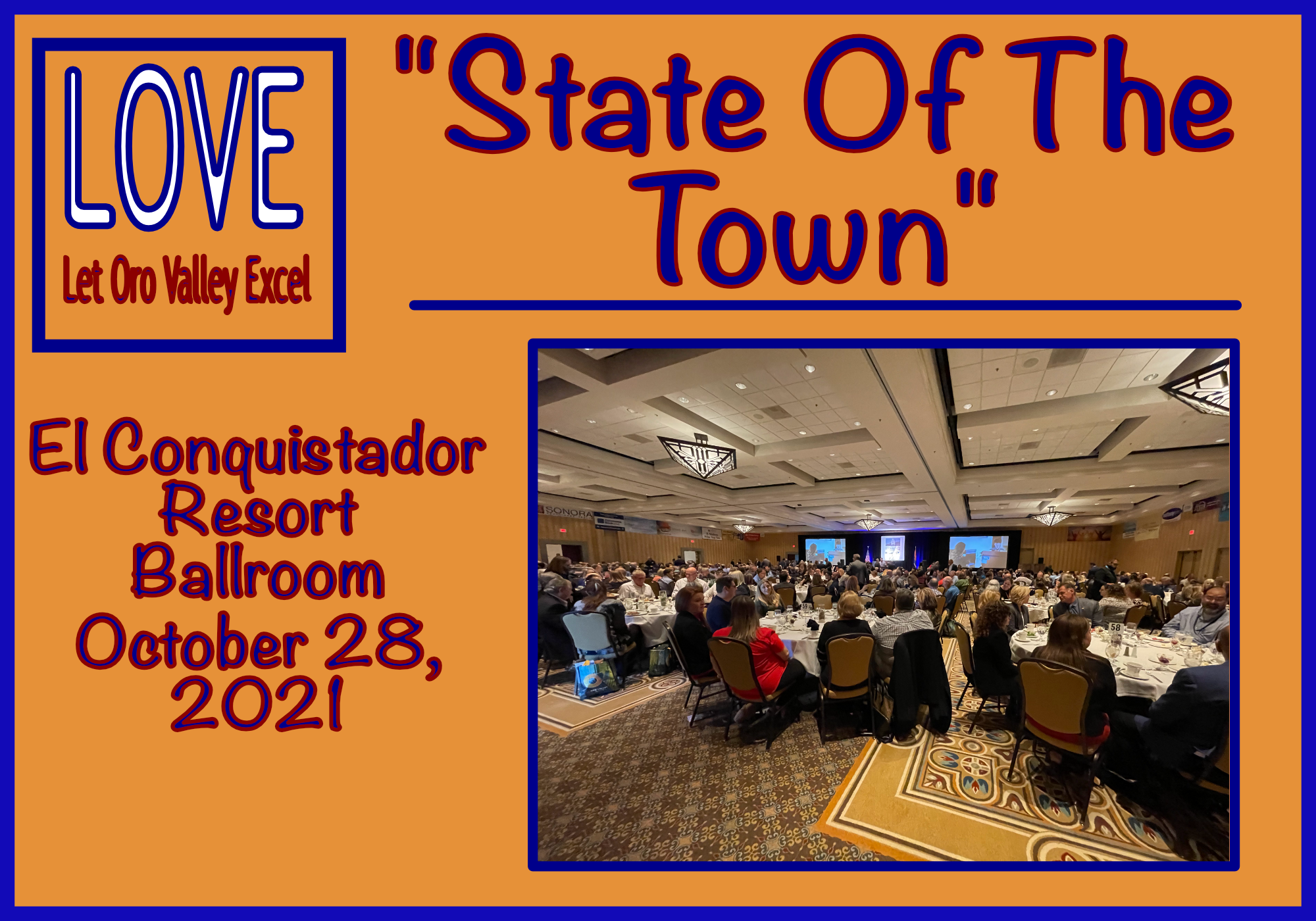
Oro Valley Mayor Joe Winfield delivered the 20th Annual “State of the Town” address to a packed audience at the El Conquistador Ballroom this past Thursday. The event was sponsored annually by the The Greater Oro Valley Chamber of Commerce.

“My goal today is to share with you a message that is framed by optimism and gratitude, for things big and small, that make living, working and recreating in Oro Valley such a blessing.”   

This is the completion of Winfield’s third year in office, a year in which the community faced by continued pandemic challenges. In fact, more than half of Winfield's Mayor term has been leading during this most unusual times.

Staying optimistic... identifying opportunities... innovation...compromise made a huge difference
“Staying optimistic throughout this pandemic has helped us to identify opportunities for overall improvement. I’d like to acknowledge some of the ways this challenge has permanently adjusted the way we do business—for the better. Even difficult times can yield innovation and reasons for gratitude.”

One innovation was the success of the OVSafesteps program, a program in which “… nearly a million dollars in aid [was] distributed to more than 200 local businesses” using CARES Act funding. Another innovation he mentioned were town led “zoom meetings.”

Winfield summarized many of the town’s accomplishments during the year, including the annexation of the 80-acre Westward Look Resort. He noted that compromise [panel right] was the key making this annexation mostly agreeable to all parties.

Completing and funding for the Parks and Recreation Master Plan was another accomplishment: “Council has recently approved expanded use of the half-cent sales tax as well as $25 million in low interest bond funding for park improvements and maintenance. The annual premium of the $25M recreation bond will be paid through the reduction in the golf subsidy, and no property or sales tax increases will be required.” He added that “…golf has remained strong”, referring to the operating performance of the town’s town 18-hold courses.

Winfield also discussed activities our police have undertaken as well as the town’s plan, together with Marana and Metro Water, to build CAP water storage and a more direct water delivery of CAP water from Avra Valley.

Video available
You can watch the Mayor's speech here.

Monday, May 10, 2021

Council Planning To Add $43Million In Debt To Oro Valley In 2022

Two measures: $43 million
The Oro Valley Town Council has passed two measures in the past month that, if approved in the 202-22 budget, will add $43 million in debt to the town. One is the previously reported issuance of $17million in debt to pay down the town's police pension (“PSPRS”) unfunded liability. The other is the incurrence of up to $25million in debt to finance what was to be a ten-year parks and recreation master plan.This is a plan that council has not publicly heard or approved.

“Pay as you go” is out… debt is in
Approval of bonding for the parks plan will abandon this council’s stated position to use “pay as you go” for parks and recreation facilities. This is the position the council affirmed last year when it approved a five year plan to reduce the annual subsidy of municipal golf to no more than $750,000 within five years. Currently, improvements to that facility as to all facilities was to be paid from current fund proceeds. This has been the town’s practice since its inception in 1974.

Cheap interest rates drive both debt decisions
One stated justification for doing this measure is the same was used for supporting the PSPRS debt: “Interest rates are cheap.” The town has estimated that it will be able to issue bonds with a less than 3% interest rate. They may well be able to do so as there is currently a dearth of new municipal bond issues in the market. But, this level of borrowing is a lot for a town of our size. It could reduce the town’s credit rating unless it pledges the sales tax money as collateral on the loan.

Recent reduced golf losses and increased sales tax revenues also drove decision to borrow to fund parks and recreation facilities
In addition to cheap interest rates, there was added rationale given for borrowing to fund the parks: Losses on municipal golf are down because the new golf operator has done a better job of operating the course than the last golf operator; and half-percent sales tax receipts are up. The council expects that both of these events will continue indefinitely.

Measure “shares the wealth” generated by the half-percent sales tax 
The measure was proposed by Mayor Winfield and Vice Mayor Barrett. One of their stated objectives is to bring unity to the town by “sharing the wealth” through use of the half-percent golf sales tax. Barrett observed in her remarks during the meeting that the sales tax is paid by everyone and that, therefore, it should be used for the benefit of everyone. The language of the resolution (included in the panel above) does just that, proposing that bond funds be used to complete Naranja Park and improving other key parks facilities.  You can watch the Vice Mayor’s comments here.

Pending 2021-22 Budget Adoption
The bonding and the use of bond proceeds are included in the town’s tentative budget. Town residents will have the opportunity to opine on any item in the tentative budget in two upcoming town hearings. The bondings will happen in the late summer if they are included in the final budget.

Wednesday, May 5, 2021

Council To Consider Three Items Tonight That Matter To You

There are three items on tonight’s Oro Valley Town Council meeting agenda that are of particular importance to residents. We have previously reported on the three. Click the links if you want to learn more about each.

Broadening the use of the half percent sales tax
The council will consider broadening the use of the half percent “municipal golf- community center” sales tax subsidy. The resolution if approved, would free dollars from the Community Center Fund to be used to support other parks and recreation uses. This is important to you because it will allow the council to use these funds for activities like the build-out of Naranja Park, improvements at Steam Pump Ranch, and completion of the town’s trails system. These are all top priorities of Oro Valley residents per the survey conducted by the town last year. 

This is not a public hearing. That hearing was held at the last council session. The item had been listed on this agenda as a “hearing”; however, that word is now lined-out in the agenda. It may have been the intention of the town to hold a public hearing; however, it could not provide proper 15-day public notice in the “Daily Territorial” for this to happen.


The council conversation on this should be lively.

Study session on the “Town Manager Recommended Budget”
A study session occurs after the regular meeting adjourns. The session is the council’s first look at the 2021-22 Town Manager Recommended Budget. This session is important to you because it involves how your money will be spent next year. There are two big budget non recurring items. One is a decision on funding a $27million plan to pay down the towns public safety pension liability. The other is a decision on funding $26.7million in parks improvements. This includes municipal golf and community center improvements. Decisions on these and other items will be forthcoming in future meetings. Tonight and continuing tomorrow night, the council will hear about the entire budget. We expect department heads to present their request.

The presentations tonight should be informative.

Expansion of Oro Vista apartments
The expansion of the Oro Vista apartments is for building two two-story buildings built on the dirt lot next to Noble Hops Restaurant, facing Lambert Lane. The lot is currently planned for restaurant use. The request is for council to approve a change to the Master Development Plan for the site area and to approve the conceptual site plan.

The council will only discuss this proposal item if one of them pulls it off the consent agenda. Otherwise, it will get blanket approval. Some, perhaps all of the council members visited the site this past Monday. We will learn what they think tonight.

You can view the full agenda for the meeting here. That also provides a link to the zoom meeting.

Tuesday, May 4, 2021

Guest View: Mike Zinkin ~ Why cut taxes when you can reallocate the additional funds instead?


The above question should not surprise anybody
After all, don’t all governments find a way to spend tax dollars, even when there is no longer a need for the original subsidy?

The history of the increased sales tax to fund the Community Center and Golf Courses
On March 1, 2015 Oro Valley initiated an increase of our sales tax from 2% to 2.5% with the additional .5% to be dedicated to the Community Center Fund. The Town had purchased the HSL properties to include golf, tennis, swimming, and a community center. The Town knew that it needed additional revenues to cover this investment.

According to the ordinance (O) 14-17, “an additional revenue source is necessary to subsidize the operating costs and fund the capital needs of the facility over time.” The tax was forecasted to “generate approximately $1.6 - $2 million annually in additional revenues.”

Some more background for the new residents in town
Immediately after the Town Council motion to purchase the HSL property, a PAC called TOOTH (Tee’d Off Over Tax Hike) was formed to gather signatures to invalidate the Council decision. TOOTH was a play on words as the mayor at that time was a dentist. They needed 1,148 signatures to get the referendum on the ballot.

Despite having to collect the signatures over the Christmas holidays (from 12/18/14 to 1/16/15), TOOTH collected 3,158 signatures (more than twice the required amount) only to have the Town Clerk void the petitions due to a minor clerical error. With one day left to gather the required signatures, another PAC was quickly formed and gathered over 1,100 signatures in just 5 hours. This was just shy of the 1,148 they needed to force a ballot issue. As such, the residents never had an opportunity to vote on whether they agreed with the tax increase to fund the Community Center, thus the purchase and accompanying tax became a reality.

Two Choices
In the current budget (FY 2020/21) which ends on June 30th, the dedicated sales tax is now forecasted to provide $2,492,960. So what does our government (Town Council) propose to do? Instead of reducing the tax, they find another reason to spend the additional revenue. Looking ahead to next year, the Town Manager’s Recommended Budget for FY 2021/22 forecasts the sales tax revenue to be $2,857,779.

The increased tax imposed on the People was to subsidize the Community Center Fund. Now that the revenues are well above the initial $1.6 - $2 million specified in the ordinance, the Council has two choices: (1) reduce the tax or, (2) find reasons to spend the additional revenue. They have chosen the latter and I believe that doing so is fiscally irresponsible.

This tax has forced the entire community of 44,000 residents to subsidize fewer than 300 “golf members.” The tax was wrong to begin with and will continue to be wrong if it is no longer going to be spent as originally proposed.

More tax history: The Utility Tax that never went away
Oro Valley already pulled a similar stunt when they passed a temporary 2% Utility Tax in 2006 to fund 18.5 new staff positions, mostly in the police department. The tax was supposed to sunset in 2009, but in 2009 the Loomis council voted to extend it at the 2% level with no sunset clause. Then, in 2010, the Hiremath council increased it to 4% and we have never gotten rid of this “temporary” tax.

Oro Valley should only tax for what it needs and nothing else.

- - -
Mike Zinkin and his wife have lived in Oro Valley since 1998. He served on the Oro Valley Development Review Board from 2005-2009, the Board of Adjustment from 2011-2012, and the Town Council from 2012-2016. He was named a Fellow for the National League of Cities. He was a member of the NLC Steering Committee for Community and Economic Development and a member of the Arizona League of Cities Budget and Economic Development Committee. He was an Air Traffic Controller for 30 years. Mike has a Bachelor’s degree in history and government from the University of Arizona and a Master’s degree in Social and Philosophical Foundations of Education from California State University, Northridge.

Monday, May 3, 2021

The Pandemic Saved Oro Valley Municipal Golf

A call to broaden the use of the half percent sales tax subsidy
Wednesday, the the Oro Valley Town Council will discuss broadening the use of the existing half-percent sales tax subsidy. That subsidy was enacted in 2015 to subsidize the operations of 45 holes of golf; and to fund the conversion of a clubhouse into a community center.

The total amount of the subsidy tax now collected exceeds the targeted initial funding. It is expected that this will continue in the future. It is because of this that council will consider broadening the use of these tax dollars. In 2015, the town estimated that the subsidy would be $2 million annually. At that time, the sport of golf was in decline locally and nationally. The clubhouse was in disarray. A subsidy was the only way the town could maintain the property.

The pandemic saved Oro Valley municipal golf by making it financially sustainable
The pandemic did so in two ways. 

First, people returned to the links because golf was one of the few activities they could do and still maintain social distance.  Nationally, there are more that a half million more players in 2020 than in 2019.  This translated into a 14% increase in rounds played nationally, despite the fact that many of the nations' courses closed for at least some period of time. Oro Valley municipal golf rounds have also increased.  The result is that Oro Valley municipal golf revenues are expected to be $3.5 million this year. 

Second, local sales tax revenues increased. This was because residents could not spend dollars in stores outside Oro Valley. Stores were closed. Instead, residents shifted to online shopping. 

Everything purchased online by an Oro Valley resident includes an Oro Valley sales tax. Oro Valley would not have accrued this sales tax revenue had the resident travelled to and physically purchased these goods elsewhere, 

The financial result this year is that the town projects that the half percent sales tax subsidy will exceed $2.8 million. That’s 40% more than the original target of $2 million.

This year the town projects that municipal golf financial performance will be close to its subsidy target is 
When all factors are considered, municipal golf financial results are expected to be less than the $750,000 annual council-set sales tax subsidy target. Per the town’s February financial report: “The year-end sales tax support for golf operations is estimated to be $697,208. This figure includes a projected net [loss of] $(905,284) for contracted golf operations, [adjusted for] $125,000 in outside HOA contributions, and $83,076 in local sales taxes generated from golf related operations.” 

A trend or blip? Either way its worth celebrating
What will happen once the pandemic is over? Will those who jumped into golf lose interest? Will players lose the time to play once they are no longer working from home? Will people reduce their online purchases in favor of in-person retail store visits? What will golf operators do to keep the momentum going? 

Time will tell. 

In the meantime, it's good to celebrate even a “blip” when it comes to the financial results of Oro Valley Municipal Golf.
---

Wednesday, April 14, 2021

Proposal To Be Heard On Broadening The Use Of The Half Percent Sales Tax Levy

Enacted in 2015, revenues support municipal golf losses
The Oro Valley Town Council will hold a public hearing on the half percent Community Center/Municipal Golf sales tax. That tax was enacted by the Hiremath Council in 2015 to pay for the substantial losses that were projected from operating the community center on the golf courses. The estimated amount of the half percent sales tax was $2million.

Sales tax revenues more than anticipated
As LOVE has reported over time, golf and community center losses have been huge; but, recently the losses have narrowed because the pandemic has increased golf course use. In addition, sales tax revenues have increased over the six years to an estimated $2.5million. 

Municipal golf’s exclusive use of revenues at stake
The public hearing will be held at next week’s council meeting. The proposal is to broaden the use of these funds to pay for other parks and recreation facilities, amenities and operations.

What is at stake here is what appears to be in the minds of some members of council and residents a belief that the half percent revenue stream belongs to the golf courses. For example, during one council meeting Council Member Solomon said something like: “We have the money from the sales tax, so let’s just open the Pusch Ridge course.” Some residents in favor of the measure wondered why the course wasn't getting its "share" of the revenues. 

Expect a large turnout at the hearing
There are some who will be upset about any change in the use of this money. These are people who live along the golf course. They lobbied successfully last year to keep 36-holes of golf operating. They wore “green T-shirts” to the Council meetings, spoke in great numbers. It appeared to some that this high level of participation intimidated the some members of council.

Council set target subsidy levels
The council decided, in 2020, to retain 36-holes of golf and to lease the Pusch Ridge facility. In doing so, they set a subsidy target level of $750,000 within four years. That would be beyond the sunset of Winfield council majority. If that subsidy level is achieved, $1.8 million in sales tax revenue from the half-cent levy would be available for other uses. So, it makes sense to either rescind these sales tax dollars or direct them to other use.

Change in use requires council resolution
The original resolution for the sales tax levy earmarked the funds specifically for the golf course community center. Thus any change in the use of those funds has to be approved through another revenue resolution of counsel. That’s the reason for the meeting.

Wednesday, February 24, 2021

Mayor Winfield Proclaims Oro Valley "A Golf Community"...Enthusiastic About Reopening Pusch View Golf Course

Winfield: “We are a golf community.”
Mayor Winfield declared that Oro Valley is a golf community at last week’s council meeting (4h21m 2/17/21 Oro Valley Town Council Meeting) This, he says, is supported by last year’s statistically valid resident survey done as part of the now in-progress Parks and Recreation ten year master plan project. 

This survey was one of several reasons he gave for championing the reopening and three year commitment to operating the Pusch Ridge Course. Other reasons he gave are an uptick in golf usage because of the Pandemic; and his assertion that the town owned golf courses are meeting their subsidy metrics. According to Winfield, the only problem with Pusch View nine hole golf course is that it has been under-promoted.

Winfield "Kicks the Can" down the road
When Winfield and fellow council members Steve Solomon and Mo Greene have their way, the course will operate starting November 1. It will close each year in May.  Three years will be the  horizon for determining what will happen next to the course. By that time, the Mayor will have completed his term. It will be someone else's challenge.

Open space option summarily rejected
The idea of allowing the property to revert to its natural state or turning it into a walking preserve was summarily rejected by Winfield and council at the February 17 council meeting.  They decided that that solution was too expensive. They based that on numbers provided by town staff. No council member challenged these numbers or the basis for them. As LOVE has previously noted, the natural space option is least costly over a five year planning horizon.

Council never considered the Pusch View Course's history of failure
The council did not discuss the operating history of this course during the meeting, a history that includes:
  • The Town purchased three financially failed golf courses in 2014 from HSL Properties. HSL's purchase of the El Conquistador resort was financially feasible only if the Town took over these courses. That is what the Town did. The Town council raised the sales tax a half cent to subsidize the losses. The subside continues to this day.
  • Once it owned the Pusch View Course, the Town observed that the course was underused and worked to market it. There was no success. 
  • In 2016, the Town then tried to turn the course into a family entertainment center, adding things like larger holes on the green and Frisbee Golf. That didn't work to stimulate use either. You can read about the Town's enthusiasm for that here.
  • In 2020, Town Council voted to discontinue the course so that the Town could lease the course back to HSL.
Winfield, Solomon and Greene must believe that the pandemic driven resurgence in course use in Oro Valley is going to continue after the Pandemic passes. They may be right. On the other hand, the fundamental reasons the sport of golf is in decline has not changed. Read about those things here.

Tim Bohen was the only council member to speak against reopening the course
Council Member Tim Bohen stated that the Town has excess golf inventory even in today's hot market.  “I just wanted to let the people know at Pusch Ridge Course: I’ve walked their course a couple of times. I’ve talked them. I have sympathy for their plight." He continued: "I really do believe as a responsible entity, we have inventory that we already have that we don’t consume and that is why I can’t support this.”

Winfield did not want a council resolution.  Jacobs insisted they that there be one.
Mayor Winfield stated at several different points during the February 17 council discussion that Town Manager Jacobs had enough information from listening to the discussion to formulate what town staff was to do next. He did not want a formal vote (“resolution”). Town Manager Jacobs insisted that there be one: "You tell me what. I will give you the how." 

RFP to lease Pusch View Golf included in resolution
Two of the three other council members, Vice Mayor Barrett and Council Member Josh Nicolson, successfully fought to insure that the resolution include directing the Town Manager to formulate  a request for proposal ("RFP") for someone to lease the facility.  That RFP will be issued and analyzed over the next seven months if approved by council.


The Resolution to reopen Pusch View Golf Course
Council passed the following resolution by a 6-1 vote: 

Resolved: “Town council directs staff to return with a plan for operation of the Pusch Ridge Golf course to be evaluated within three years as to its continued feasibility, capital improvement requirements while also looking at alternatives to look at water usage and potential new configurations and a third party lease.” 

Town Manager Jacobs will present the plan at the March 17 Town Council Meeting.
---

Wednesday, February 17, 2021

The Watchdog Report: The $750,000 Dollar Question


Who remembers the letter to the Council from the Town Manager dated September 4, 2019?
Yes, this is a loaded question because I seriously doubt if any of the council members would remember it since it was communicated almost six months ago. Additionally, neither Council members Greene nor Bohen were on Council when the above communication was written.

However, this is an important document because it offers the Town Manager’s forecast with the important caveat that the Mayor stipulated -- that the 36-hole option would require no more than a $750,000 tax subsidy.

Ms. Jacobs’ report was full of prerequisites that had to be fulfilled before the maximum subsidy of $750,000 could be accomplished. One of the requirements was that “The irrigation replacement and general refurbishment of both 18-hole courses was completed.” This had not even been started and the costs for just the irrigation improvements for the Conquistador course alone are over $1 million. This money is to come from the existing Community Center Fund, when, and if, it becomes available.

The forecasted target dates
In her report Ms. Jacobs states:
“By adding in the sales taxes collected by Troon for golf ($46,500), the utility sales tax for the water ($40,400), and the projected additional revenue from opening up the member course to day-play ($175,000), the subsidy is projected to meet the $750,000 target by FY 22/23. If the HOA contribution discussed below is factored into the pro forma, the subsidy is projected to meet the $750,000 target by FY 21/22.”
Jacobs goes on to say:
“According to the pro formas attached, the $750,000 tax subsidy target is achievable by FY 21/22 and possibly sooner if revenue collections remain strong. The potential action plan and accompanying pro formas included in this memorandum more fully demonstrate the financial viability.”

You can read the entire report HERE.  

Since this communication was written almost six months ago, nothing has been accomplished toward improving the courses because the money is not there. Currently available financials from the first 5 months of FY 2020/21 (July-Nov) reveal that the tax subsidy is already over $1 million.

The current formula is not working
How many communications are going to be written, and forgotten, before the Council understands that the 36-hole formula is not working and will not work?

The Mayor and 3 Council members ran on a platform to do something about the golf financial drain. The meetings and abuse they took from the “Green Shirts” are over.

Although golf is up 30% nationwide due to the pandemic, losses continue for Oro Valley due to the fact that our golfing population cannot support one entity owning 36 holes. The Town could possibly support the losses with just 18 holes.

Mr. Lopez and HSL want nothing to do with golf as witnessed by their refusal to take on the 9-hole Pusch Ridge course. This is further evidence that golf does not make good business sense.

Oro Valley is made up of more neighborhoods than Canada Hills and the Villages. In fact, the vast majority of Oro Valley residents live outside those communities. What it is going to take for the council to represent the entire Town, and not just one faction?

---
Mike Zinkin and his wife have lived in Oro Valley since 1998. He served on the Oro Valley Development Review Board from 2005-2009, the Board of Adjustment from 2011-2012, and the Town Council from 2012-2016. He was named a Fellow for the National League of Cities. He was a member of the NLC Steering Committee for Community and Economic Development and a member of the Arizona League of Cities Budget and Economic Development Committee. He was an Air Traffic Controller for 30 years. Mike has a Bachelor’s degree in history and government from the University of Arizona and a Master’s degree in Social and Philosophical Foundations of Education from California State University, Northridge.

Monday, February 8, 2021

Water Rate Increase On The Horizon

Water Commission to discuss tonight
Tonight, the Oro Valley Water Commission will hear about a water rate increase from town Water Director Peter Abraham. Abraham plans to offer a water rate increases to council every year. Tonight’s discussion is the first step in the process for a 2021 rate increase.

Potable water rates would increase minimally
The cost of the water consumed will increase minimally, if a proposed water rate increase is approved by council in June. According to Abraham, a user of 15,000 gallons would see an increase of a bit more than a dollar a month. The bill would be about $42 for water. He contends that this cost is 10% less than Metro Water and Marana Water. He is making no recommendation to change the groundwater preservation fee. This is $.90 per gallon consumed. As we have noted previously, much of the cost of an Oro Valley water bill is from fees and taxes added on to the cost of water.

Reclaimed water commodity rate would increase 10 cents per thousand gallons
Under his proposal, the reclaimed water rate would increase by .10 per thousand gallons. Golf irrigation is the primary consumer of reclaimed water. A typical 18-hole course consumes 10 million gallons a month. The cost for this is almost $27,000. The proposed change would increase that to $27,930.

Potable water rate continues to subsidize golf courses

"The town's reclaimed water rate is based on the cost of providing reclaimed water. However, the cost does not include 79% of the debt service cost incurred in building the reclaimed water system. According to town water Director Peter Abraham, reclaimed water would be more expensive than potable water if the the total debt service were included in the reclaimed water rate. This would provide a disincentive if the were set at this level. Town policy is to set the reclaimed water rate at the cost of service, but not more than the potable rate. Town staff and the towns' water commission are recommending to council that this policy remain."

The rate changes this year are comparable for both the potable and reclaimed water rates. This indicates that this subsidy policy continues.

Potable water cost also subsidizes golf because residents pay a sales tax on water used. A half cent of that sales tax is earmarked to support golf.

The town council will hold a public hearing in June on the rate increase. If approved, it will take effect on August 1.
---

Tuesday, October 20, 2020

Fiscal Responsibility, Municipal Golf and Quality of Life Are "Top Of Mind" To LOVE Readers

What you want town council to accomplish
Fiscal responsibility, golf spending rationalization and quality of life in Oro Valley are top of mind issues for LOVE readers.  This conclusion is based on an online survey we conducted the week of October 5. We asked: "What is the one thing you want to see the new town council accomplish?"

Top Challenge: Be Fiscally Responsible
Respondents want the town to be strong financially. This is driven by the uncertain near and long term impact of Covid-19 related business and social restrictions.  

Oro Valley is an "older community." As one resident put it:  "Hold the line on spending. Many retired citizens in Oro Valley are on fixed income." Another noted that they want the town "to be able to handle unknown drains on the Town's funds from unexpected issues (like impact of Covid-19), and to be able to assist and encourage small businesses to start up successfully here in Oro Valley."

Source: Week of October 5 LOVE Survey
Others voiced similar concerns.
  • "Balance the budget and make the tough decisions that gets us there without playing games with the financials."
  • "More transparency is needed. Spending must be monitored more closely. Constituents should have the final voice as to what goes on."
There was also a concern voiced that Oro Valley's spending is inflated after years of continual spending increases since 2010. "Too much fat in budgets result in taxes higher than needed." 

Number Two: Rationalize spending on Municipal Golf 
The town's subsidizing the operation of two golf courses through a sales tax is still not a settled issue among some. They say that Oro Valley municipal golf benefits few at the expense of many. Apparently, the town's plan to reduce golf subsidy to no more than $750,000 by 2022 does not satisfy them; or perhaps they are not aware of the plan approved by council in January.
  • "Eliminate all expenses associated associated with the golf courses and community center, and stop the associated sales tax support."
  • "The expense and the paltry number of community members it actually serves. Open park space behind the homes along the course will not negatively impact property values, lots with open space behind them sell first and for a significant premium over lots that abut other lots. It's not like the course is being replaced with apartments and strip malls."
Number Three: Improve The "Quality of Life"
Some want the town to improve the town's park system. Doing such "Bolsters property values, provides recreational opportunity, promotes sense of community, attracts families" According to some, it would also help the town "Regain the reputation of one of the best places to live in the U.S."

One way to do this is to "Preserve the Vistoso golf course as a green space because it will define our town's vision of a great place to live."

Another resident noted that Oro Valley's focus on cluster zoning and small home lots is actually driving potential residents away."Stop permitting those developments with the houses sitting almost on top of each other with NO back yards! Families with kids need room for them to play. Maybe do some gardening."
---
Note: The results of our survey are by no means statistically representative of the thoughts of the entire community. They do provide some insight into what LOVE readers would like to see happen.

Wednesday, September 16, 2020

Oro Valley Weathers The Financial Storm.... So Far

Council discusses 2020 year end results tonight
Tonight, town council will hear the unaudited financial results of three of the towns funds for the year ended 2020: The General Fund, the community center fund and the Highway Fund. Results have been uncertain because of the unknown financial impact of the pandemic.  It appears the town has weathered the storm.

General Fund Balance Increased to $21.4 million
The general fund pays for all of the town's administrative functions and the police department. It is the fund that would be most impacted by the pandemic since sales tax collections are about half of total general fund revenues.  Year end balance is expected to increase by $1.8 million from the beginning of the year to $21.4 million.

(Click image to enlarge)
General Fund revenues 6% over budget
The town took measures early in March to slow spending and freeze hiring. The objective was to 
"hunker down" and be prepared for the worst. That game plan worked through the end of the year. The total estimated year end was 6% over budget, totaling $41.7 million.  Local sales tax revenues and interest income exceeded budget by $2.5 million. Inter-government funds and charges for services were $800,000 under budget.

General Fund spending 5% under budget
Total General Fund spending was $39.9 million. This was $2.1 (5%) million under budget. Spending in all departments except for legal were under budget. The Police and the Parks and Recreation Departments spent $1.2 million less than budget.

Community Center essentially on budget
Community Center revenue was $175,000 less than budget. Spending was $285,000 less than plan. The center received sales tax subsidy of $2.9 million. This amount is far more than the $750,000 sales tax subsidy target that was set by the town council last November. That subsidy level is to be achieved by 2023.  Golf revenues and membership fees were 9% over budget. Most other revenue sources were under budget because the Community Center has been closed since March.

Highway Fund slightly over budget
"In the Highway Fund, total actual revenues for the year came in over budget by approximately $272,000 or 7.2%. Expenditures for the year were under budget by roughly $12,000 or 0.3%. Overall, the Highway Fund ended the year with a decrease in fund balance of $53,343 (note that the planned budgeted decrease in fund balance was $337,241) (source)
---