Showing posts with label OVHS. Show all posts

Tuesday, August 19, 2025

While We Were Away...

Sidles and Adler retire
Longtime Town of Oro Valley employees Margie Adler and Tobin Sidles retired this August. Adler, who served as the town’s economic development specialist since 2015, was recognized for her dedication to helping local businesses and for delivering regular economic updates to the community. According to Mayor Hiremeth, Margit was "...the face of small business for Oro Valley." Sidles, the Town’s Legal Services Department Director, retired after 35 years of service and was honored with the State Bar of Arizona’s 2025 John Belatti Public Lawyer Career Achievement Award for his commitment to public service and ethical legal practice. Both leave behind strong legacies in their respective fields.

Naranja Drive path construction begins this fall
Construction of the Naranja Drive Multi-Use Path is scheduled to begin in mid-September 2025, following the Oro Valley Town Council’s unanimous approval of final funding on June 30. The 1.75-mile, 10-foot-wide paved path will run along the north side of Naranja Drive from La Cañada Drive to First Avenue, providing safer access for walkers, cyclists, and joggers. Nearly 91% of the project’s $3.99 million cost is covered by federal and regional transportation grants, with the Town contributing $341,000 through local project savings. The Arizona Department of Transportation will oversee the work, which is expected to be completed by March 2026. Town leaders say the new path will improve safety and connectivity for the community (Source: Town of Oro Valley Media Release)

Napier announces candidacy for Mayor
There is an important election coming up this summer. It is an election for the mayor of the town. There are also three council seats that are up for election. Thirty-year  Oro Valley resident Mark Napier has announced that he will be running for council. In his August 13 Facebook announcement Napier notes: "Oro Valley has provided so much for my family and me over the years: Safe neighborhoods, beautiful open spaces, good parks, and an incredible sense of community. This is why I am running for Mayor in the August 2026 election - to ensure we preserve our community character and values, while responsibly and strategically planning for our future." (Source)

A few notable updates from the July town manager "Executive Report To Council"
Several smaller updates stand out in the July 2025 Town Manager’s Executive Report. The Town Council approved right-of-way license agreements for new high-speed internet providers, paving the way for expanded service in Oro Valley. Only two new short-term rental licenses were issued in June, with the vast majority of these rentals being single-family homes. Every available segment in the Town’s Adopt-A-Road program is now spoken for, reflecting strong community participation. Transit ride numbers increased slightly to nearly 68,000 rides in fiscal year 2024/25, though monthly usage appears to be leveling out.

Drones overhead? Know your rights
Oro Valley police addressed common concerns in the July 2025 CrimeFighter newsletter, reaffirming that drone flights over private property—such as backyard and rooftops—are legal under federal jurisdiction. As Oro Valley lies in Class G airspace, the Federal Aviation Administration (FAA) holds controlling authority over drone operations, and the town does not impose additional airspace restrictions. While police oversee public safety in flight situations, they don’t regulate drone operations. The only limits are standard FAA rules: drones must fly below 400 feet, avoid sustained flights over people or moving vehicles, and refrain from capturing images inside private yards without consent. Homeowners uncomfortable with overhead drones are encouraged to reach out to OVPD for guidance. (Source: OVPD Crimefighter, July, 2025)

Pusch Ridge Golf Course seeks Audubon Cooperative Sanctuary Program Certification
The Pusch Ridge Golf Course has joined the Audubon Cooperative Sanctuary Program for Golf Courses, launching a comprehensive process to enhance wildlife habitat, promote conservation, and improve environmental stewardship. This signals a commitment to protecting the natural resources that make the course unique, benefiting not only golfers but also residents and wildlife. Achieving certification will mean the course meets high standards for habitat management, water conservation, and chemical safety. It will place Pusch Ridge among a select group of environmentally responsible courses in the region and show Oro Valley’s leadership in balancing recreation with conservation. The project will also offer new volunteer opportunities for those who want to support sustainability and help shape the future of the golf course. (Source: Friends of Pusch Ridge Golf media newsletter, 07-29-25)    

Draft of OV’s Path Forward coming later this fall
Residents can expect the full draft of OV’s Path Forward—Oro Valley’s next 10-year action plan—to be released later this fall, offering the first comprehensive view of proposed goals, policies, and action steps developed with input from more than 100 residents during Phase 2 earlier this year . The initial 30% draft was completed by May 2025, and now includes 31 goals, 78 policies, and over 255 action items organized into themes such as sustainability, land use, parks, and public safety. The draft marks a point when the community can review, refine, and ensure that the final plan reflects residents’ priorities before it goes to a public vote in November 2026.

Oro Valley secures $3 million for water sustainability
The Oro Valley Water Utility has secured the full $3 million grant from the Water Infrastructure Finance Authority of Arizona to support the Northwest Recharge and Recovery Delivery System (NWRRDS). This grant was fully anticipated by the town and it's planning so it's no surprise. This regional project—done in partnership with Marana and the Metro Water District—will allow Oro Valley to store and recover renewable water supplies, significantly reducing groundwater pumping and helping stabilize aquifer levels. For residents, this means improved water security, better water quality, and less risk of land subsidence. The grant also eases long-term costs for customers by offsetting infrastructure expenses without requiring repayment. Once completed in mid-2026, the system will provide reliable renewable water to over 115,000 customers across northwest Tucson. (Source: Town of Oro Valley Media Release)

The OVHS has had a very busy summer 
The Oro Valley Historical Society marked its 20th anniversary with a summer full of projects and community milestones. The Society launched a new website with the help of Red Coyote Services and dedicated volunteer Lynn Zoyiopoulos, rejuvenated the Heritage Garden with Home Depot’s support, and—thanks to a major Chamber of Commerce Foundation donation—installed eight new interpretive signs at Steam Pump Ranch. OVHS volunteers completed updates to the Procter-Leiber family tree, advanced the digitization of the Society’s historic records, and expanded outreach by meeting with other regional historical groups. They also hosted the Tucson Paranormal Society for a special museum investigation and celebrated Jim Williams, who received a national award for his book, “Oro Valley: The First Fifty Years.” All of this activity sets the stage for a full fall calendar, new exhibits, and collaborative events at Steam Pump Ranch. (Source: OVHS August 2025 Update).
- - -

Thursday, May 29, 2025

Bits and Pieces

BFC review of 2026 Town Manager’s Budget checks a box for town manager, but adds little value to the budget process
Oro Valley’s Budget and Finance Commission (BFC), established in 2019, has not consistently participated in the review of the Town Manager’s Recommended Budget (TMRB). While it was not involved in last year’s FY 2025 budget process, it has occasionally received presentations in prior years without playing a formal advisory role. This year was much the same as that, as staff presented the TMRB to the Commission on May 20.

The BFC did not make a substantive contribution to the development of the TMRB at the meeting. This is because the budget had already been developed and finalized for presentation by the time the BFC reviewed it. The Commission’s role was limited to reviewing and asking clarifying questions. While their discussion helped reinforce certain priorities, like fiscal sustainability and transparency, their comments led to no changes in the budget. Thus, their involvement seemed more like checking a box in the process of completing the TMRB, rather than seeking meaningful input during its development.

Town exploring new taxes to fund future capital needs
At the May 20 meeting of the Budget and Finance Commission, Town Manager Jeff Wilkins introduced a discussion about three potential new revenue sources that are not currently part of the Town Manager’s Recommended Budget. These include a use tax, a telecommunications tax, and a commercial rental tax—all of which are common in nearby municipalities like Tucson, Marana, and Sahuarita but are not currently levied in Oro Valley. Wilkins described these taxes as a way to diversify the town’s revenue base, enhance financial stability, and create a dedicated funding stream for capital needs such as roads and public safety infrastructure.

Although these proposed taxes are not included in the fiscal year 2025–26 town manager recommended budget, Wilkins used the budget presentation to make the case for exploring them. He emphasized that the town’s five-year forecast shows a capital funding shortfall by year five, and that relying solely on existing revenue sources may not be sustainable. According to Wilkins, the proposed taxes could generate between $900,000 and $1.8 million annually, and Wilkins suggested dedicating all proceeds to capital—possibly even restricting it further to public safety. Commissioners responded with questions about operational costs associated with capital projects and whether future councils would be overly constrained by strict earmarking of these new revenues. 

Budget and finance commission recommends approval of $2.84 million contribution to fully fund PSPRS for FY 2026
At its May 20 meeting, the Oro Valley Budget and Finance Commission voted unanimously to recommend Council approval of the FY 2026 PSPRS pension funding policy. The policy includes a total contribution of $2.84 million to the police retirement plan—$738,817 as required by actuarial valuation and an additional $2.1 million in excess of that requirement. This extra payment is intended to eliminate the plan’s remaining unfunded liability and bring the plan to 100% funded status by June 30, 2026. Commission members supported the action after confirming the plan was financially feasible and aligned with the Council’s long-standing goal to fully fund the police pension plan.

New signs, tours, and research projects featured in OVHS May update
The Oro Valley Historical Society’s (OVHS) May newsletter highlights several new initiatives. Eight interpretive signs for Steam Pump Ranch are now in production and expected to be installed by early June, offering year-round self-guided tours.  The Society also launched a redesigned website in April and is seeking volunteers to help with content and outreach. Additional efforts include digitizing historical audiovisual materials, creating an educational display about George Pusch, and continuing research on the families who shaped Oro Valley’s early history.

Disc golf returns with summer vibes and mountain views
Oro Valley’s Pusch Ridge Disc Golf Course is reopening for summer play starting  this Saturday, Nestled at the base of the Santa Catalina Mountains, the 18-hole course offers daily play from 7 a.m. to 7 p.m. through September 21. New this year: weekend golf carts, short tees for novice players, and PDGA-sanctioned league play every Friday at 4:30 p.m. Tee times are required on weekends (7–11 a.m.) via PlayOV.com, while weekday play is first-come, first-served. At $10 per round, it’s a fun, affordable way to enjoy the outdoors—and the scenery can’t be beat. (Source: Town of Oro Valley Press release)
- - -


Thursday, December 5, 2024

Preserving Oro Valley’s Legacy: Historical Society Secures Grant for Steam Pump Ranch Enhancements

Oro Valley Historical Society receives a generous grant
On Monday, November 25, the Oro Valley Historical Society gratefully accepted a $3,600.00 grant from the Oro Valley Chamber Foundation at the Foundation Board meeting. In attendance at the meeting were Founder of the Society, Pat Spoerl; current President, Denzil Walker; Board member, Bob Kellar; Encore Fellowship volunteer, Lynn Zoyiopoulos; and Otton Suarez, supporter and Board member of the Foundation.

Purpose of the grant
The grant will be used to research and design and hire a company to manufacture new permanent signs at the historic Steam Pump Ranch. The Society has already put in place a committee to work on this very important project, which will help preserve the historic heart of Oro Valley and its stories.

Significance of the project

"OVHS is pleased to have been awarded this grant from the Oro Valley Chamber of Commerce Foundation. The grant is very timely in making Oro Valley's heritage more accessible to all who visit Steam Pump Ranch. Permanent outdoor interpretive signs that explain the history of the buildings and tell stories of the people who lived and worked in them will be available to those who visit the Ranch any time between sunrise and sunset," said Pat Spoerl, Founder.

Gratitude for the grant
The Oro Valley Historical Society is so grateful to the Oro Valley Chamber Foundation for this grant and the impact it will have on our ability to support our mission to promote research, preservation, education, and dissemination of history related to the Greater Oro Valley area. Thank you for joining us to keep Oro Valley history alive!
- - -

Photo caption
From left to right: Bob Kellar, Board Member; Lynn Zoyiopoulos, Encore Fellow volunteer; Pat Spoerl, Founder; Otton Suarez, Supporter; Denzil Walker, President.

Thursday, October 3, 2024

Discover Exciting Historical Society Fall Events and Volunteer Opportunities at Steam Pump Ranch

Celebrate fall at Steam Pump Ranch
It’s October, and what a great fall season we’ve had at historic Steam Pump Ranch! 

Santa Catalina exhibit this Saturday
Many of you have visited the Pusch House Museum to see our current exhibit, The Santa Catalinas: Our Magnificent Mountains. This exhibit is available to view on Saturday, October 5 and 12, after which we’ll change exhibits to A Salute to the Military: Recognizing Military Service, Both Past and Present, which will be on display until November 23. (Please note, the museum will be closed on November 30.)

October 12: E
xciting raffle and Jeep display
And look what's happening on October 12 for Jim Click Raffle supporters—you’ll have the opportunity to see this year’s First Place Prize, the 2024 Jeep Wrangler Rubicon 4xe Plug-in Hybrid (MSRP starting at $61,180), at Steam Pump Ranch! The Society will have it on display, so you can envision what it would be like to win it for your family. We’ll be selling raffle tickets that day (as we do every Saturday until November 23), and you could be the lucky winner! 

Tickets are only $25 each or 5 for $100, and all proceeds from ticket sales support the Oro Valley Historical Society, thanks to the generosity of Jim Click. So, visit the Ranch on October 12 to buy a ticket, see the Museum, indulge in the goodies at the Heirloom Farmers Market, and discover what treasures the vendors have brought for you.

October 15: Special author event at Oro Valley Public Library
In keeping with our military theme in October, on October 15 at 2 p.m. at the Oro Valley Public Library, we will have the honor of hearing from Venetia Hobson Lewis, author of the award-winning novel Changing Woman: A Novel of the Camp Grant Massacre. This novel weaves together the stories of the actual perpetrators with fictional characters to recreate the events of 1871, both in relation to the massacre and their private lives.

Visit the museum and library for free
Visits to the Museum and the presentation at the library are complimentary, and donations are gladly accepted. We hope you will join us to help keep Oro Valley history alive—history loves company!

Join the Oro Valley Historical Society
The Oro Valley Historical Society is a 501(c)(3) non-profit volunteer organization, whose mission is “To promote research, preservation, education, and dissemination of historical information related to the greater Oro Valley area.” We invite you to become a supporter and help keep Oro Valley history alive.

Volunteer opportunities available
We are currently looking for enthusiastic volunteers who are interested in becoming docents at the Pusch House Museum and for Steam Pump Ranch tours. Also, if you love social media, fundraising, or gardening, we could use your skills—there’s something for everyone because history loves company! Contact us at https://www.ovhistory.org.
- - -

Thursday, September 5, 2024

OVHS Returns to Steam Pump Ranch: Exciting Exhibits, Events, and Summer Highlights

The Oro Valley Historical Society Returns to Steam Pump Ranch
It’s September, and the Oro Valley Historical Society is back at the Ranch – Steam Pump Ranch, that is!

New Exhibit at the Pusch House Museum
The Pusch House Museum will open on September 7 from 9 a.m. to noon to welcome visitors with the new exhibit – The Santa Catalinas: Our Magnificent Mountains. This exhibit will be available for viewing every Saturday until October 12 and will include information about the geology, settlers, mining, and Catalina State Park. You will surely be amazed at the details you’ll learn about the beautiful mountains we are lucky enough to see every day.

Ranger Talk: Catalina State Park’s History and Future
In conjunction with the exhibit, we are fortunate to have an opportunity to hear from an actual Catalina State Park ranger on Tuesday, September 10 at the Oro Valley Public Library. Mr. Pat Damiani will speak to us about Catalina State Park: Past, Present, and Future at 2 p.m. Both the talk and the exhibit at the museum are free, with donations gladly accepted.

What Did We Do Over the Summer?

Do you wonder what we do over the summer months? Well, here’s a snapshot...

Engaging Oro Valley Students During History Week
In June, our docents had the opportunity to show Oro Valley students the Steam Pump Ranch and Pusch House Museum during history week, celebrated by the Oro Valley Parks and Recreation Department’s summer camps. The Town team did a great job introducing the Ranch and its early inhabitants, while students could tour the museum’s exhibits to answer some of the questions that came up.
Honoring Henry Zipf with a Memorial Bench
That month, we also had the opportunity to honor Henry Zipf, a past president, lifetime member, and great-grandson of George Pusch, at a dedication ceremony for the memorial bench purchased with donations received after his passing last year. The timing was beautiful, as we dedicated the bench on what would have been his 68th birthday. Come to the Pusch House Museum to see where it sits today, overlooking the Pusch House and the beautiful Pusch Ridge!
A Presentation from Local Historian Roxy Johnson
But not everything we did in June was at the Ranch. Another of our past presidents, and daughter of early homesteaders in Oro Valley, Roxy Johnson, gave a presentation to residents of the Country Club of La Cholla about her family’s life long before we became the Town of Oro Valley. Just a reminder – Society docents are very willing to give presentations to all groups and can even arrange private tours of the Ranch for interested parties. Use the Contact link on our website (https://www.ovhistory.org) to make arrangements.

Ongoing Projects and Updates
Throughout the summer, we have been busy cataloging some of our journals to make research easier, working with the Town’s Communications Department to edit oral history videos that will be on our website soon, designing a protective frame for a silk shawl owned by Gertrude Pusch, daughter of George and Mathilda Pusch, replacing an informational sign that went missing during the season, adding a permanent informational sign at the Steam Pump Building, meeting with the Town about our lease agreement, and collaborating with Home Depot on upgrading our Heritage Garden. More to come on all of those!

Join Us This Season at Steam Pump Ranch
We hope to see you at the Ranch this season – remember, volunteers are always welcome, tours of the Pusch House Museum are complimentary, and donations are gladly accepted!
- - -

Thursday, April 4, 2024

OVHS: It's A Birthday

It’s a birthday!!
Oro Valley turns 50 years old this month, and the Oro Valley Historical Society is ready to celebrate!

We'll be in Saturday's Parade
We will start with participating in a Town sponsored parade beginning at Ironwood Ridge High School on Naranja Drive at 9 a.m. on April 6. You’ll definitely be able to recognize our entry as we travel to the Oro Valley Public Library with many other Oro Valley celebrants!

We'll feature stores about Oro Valley's Journey
Also, from 9 a.m. until noon on April 6 and on April 13, the Historical Society will feature stories about the journey to make Oro Valley a Town at the Pusch House Museum at historic Steam Pump Ranch on Oracle Road. Shop at the Heirloom Farmers’ Market and then stroll to the Museum to discover the stories about the heroes who made Oro Valley a Town. Full disclosure – it wasn’t easy!

On April 11 at 2 p.m
Jim Williams, author of Oro Valley The First Fifty Years will moderate a panel discussion at Oro Valley Public Library with early Town employees who helped make Oro Valley the community it is today.

But wait – there’s more! 
On April 13, the Historical Society will be a part of a huge Town celebration planned at James D. Kriegh Park on West Calle Concordia starting at noon, with a fireworks finale at 9:30 p.m. This free, family-friendly experience will include live entertainment, activities for kids, food trucks, and alcoholic and non-alcoholic beverages available for purchase. You have to be there! History loves company!

Join the Arizona Gives Campaign
And how could we let April go by without telling you that the Oro Valley Historical Society is participating in the Arizona Gives campaign for the first time this year? We could use your support! Donations can be made any time through April 15.  Click on “Find Organization” top right of front page and type in Oro Valley Historical Society. Your donation will be acknowledged by Arizona Gives and will appear as Alliance of Arizona Nonprofits. There will be a designation for Arizona tax credits on that receipt. The Society will also send an acknowledgement unless you choose to remain totally anonymous. We appreciate your donation!
- - -
WE WANT YOU!  
The Oro Valley Historical Society is a 501 (c) (3) non-profit volunteer organization, whose mission is “To promote research, preservation, education, and dissemination of historical information related to the greater Oro Valley area.” We invite you to become a supporter and/or a volunteer. Visit us at https://www.ovhistory.org and help keep Oro Valley history alive!

Thursday, January 4, 2024

Historical Society Features The Early Settlers

Before Oro Valley, there were the early settlers
Early settlers and homesteaders were important to the growth of Oro Valley almost 200 years ago. Prior to their move north of Tucson, our Town didn’t exist – no Catalina State Park (it was a glorious landscape of trees, grass, cactus, and water); no Oracle Road, of course, just a dusty, rutted, gravel road between Mammoth and Tucson; and certainly no Steam Pump Ranch until George Pusch came along in the 1870’s. 

Francisco Romero--the first non native settler
The first non-native settler to our community was Francisco Romero, who was part of an old Tucson family that had come to Tucson to be a part of the Spanish army around the 1820’s. He envisioned that a part of what is now Catalina State Park would be the perfect place for a cattle ranch, and he built his home in what had been a Hohokam village. 

Perhaps you have seen Romero Ruin while hiking in Catalina State Park. Now, it is hard to believe that area was selected as a great place to raise cattle and crops and have a home. Because of Apache attacks, Francisco did not stay in this area for very long, although his son did return to the area to build his own home which must have been a testament to how valuable the property was at the time.

Then...Sutherland, Marin, Aragon and Elias
And the Romero family wasn’t alone. Other early residents of the Oro Valley area during that time were William Sutherland, (ever heard of Sutherland Wash in Catalina State Park?), Francisco Marin, Francisco Aragon, and Jesus Elias, who acquired land grants from the Mexican government in the 1870s and 1880s. These homesteaders contributed to the development of ranching and farming in our area. 

Our January Exhibit...
And you can learn more about them and others who lived their dreams of being prosperous ranchers unnerved by the Apache concerns at the time! The Oro Valley Historical Society’s January exhibit at the Pusch House Museum in historical Steam Pump Ranch is all about the early settlers and homesteaders in our area. Come see why and how these courageous, energetic families chose Oro Valley as their new home…probably for way different reasons than we did!

A "shout out" To Intelligent Office
We would like to thank Intelligent Office for their recent support and donation to our mission. Located in Innovation Park, the company provides individuals with office space to call your own now that so many of us have gone to remote work. You have offices, meeting space, someone to answer your phone, executive assistants, and a mailing address. What more could you ask for in this busy world? https://www.intelligentoffice.com
- - -
Are you looking for something to do? Want to make a difference?
We are currently looking for enthusiastic volunteers who are interested in becoming docents at the Pusch House museum and for Steam Pump Ranch tours. A training session is scheduled for January 10 at 10:30 a.m. in the Pusch House Museum. We hope to hear from you. Contact: Tina at tinhow@comcast.net 

In addition, we could use some help with social media, fundraising, and gardening – there’s something for everyone because history loves company!

About Us
The Oro Valley Historical Society is a 501 (c) (3) non-profit volunteer organization, whose mission is “To promote research, preservation, education, and dissemination of historical information related to the greater Oro Valley area.” We invite you to become a supporter and/or a volunteer. Visit us at ovhistory.org and help keep Oro Valley history alive!


Thursday, December 7, 2023

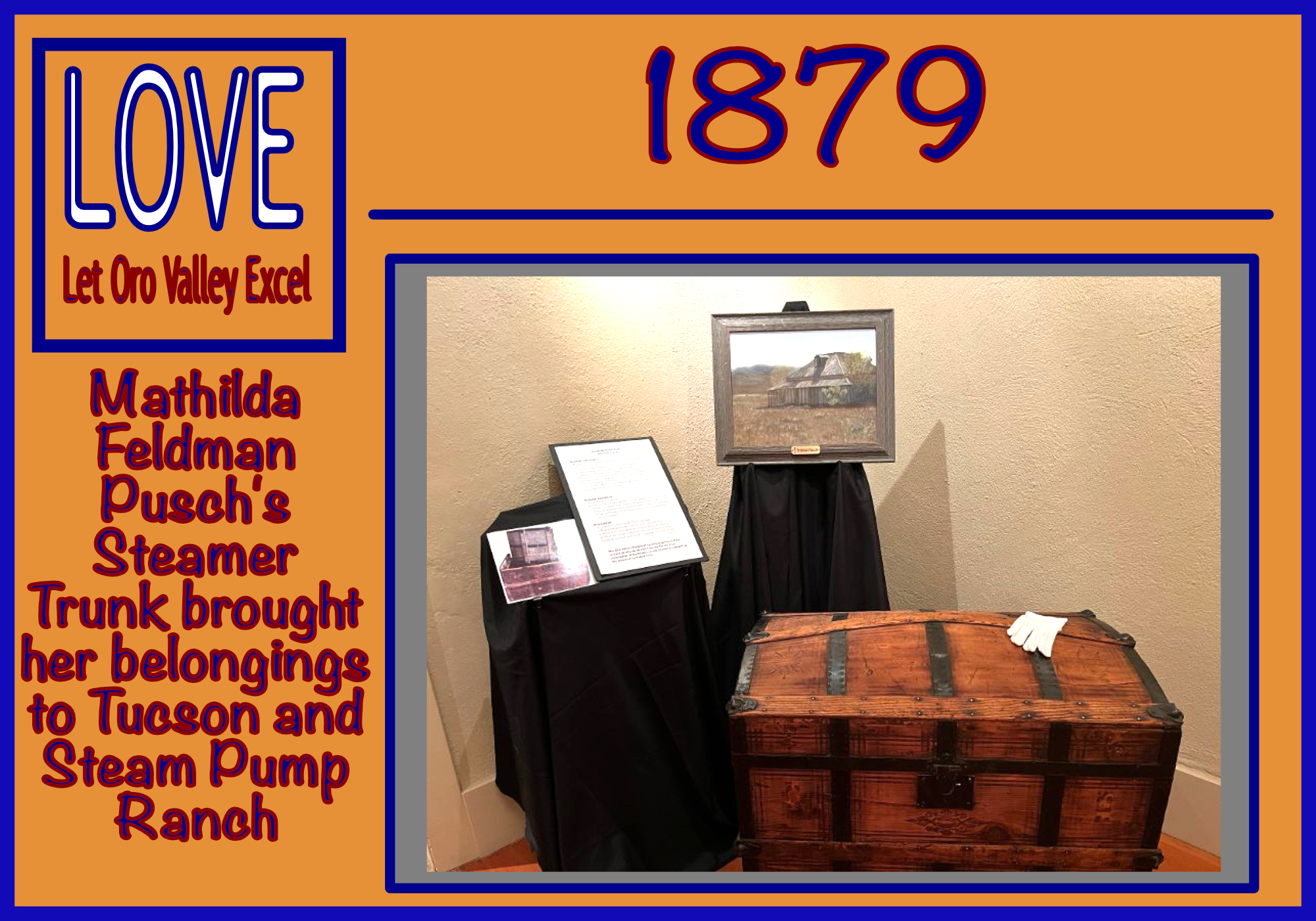
Capturing History: A Trunk For All To See

What a journey! Drockenburg, Germany to Tucson Arizona in 1879 by boat to the U.S. and then by train to Tucson. Arriving at the train station was relief not to be bouncing around on train tracks and bumping into whatever is close by! Of course, now in a strange city, quite unlike anyplace I have ever been before – dusty streets, animals roaming around everywhere, and very hot!
 
What is the next part of the journey? Well, history doesn’t say exactly where I ended up, but it must have been downtown Tucson somewhere and then, a year later, into a very nice house on South Jackson Street (where the convention center is now) and then, much later, out to Oro Valley where I am now.
 
No, I’m not a person. I am the steamer trunk that Mathilda Feldman Pusch used to bring her belongings to Tucson and Steam Pump Ranch where I can now be seen in the historic Pusch House Museum on Saturday mornings. And wait until you see me now! A lifetime member of the Oro Valley Historical Society, Joe Frannea, made me beautiful again. Don’t you agree?
 
Here’s what Joe knew about me so that he could make that transformation.
 
I’m a dome top trunk which made it hard to place something on top of me thus avoiding much damage during transport, and the shape also permitted rain to run off should I be placed outside in inclement weather. Plus, the dome shape made me much more attractive, so I could be used for storage even after a long journey and placed in a visible area of a home for decoration.

Come see me at the Pusch House Museum on Saturday mornings from 9 a.m. – noon (except for December 23), along with the detailed notes of the renovation that Joe did to make me a safeguard for valuables again – items that could be transported from Germany to America in the 1800’s.
 
And on December 9, meet Jim Williams, author of the new book Oro Valley: The First Fifty Years. Yes, Oro Valley is much younger than I am, and you will meet the author and be able to purchase his book to see how Oro Valley came about, and how we have matured.
- - -
WE WANT YOU! 
The Oro Valley Historical Society is a 501 (c) (3) non-profit volunteer organization, whose mission is “To promote research, preservation, education, and dissemination of historical information related to the greater Oro Valley area.” We invite you to become a supporter and/or a volunteer. Visit us at ovhistory.org and help keep Oro Valley history alive!


We are currently looking for enthusiastic volunteers who are interested in becoming docents at the Pusch House museum and for Steam Pump Ranch tours. Training sessions are being scheduled. We hope to hear from you. Contact: Tina at tinhow@comcast.net In addition, we could use some help with social media, fundraising, and gardening – there’s something for everyone because history loves company!
- - -

Friday, June 16, 2023

Bits and Pieces

Steam Pump Ranch Bunk House and Barbecue done in July
The town reports that construction on the bunkhouses and the barbecue are coming along schedule and should be completed by July 29. There will be a ribbon cutting ceremony at 10:00 am on July 18. (Source: Oro Valley Historical Society Newsletter)

“Jimkrieghite” will put Oro Valley “on the map”
Council Member Joyce. Jones-Ivey noted at last week’s town council meeting that a new mineral has been discovered in the Catalina Mountains. It has been named for Jim Kreigh, Oro Valley’s founder. The mineral was found by long-time resident and town volunteer Warren Lazar. University of Arizona geologists determined that that mineral only exist in the Catalinas. It was likely formed from a lightening strike. Major announcements are forthcoming. The mineral is on display at the Geology Museum at the University.

Former Council Member Parisi supports OVCN Sports Facility…misses the point
Former Town Council Member Paul Parisi supports the massive sports facility the Oro Valley Church of the Nazarene wants to build. Speaking at last week’s town council meeting, Parisi stated that growth is inevitable and that residents have always opposed it. He noted that residents did not want the town to build Riverfront Park when he was on council (at the beginning of the century). Parisi also said that he respects the rights of property holders. The OVCN property is not zoned for a sports facility. OVCN is free to use it is currently zoned. No one objects to that.

Free document shredding Saturday
“The Town of Oro Valley will once again hold a free document shredding event for Oro Valley residents on Saturday, June 17. The event will be held at the Oro Valley Marketplace” (Source: Town of Oro Valley Media Relase)

Thursday, May 25, 2023

Bits and Pieces

Henry Zipf, great-grandson of the Pusch Family has died
"The Oro Valley Historical Society Board members are saddened to announce the passing of our President Henry K. Zipf. Henry was the great-grandson of George and Mathilda (nee Feldman) Pusch, grandson of Gertrude (nee Pusch) and Henry W. Zipf, and son of Henry (Hank) G. and Ann (nee Lourie) Zipf. Henry is survived by sons Nolan and Stephen and his partner, Debra. 

The Pusch/Zipf family has long historical roots in both the Greater Tucson and Oro Valley areas. Henry was an active member and board member of the Society for many years. He dedicated much time and many resources to the organization. He had a great deal of local knowledge of Oro Valley’s early years. Henry was full of entertaining stories that included ranch life and his lifetime in the Tucson area. Henry could “spin a good yarn” and his chuckle was infectious!" (Source: Oro Valley Historical Society email)

Summer "Disc Golf" at Pusch View Course
Town of Oro Valley is offering disc golf on he Pusch Ridge Golf Course from June 6 through September 30. Tee times be begin at 7am and players will be able to play until 7pm.  There will be no conflict with regular golf as there will be time sufficient to overseed prep the course for its November 1 opening. The group Friends of Pusch Ridge Golf would like to see the course offered as a year-round traditional golf course. (Source: Friends of Pusch Ridge Golf Newsletter)

Crimefighter Newsletter focuses on Phone Scams
This month's issue of Crimefighter, a publication of the Oro Valley Police Department, focuses on phone scams. It details four scams. The article links to some fraud prevention tips. Both the newsletter and the tips are worth reading. One scam they did not list is the "pays us with a visa debit card" scam.  This is where the scammer wants to you to send the money through your purchase of a debit card. These cards are not traceable, thus they are ideal for scammers  By the way, there is no reputable organization that would request you to do so... so don't fall for this one.

Don't forget to take the town's housing survey by May 31
The town is conducting a housing survey.  You can complete the survey online. You can do this as many times you wish with as many different answers as you wish.  To date, there have be almost 1,000 responses. The town's Phoenix-Based consultant on this project, WestGroup Research, is using phone calls to conduct a statistically valid survey.  There have been 350 of these to date.  (We wonder how this works given that most people use cell phones as their primary contact and there are no cell phone directories. Also, many phone cell users do not answer calls from anyone they don't know.) There is also a survey of business owners on this matter. 75 have responded so far.

Some consider this to be a  biased  survey of housing needs. 

The result of the survey matters because they will be relied upon in the building of the 2026 General Plan. Also, developers and town staff will use the results to assess economic development requests.

Community Center "silver sneaker" members disadvantaged if they want to be premium members
There are two memberships to the community center: Regular and premium. Members use the senior sneaker program, a program that some health care insurance providers offer, can get a"paid for" regular membership. However, they are not allowed to be a premium member unless they pay the full fee. If they do so, they forego the "silver sneaker" benefit. The town is looking in to this.
- - -

Wednesday, May 10, 2023

Steam Pump Ranch: An Oro Valley Historical Site That Should Be Used As Such

Steam Pump Ranch is an historical property
Pima County purchased Steam Pump Ranch for $5 million in 2006. It was part of a Pima County Bond offering. Once acquired, they turned the park over to Oro Valley. "The property provides an excellent locale for developing a “sense of place” for Oro Valley and holds economic viability as an educational facility, special event venue and heritage park." (Source: Section 2) It is a 15 acre property acquired to "stregthen Oro Valley's firm connection to the past: (2008 Steam Pump Ranch Master Plan, Page 4).

Over the years, use of the park have changed
The town plans town offices there. Events that have nothing to do with the town's history are held there... including some drive in movies.. .and the "Second Saturday Farmer's Markets. 

Two upcoming events illustrate how far the town has strayed from using Steam Pump Ranch. Both events are this weekend. Friday is "Parent's Night Out" Event. "Drop off the kids at Steam Pump Ranch and go enjoy your evening. We will treat your kids to a movie, games, crafts, pizza, and snacks. We know you work hard, and we want you to play hard or maybe just take a nap without someone saying 'look at me" The other is family camping event for the following night.

The Oro Valley Historical Society (OVHS) has taken note of of this
Speaking at last week's "Call To Audience" Devon Sloan questioned why these event's are not being held at a town park. We include her remarks in their entirety.

"Why[are these two events] not at any of our larger, more family oriented other parks in Oro Valley, namely Riverfront Park with much larger grassy area, small trail, and a little playground? Or James Kreigh Park with again much larger grassy area, trails, playground, or the major park in Oro Valley, where we are spending tons of money - Naranja which has even larger grassy area, trails, and playground." 

Steam Pump Ranch was placed on the National Register of Historic Places based on the sense of place that it provides all of us
There is no playground and only a small grassy area surrounded by a historic home, a barbecue area under reconstruction and two small buildings that are being reconstituted as rest rooms. There is fencing around these buildings to protect citizens and the buildings. It doesn’t seem like the perfect place for family activities. 

In the Cultural Heritage and Preservation Plan of 2015, it is noted that Steam Pump Ranch is an “important part of the Town’s heritage” and that “a primary concern in the future is the protection of the historic core at the Ranch”. It also states that “partnerships will be a key element in maintenance of the property and providing public access .” 

Events at Steam Pump Ranch should have an historical and cultural perspective
The Oro Valley Historical Society would have been thrilled to be a part of either or both of these two Town activities by providing some historical and cultural aspect of the Ranch, if we had been included as a partner. We specialize in education - perhaps a short story about the Ranch, the people who lived here, how they changed the scope of our area in the 1800’s. We weren’t informed about these two events, however. 

It is our hope that the Town will reconsider the types of activities that are held at Steam Pump Ranch, to include the historical society in future events (like the parents’ night out in June or the camp out in October) and will consider maintaining the integrity of our most visible historic core in accordance with state and national guidelines. 

They didn’t have real playgrounds when George Pusch lived on the property, but we have them now in our three parks. Let’s use the parks as the family gathering place for parents and kids and truly allow the historical society to partner with the Town to inform, preserve and protect our history."
- - -

Thursday, April 13, 2023

OVHS: “Happy 49th Birthday Oro Valley!”

The Beginning of the Town of Oro Valley
In April, the Oro Valley Historical Society focuses on the history of the town and how Oro Valley  came to be. 

My how we’ve changed since Jim Kriegh’s idea of becoming a town (to avoid becoming part of Tucson), to the town we are today. 

The town’s fathers had to battle with the City of Tucson and Pima County to make it so. They even went to court. Finally, the town was a reality after four years of effort.


Here’s the chronology of how Oro Valley came to be.
  • Jim Kriegh began an inquiry with residents regarding the idea of incorporation. 
  • A petition for incorporation was filed with Pima County on March 16, 1970. 
  • 80% of residents in proposed boundaries signed the petition. 
  • Pima County rejected the petition on grounds that the area contained large areas of uninhabited rural lands and lacked a central business center. 
  • April 23,1970, Kriegh and Steve Engle began the legal process seeking a writ of mandamus in the Pima County Superior Court ordering the supervisors to incorporate the town. 
  • March 31, 1972, Oro Valley won its incorporation suit. It became the third independent municipal government in the region (with Tucson and South Tucson). 
  • April 3, 1972, the Pima County Board and the City of Tucson filed an appeal to prevent incorporation. 
  • Finally, on January 28, 1974 Oro Valley was approved to incorporate by order of the Arizona Supreme Court. 
  • Pima County and the City of Tucson asked for reconsideration but the court denied the request and ordered the Pima County Board of Supervisors to appoint the first Town of Oro Valley Mayor and Council. 
  • Pima County Board adopted a resolution to incorporate Oro Valley on April 15, 1974 and appointed the first Oro Valley Mayor and Council on April 17, 1974 thus, the town’s official birthday. 
  • On April 23rd the first public meeting was held at CDO High School. Ken Holford was elected the first Mayor and Steve Engle was chosen as Vice-Mayor. 
  • The first budget was approved on June 20, 1974 for the full fiscal year of $114,014. 
  • October 6 1974, the town meetings began in the first Town Hall at 9040 N. Oracle Road. 
  • An effort by a group of residents to disincorporate failed in April 1975 due to lack of the required signatures for the petition. 
  • July 1975 the beginning of the fiscal year, the Town began contracting for services, such as police, fire, court services, road maintenance and rabies control. 
  • February 1976, the Town hired three officers and established its own police department. Frederic Roof was appointed Superintendent of Police. 
  • Fall of 1976 the first General Plan was developed.
(Source: Research by Henry Souzzi)
- - -
See you in the fall!

Friday, January 27, 2023

Bits and Pieces

OVHS local  historian event on February 19
Meet Wynne Brown, local author and historian on February 19 at 3pm.  Wynn will present her book: “The Forgotten Botanist – Sara Plummer Lemmon’s Life of Science and Art." at the Oro Valley Country Club. Visit the Oro Valley Historical Society website to purchase tickets for the presentation and dinner. Proceeds for the event will allow the Oro Valley Historical Society (a non-profit 501c3) to continue its mission to promote research, education, preservation and dissemination of history of the Greater Oro Valley area.

Riverfront Park play area refurbishment progress on time while Aquatic Center reopening delayed
Town Staff continues to make progress on replacing the surface of the Riverfront Park play area.  The area is scheduled to be reopened after February 3.  Things are not progressing as well with the maintenance and repair activities at the Aquatic Center. "The facility's improvement project has experienced delays
Click to enlarge
related to the arrival of equipment necessary to the completion of the project. Due to these delays the project timeline has been extended and a new reopening date of Monday, February 13th is what we will be targeting."(Source: Parks and Recreation Bulletin)

New Car Wash for Village Center considered next week
Next Wednesday, The Oro Valley Town Council will consider an application for use of an area adjacent to ""In N’ Out Burger". The area is in the Oro Valley Village Center (aka Oro Valley Marketplace). The request was unanimously approved by the Planning and Zoning Commission. As there is an existing queuing problem at "In N’ Out",  town staff added a provision for approval requiring the reconfiguration of the existing "In N’ Out" drive  prior to the issuance of a Certificate of Occupancy for the car wash. 

The meeting next Wednesday is a public hearing in town council chambers. No one from the public spoke at the Planning and Zoning Commission meeting. (Read more about the Planning and Zoning Commission decision here. Learn more about what is being proposed here.)
- - -


Thursday, January 26, 2023

Cattle In Arizona

The Explorers brought cattle to North America
Cattle in the Arizona Territory Cattle are not native to North America, however they have been present in the Southwest for almost 500 years. 

Christopher Columbus brought cattle to eastern North American in 1493 and the Spanish explorer Vasquez de Coronado brought cattle, sheep and horses to what is now Arizona as part of his 1540 expedition from Mexico to locate gold for the Spanish crown. The expedition was unsuccessful, however. Livestock and people may have remained behind when the expedition returned to Spain. The cattle were likely Andalusian Cattle from Spain that were imported into Mexico. They are often termed “Criollo” or “Corriente” and are well adapted to arid landscapes.

Father Kino brought cattle to Southern Arizona
In the late 1600s the Jesuit priest Father Eusebio Kino established missions in northern Sonora and southern Arizona. He brought herds of cattle from Mexico with him and became known as an expert cattleman. 

Open range cattle ranching began in the 1870's
The remnants of these herds may have survived until the early 1800s when Apache raids on settlements, primarily for cattle and horses, occurred on a regular basis. Apache raiding ended in the early 1870s when the federal government established reservations to confine the mobile tribes. The era of “open range” cattle ranching soon began in southern Arizona.

Ranchers got cattle from various sources
Ranchers in southern Arizona obtained cattle from a number of sources. In the early years they came primarily from Mexico and Texas and were known as Mexican cattle and Texas Longhorns. Later on, ranchers experimented with some European breeds from eastern America: primarily Hereford, and Shorthorn and some Durham and Angus. Great cattle drives crossed the Arizona Territory from Texas to California and from California to Texas. Arizona ranchers incorporated new breeds into their herds in an effort to improve their stock. By the mid 1880s Herefords had become the most successful breed adapting well to the vast grasslands in the open range era.

Visit our exhibit to learn more
This article is from an Oro Valley Historical Society exhibit item on display at the Pusch House Museum. If you would like to discover more about Cattlemen, Cowboys, and Ranchin’ visit the Pusch House Museum at Steam Pump Ranch at 10901 N. Oracle from 9 to Noon on Saturday, January 28. This is the last week of the exhibit.
- - - 

Thursday, January 12, 2023

A Bit of History: Cattle Ranching in the Greater Oro Valley Area

Cattle were brought to North America
Cattle ranching is so predominant in the United States that it is easy to forget that cattle were not native to North America. 

Gregorio de Villalobos first brought cattle to Mexico in 1521. In 1540 Francisco Vasquez de Coronado while passing through the San Pedro Valley in search of the Seven Cities of Cibola, brought cattle, sheep and horses. Missionaries as well as the Spanish policies of appeasement supplied the Native Indians with livestock and so, ranching grew.

Ranching began in 1854
After the Gadsden Purchase of 1854, Anglo-American immigrants arrived and established ranches in southern Arizona. Shortly thereafter, the railroad lines connected the west to eastern markets and allowed cattle to be easily shipped further increasing ranching interests. 

Water a challenge
Early ranches in our local area were technically established on public land. Most cattle were managed on open range ranches that were located along streams and washes that could provide water.  

Unfortunately, ranchers found it difficult to have profitable operations due to the lack of grazing area and the unpredictability of the water supply. 

Ranching at Steam Pump Ranch
The first non-native rancher in the area was Francisco Romero, who established his homestead in about 1869 in what is now Catalina State Park. His son, Fabian, continued to ranch in the area and made land claims when they became available. The Romeros were followed by George Pusch, John Zellweger, William Sutherland, Francisco Marin, Teodoro Marin, Jesus Elias, and Ramon Gallega.

Ranching had its ups and downs
Much like the general U.S. economy, ranching was impacted  World War I, the Great Depression, and World War II.  After WWII, renewed interest in local ranching took hold when Easterners with a love of the Western lifestyle amassed land from federal grants as well as ranch sales by destitute owners. Some of this new wave of ranch ownership, did not personally ranch the land, but hired foreman to oversee the operation. 

Prominent Oro Valley Ranchers located along Oracle Road gave way to development
Some of the prominent Oro Valley ranchers were Walter McDonald, Joseph McAdams, Jack Procter, Lloyd Golder Jr., and Laurence Rooney. Many of these ranch properties were located along the Oracle Road corridor. As suburbia took hold in the late 1950s, the value of the land for development outweighed the value of ranch productivity. Little by little the land was sold for commercial and residential expansion and today we have the Town of Oro Valley.
- - -
Reference material: Claiming the Desert – Settlers, Homesteaders and Ranchers in Oro Valley, Arizona 1865-1965 by James A. Williams. This book can be purchased on Amazon or at the Oro Valley Historical Society booth at the Farmer’s Market, Saturdays from 9 to Noon. 
- - -
If you want to know more about “Cattlemen, Cowboys, and Ranching” visit the Oro Valley Historical Society exhibit at the Pusch House Museum at Steam Pump Ranch 10901 N. Oracle Road on January, 7, 14, and 28 from 9 to Noon.
- - -
We hope you will support the Oro Valley Historical Society and attend a fundraising event on Sunday, February 19 at the Oro Valley Country Club. Author Wynne Brown will discuss her book “The Forgotten Botanist – Sara Plummer Lemmon’s Life of Science and Art.” Tickets can be purchased on our website www.ovhistory.org.

Thursday, December 1, 2022

1853 Gadsden Purchase Added Southern Arizona (and Oro Valley) To The US

A war with mexico and then...
In 1848, the Mexican-American War ended with Mexico ceding nearly half of its territory in the Treaty of Guadalupe Hidalgo to the United States; including what is now, California, Arizona, New Mexico, Nevada, and Colorado. 
 
The territorial boundary line in what is now Arizona was north of the Gila River (making the Tucson area part of Mexico). This restricted access to California via the established Mormon Battalion route which remained part of Mexico. Settlers in that area were often under attack and without protection.

...a purchase of land that includes Oro Valley 
President Franklin Pierce, sent James Gadsden, U. S. Minister to Mexico, to Mexico City to purchase additional land needed to connect the lower Mississippi to California. Initially, the parcel of land was to include all of Baja California and the Port of Guaymas on the Gulf of California.
 
With the looming conflict between the North and the South, the northern states were wary of the possible expansion of a southern route to the west which could strengthen the southern economy as well as expand slavery.
 
Gadsden had been given six boundary line proposals by the U. S. Senate with commensurate purchase prices to take to the Mexican government. Finally, in 1853, a compromise was reached in Congress, and the border was set to cross Arizona south of the Gila where it stands today. The Gadsden Purchase ($10,000,000) acquired all of New Mexico south of the 34th Parallel plus the land between New Mexico and California (now Arizona). The newly acquired land became the Territory of New Mexico and part of the United States. Arizona did not become its own territory until 1863.

Purchase accommodated building the rail roads
Gadsden did not believe the ratified treaty for the land was in the best interest of either the U. S. or Mexican governments. That being said, the Gadsden Treaty that was signed December 30, 1853, would add the needed territory to build the southern transcontinental railroad which in large part was the primary reason for the purchase.
 
Bringing commerce to Tucson and the surrounding region
Though Gadsden did not see the fruition of his efforts, the railroad lines that he envisioned did come to be. Between 1878 and 1881 the Southern Pacific Railroad built the southern transcontinental line between Yuma and El Paso. The Atchison Topeka and Santa Fe Railroad linked to the port of Guaymas in Sonora, Mexico. All of these lines are within the Gadsden Purchase area and make it one of the busiest lines in the Western Hemisphere. Needless, to say it put Tucson and the greater Tucson area on the map and on the road to progress.
- - -
This month visit the the Pusch House Museum to learn more about "Traditions, Toys and Trains"
Want to find out more about railroad lines in our area? Stop by the Pusch House Museum on Saturdays from 9 a.m. to Noon, December 3, 10, and 17 for the Oro Valley Historical Society’s new exhibit, “Traditions, Toys, and Trains”. The exhibit features familiar holiday traditions, the history of some of our favorite toys and local train history and the connection between trains and Christmas. Children can also drop off letters to Santa in our “special mailbox” on those dates AND on Saturday, December 17 from 10 to Noon, they can meet Father Christmas!

Thursday, November 17, 2022

November Is Native American Heritage Month

A celebration
November is Native American Heritage Month, an annual celebration when we can all come together to honor and celebrate the cultures, traditions, history and contributions of American Indians and Alaska Natives.
 
Proclamation
As President Biden stated in his Proclamation of October 31, 2022:
"During National Native American Heritage Month, we celebrate Indigenous peoples past and present and rededicate ourselves to honoring Tribal sovereignty, promoting Tribal self-determination, and upholding the United States’ solemn trust and treaty responsibilities to Tribal Nations. 

America has not always delivered on its promise of equal dignity and respect for Native Americans.  For centuries, broken treaties, dispossession of ancestral lands, and policies of assimilation and termination sought to decimate Native populations and their ways of life.  But despite this painful history, Indigenous peoples, their governments, and their communities have persevered and flourished.  As teachers and scholars, scientists and doctors, writers and artists, business leaders and elected officials, heroes in uniform, and so much more, they have made immeasurable contributions to our country’s progress.

Grown in importance over time
What started in the early 1900s as a day of recognition for the contributions of America’s first inhabitants has grown into a month designated to acknowledge their achievements and cultures. In 1990 President George H. W. Bush approved a joint resolution designating November as the first National American Indian Heritage Month (now known as Native American Heritage Month).

574 federally recognized tribes
There are currently 574 federally recognized tribes, and Native Americans comprise about 2 % of the United States population. They account for over 10% of the population in Oklahoma, New Mexico, and South Dakota, and 20% in Alaska. 
 
22 in Arizona
Arizona is home to 22 federally recognized tribes, each with its own history, culture, and traditions. Nearly 30 percent of the land base in the state belongs to tribal nations and communities. The first reservation established in the state was the Gila River Indian Reservation south of Phoenix, in 1859, under U.S. government treaty authority. It is home to the Akimel O’odham (Pima) and Pee-Posh (Maricopa) tribes.
 
Arizona contains the largest Indian Reservation in the United States, the Navajo Nation, established in 1868, which also extends into Utah and New Mexico. The reservation covers over 27,000 square miles. Nearly 200,000 members (Dine’) live on the reservation while the Navajo population is approximately 400,000 enrolled members.
 
Oro Valley has a rich Native American heritage
The land that is now Oro Valley was once used and maintained by Indigenous people. Before Spanish explorers, Mexican settlers, miners, and other European-Americans entered the Cañada del Oro Valley the land was occupied by numerous people. Seasonal hunting and food gathering camps from many hundreds of years ago were located along the base of the Santa Catalina Mountains and large villages were present near the Cañada del Oro.
 
The Romero Ruin in Catalina State Park was a large Hohokam village occupied for centuries. It is open to the public and has an interpretive trail that provides information about the inhabitants who lived there around 1000 years ago. Honey Bee Village was also a large Hohokam village, located near Rancho Vistoso Boulevard. The central portion of the village (13 acres) has been set aside as an Archaeological Preserve surrounded by residential development. It is also open to the public. A third large village, known as Sleeping Snake Village, was located near the foothills of the Tortolita Mountains. It was excavated in preparation for development of the Vistoso Golf Course that is now the Town of Oro Valley Vistoso Trails Nature Preserve. A few petroglyphs remain near the trails.
 
These three large villages are considered ancestral villages by the Tohono O’odham. The Tohono O’odham Nation, the second largest reservation in Arizona, established in 1916, lies in the Sonoran desert west of Tucson although Oo’dham people historically lived throughout much of southern Arizona and northern Sonora, Mexico.
 
Certain place names in early Arizona history were derived from the O’odham language of the late 1600s and 1700s. Tucson came from Cuk son meaning “black base” (Black Mountain lies at the southern edge of Tucson). The state name, Arizona, is derived from “Al sonag” meaning “Place of the small spring”.
By the time Spanish explorers and then Mexican settlers entered the Tucson Basin there were apparently no O’odham settlements near the Cañada del Oro. The valley had become part of Apache raiding territory.
 
Apaches are culturally distinct from the Akimel O’odham and Tohono O’odham peoples who consider the Hohokam their ancestors. By the early 1700s nomadic Apaches (Ndee) had acquired horses from Spanish explorers and with them they developed raiding practices that became an important part of their economy. Mexican settlements and O’odham villages were frequent targets.
 
While under Mexican rule in the late 1700s and early 1800s military troops stationed in Tucson occasionally pursued Apache raiders north along the western edge of the Santa Catalina Mountains crossing the Cañada del Oro in what is now Oro Valley. The Cañada del Oro crossing played an important role in a number of raids among the Apaches, Tohono O’odham and the increasing number of Mexican and American settlers.
 
Most Apaches in the Cañada de Oro Valley were moved to the San Carlos Apache Reservation, established in 1872, although some were allowed to live freely in the San Pedro Valley. They hunted and farmed in the Oro Valley area until the first large ranches, including Romero, Sutherland, Pusch’s Steam Pump and San Pedro, were established. Soon afterward the transition to a livestock and ranching economy dominated by newly settled Americans was complete in southern Arizona and there was no longer a home for Apaches outside of established reservations. Today, little evidence remains of their historic use of Cañada del Oro Valley.
 
The Pascua Yaqui Tribe is located in the Tucson vicinity, however there is no material evidence that they lived or used the lands that are now part of Oro Valley. Their roots are in Sonora, Mexico and many still live there on reserved lands. Some migrated to Arizona in 1884 fleeing government persecution for their traditional agricultural lands. The Tribe received reservation status for a small parcel of land southwest of Tucson in 1964 and they were granted federal recognition in 1978.
- - -  
November is a special time to learn more about the legacy of native traditions and people as well as the important issues facing Indian country today. There are numerous events, museum exhibits, programs and lectures throughout the state honoring our first residents. In Oro Valley there is an exhibit devoted to Native American cultures in the Pusch House Museum at Steam Pump Ranch.