Showing posts with label Gephart. Show all posts

Wednesday, March 18, 2026

Latest Oro Valley Five-Year Forecast Shows Fiscal Stability

Five year forecast shows no financial cliff
Finance Director David Gephart presented preliminary five-year financial forecast to the Finance Director David Gephart to the Budget and Finance Commission yesterday. The forecast shows that Oro Valley’s revenues and expenditures remain closely aligned through FY 2030/31, with reserves maintained at the Town’s 25% policy level.

Nothing in the forecast indicates that the Town is currently in financial distress or forecasted to enter one during the five-year period. The forecast shows steady, though slow, revenue growth driven largely by local sales tax while noting that construction-related revenues are expected to decline gradually as the community approaches buildout. 

Four key funds considered
The overall conclusion of the forecast comes from looking at the Town’s major operating funds together rather than individually. [Panel right] These include the General Fund, Highway Fund, Capital Fund, and the Community Center operations, including golf. The funds are interconnected through a series of planned transfers, with the General Fund and Capital Fund supporting certain activities in other funds. When viewed together, as the Town presented in its summary chart, the forecast indicates that revenues and expenditures across these major funds remain in balance over the five-year period while overall reserves remain stable.

Four key revenue assumptions
As with any long-range financial forecast, the accuracy of the forecast will depend on how assumptions unfold over time. There are four key revenue assumptions: Redevelopment of the Oro Valley Marketplace will generate approximately $2.2 million in new sales tax revenue beginning in FY 2026/27; construction-related tax revenues will gradually decline as available land for development diminishes; the incorporation of San Tan Valley will dilute Oro Valley’s per-capita state-shared revenues by about 1.6% annually; and remaining revenues will continue to grow modestly in line with historical trends.

Cost control and modest spending growth drive spending forecast
On the spending side, the forecast assumes that the Town will manage spending efficiently. Personnel costs are projected to grow at about 3 percent annually, reflecting pay adjustments, police step increases, and rising benefit costs, with no new positions included in the five-year outlook. Operating expenses are expected to increase at roughly 2 to 3 percent per year, consistent with inflation. The forecast also includes ongoing capital commitments, such as annual funding for the Vistoso Trails Nature Preserve and continued investment in roadway maintenance and improvements. Together, these spending assumptions help explain how the Town expects to maintain balanced operations over the forecast period.

And if the forecast does not come to pass, the Town has a “Budget Stabilization Plan”
The Town also has a Budget Stabilization Plan in place should revenues fall short of forecast. The plan [panel left] is structured to protect essential services as long as possible, with more significant impacts only if revenue shortfalls become large. The plan outlines a series of graduated responses based on the size of any projected shortfall, beginning with steps such as reducing discretionary spending, delaying the filling of vacant positions, and postponing capital projects, and progressing to measures such as hiring freezes, use of fund balances, and service reductions. In more severe scenarios, it includes program reductions, workforce impacts, and consideration of fee or tax increases.

Finance Director Gephart cautions 
Though Gephart said that the five-year forecast aligns with current Council direction and that, based on that direction, staff has developed a financial forecast that maintains balanced operations and continues existing service levels, he did emphasize many cautions. During the presentation to the Commission, he placed greater emphasis on the uncertainties within the forecast, noting that its results depend on key assumptions and that it does not include all longer-term staff-desired capital projects. He also discussed factors that could affect outcomes, including sales tax performance and broader economic conditions. Perhaps these are simply the cautions of a prudent financial advisor, but presenting a forecast and then focusing much of the discussion on what could “go wrong” does raise the question of how confident he is that the forecast will be achieved.

Next Up: Gephart will present the forecast to the town council tonight
The commissioners did not raise objections to the forecast. Rather, their comments focussed on gaining a general understanding of the assumptions and recognizing that the forecast is subject to change based on economic conditions. We will see what council members think tonight when Gephart presents the forecast to them.
- - -

Tuesday, June 17, 2025

The Police MOU: A Four-Year Agreement—A Bumpy Road Caused By Town Staff Errors

Flawed pension impact calculations derailed the MOU negotiations 
Oro Valley’s new police pay agreement is now in place, as we reported last week. With the deal ratified, pay and pension provisions are set through 2029—unless police pay rapidly escalates in Marana. But getting to an agreement was not easy, largely due to flawed estimates of the pension impact of the various proposals. In fact, it took a declaration of impasse by the Oro Valley Police Officers Association to get a meaningful agreement.

How did it get so complicated?
To understand what happened, we requested and reviewed more than ninety emails and schedules from the Town. Our public records request asked for any reports, memos, modeling worksheets, presentations, or correspondence prepared by Stifel & Co related to the pension liability impact of the police union MOU proposals. We specifically asked for documents showing how pension costs were modeled, the assumptions used, and any communications between Town staff and Stifel about adjustments made to the analysis between April 14 and May 7, 2025.

Early April: An outside advisor runs the numbers
In early April, both the union and Town proposals were far apart on pay and pension impacts. At some point, Town staff had engaged Stifel & Co to analyze how each proposal would affect the Town’s public safety pension obligation. An April Stifel analysis showed the union proposal would have a far greater impact on pension costs than management’s offer. This early analysis indicated the union proposal would increase the Town’s pension obligation by $8.3 million (9.48% of total liability), while the Town’s proposal ranged from $2.2 million (2.55%) to $8.0 million (9.15%), depending on assumptions.

$5 million total impact limit given to town staff
This result came as a shock to Town staff. It was well over the “limit” they had been given: “We have received direction to attempt to keep the total cost of the new agreement, including PSPRS impact, to around $5M which our last proposal did not do. Additionally, our Town Council likes options when it comes to these things.” [Gephart to Daghestani email of April 18, 2025 (Email 47.pdf)]. At one point in the discussions, a Town representative told the union that their proposal could “bankrupt the town”—a comment that reflected how high the early pension impact figures were and set the stage for even greater tension as the impasse loomed.

The April frenzy: A search for affordable options
Between April 14 and April 30, the situation became especially intense. Town staff scrambled to understand the financial impacts of the various options. For example, between April 17 and April 23, Finance Director David Gephart worked with Human Resources Director Andrew Votava to develop and submit new management pay proposals to Stifel for analysis. As a result, staff sent at least two new management pay scenarios for Stifel to cost out, while continuing to refine a third. This period was marked by rapid back-and-forth as staff tried to provide council with multiple, affordable options ahead of the scheduled executive session at the end of April.

The union declares impasse—and uncovers an error
By April 28, negotiations had become so unproductive that the union declared an impasse. One reason was that the union determined Town staff had miscalculated the pension impact by including eight Deferred Retirement Option Plan (DROP) officers. DROP officers are police employees who have entered a program that lets them “retire in place”—collecting pension while still working, but not accruing new pension benefits. Including these officers in the original pension calculations overstated the Town’s true obligation because their salaries no longer affect pension costs.

Two April mistakes in calculating pension impact
This episode surrounding the pension impact was a mess that could have been easily avoided. Town staff made two mistakes that were entirely preventable, had everyone on the negotiating team understood how the different offers would affect pension costs. First, on April 23, Gephart wrote to Stifel acknowledging that his earlier implementation of “Mgmt 3” was incorrect and provided revised weighted averages to bring the PSPRS impact down. Second, the inclusion of eight DROP officers in the analysis was not discovered by the Town, but was caught by the union, which correctly pointed out that DROP officers should not have been counted. While these mistakes were unfolding, negotiations continued using faulty data. It’s no wonder the union declared an impasse on April 28. The Town was not operating in good faith.

What happened in May?
We don’t have documentation of what occurred during May. However, we do know that the final Memorandum of Understanding was agreed upon and adopted by the Town Council on June 6. Based on the timeline, it appears that the council’s involvement, along with the use of accurate and mutually agreed-upon data, enabled both sides to reach a settlement. 

The terms of the final agreement are very similar to those under discussion in April, suggesting that resolution would have been possible had accurate pension impact numbers been provided.
- - -

Wednesday, March 19, 2025

Tackling Key Challenges in Oro Valley’s Latest Five-Year Financial Forecast

Reasons for optimism
Yesterday, we discussed the town’s latest five-year financial forecast and highlighted the challenges ahead. Today, we focus on what the town can do to meet these challenges.  We think there's reason for optimism.

Returning Operating Fund reserves to historic levels would eliminate the capital fund "deficit"
The town maintains a General Fund reserve of 30% of General Fund expenditures, an increase from the previous 25% level implemented five years ago to address economic uncertainty from the pandemic. 

At the meeting Vice Mayor Barrett suggested that reducing the reserve back to 25%, which could free up approximately $2.5 million as a one-time boost for capital projects. Gephart acknowledged this benefit but warned that “it doesn’t address the long-term closing of our excess ongoing revenues over ongoing expenditures” in the general fund. However, what it does is to release funds that more than cover the shortfall of $1million in the 2030 projected balance of the capital fund. 

Bond financing would provide needed spending for major items 
Unlike last year, there was no significant discussion of bond funding for capital projects in this year's discussion. However, there were indications that bonds might be issued to finance a new police facility study next year. The town’s latest grant request status report includes a $3.8 million request from the Department of Justice - Byrne Discretionary (Law Enforcement), a fund designed to support community justice projects. The grant is pending.

The town could sell for capital projects that will not be covered by grants. This is a common use of bonding and the town's current debt service [panel above] decreases substantially by 2027.  In addition, the town's future debt service projection indicates a substantial drop in debt service funding, thus freeing up the capacity to bond future projects.

Annexing retail rich areas can improve the General Fund sales tax revenue "picture"
We have not seen a recent Town of Oro Valley annexation plan. The last one we saw was in 2021. That plan identified a number of areas that are target rich for Oro Valley. Here are a couple of areas; and we've added in one of our own.

As for the General Fund and the shortfall in sales tax revenues, move forward to annex retail rich areas for annexation. One area is the east side of Oracle north of Ina that has Guadalajara Grille and other retail already in place. A second area is to annex the retail businesses on Oracle south of Ina Road. Retail there includes Safeway and Whole Foods. 

In the longer term, focus on annexing the "New Foothills Mall".  The town considered this almost 20 years ago. The town concluded that it just wasn't a good idea at that time. That was before the La Cholla Blvd became a "highway".  Now La Cholla Blvd as a giant siphon for bringing business out of Oro Valley. That's because it's far easier for residents who live in that area to quickly get to shopping rather than traveling across town to get to Oracle Road, which is where most of the retail is  located in Oro Valley.

"Reducing retail leakage" will help too
One area on which the town is focused is finding ways to reduce “retail leakage.” That is when residents spend money outside of Oro Valley instead of supporting local businesses, leading to lost sales tax revenue that could fund town services. The town has already identified challenges such as significant retail leakage in categories like automobile dealerships, clothing stores, gasoline stations, electronic shopping, and general merchandise, with total estimated lost revenue exceeding $776 million. Some of the actions the town is considering include educating residents about the benefits of shopping locally, targeting specific audiences for year-round campaigns to promote local shopping and dining, and strategically recruiting businesses that align with local consumer demand. The next steps include setting recapture goals, aiming to reduce the leakage gap by a percentage through a combination of shopper retention efforts and attracting new businesses to meet local demand. (Source: Presentation to Town of Oro Valley Town Council by Economic Development Director Paul Melcher, 3-5-25)

Bringing focus to revenue generating touring is another avenue 
Oro Valley is conducting a Leisure and Travel Study to develop a tourism strategy after taking over destination marketing from Visit Tucson in March 2024. Initial efforts, including hiring a marketing manager and launching digital campaigns, have shown limited success, leading two major resorts to rejoin Visit Tucson independently. The study, led by CSL International and a town-appointed steering committee, aims to assess the effectiveness of current tourism investments, explore sports and arts tourism, and consider regional partnerships with nearby communities. Some residents are concerned about the study’s focus, transparency, and the town’s lack of experience in tourism management. Critics argue the strategy should prioritize generating tax revenue rather than simply increasing visitors and note that the decision to leave Visit Tucson was made without consulting key stakeholders. The study, expected to take six to eight months, will present its first update in April. (Source)

And remember
Financial forecasts are conservative planning tools rather than definitive predictions. The future is almost never what is predicted. In addition, town leadership is actively seeking alternative funding sources, including federal grants and strategic fiscal policies, to ensure continued support for essential community projects. With thoughtful planning and careful adjustments, Oro Valley can navigate these financial hurdles effectively in the years ahead.
- - - 


Tuesday, March 18, 2025

Oro Valley’s Latest Five-Year Financial Forecast Highlights Budget Pressures and Challenges

Challenging financial times ahead
Two weeks ago, Town Manager David Gephart presented the town's five-year financial forecast to the Town Council. Not much has changed from last year’s forecast. Both forecasts emphasize funding shortfalls beginning in fiscal year 2026-2027, primarily due to declining state-shared revenues, escalating operating and maintenance costs, and insufficient growth in gasoline tax revenues. In other words, the town will need to live within its means over the next few years or identify significant new revenue sources.

Declining state shared revenues affecting General Fund
A primary concern highlighted by Gephart is the significant decrease in state-shared revenues, largely due to Arizona’s implementation of a flat income tax rate of 2.5%. He pointed out that “state-shared revenues are not expected to fully recover to last fiscal year levels until fiscal year ’29,” creating financial strain on the General Fund and a flat revenue projection through fiscal year 2028. This reduction limits the town’s financial flexibility, particularly impacting available capital improvement funds.

Rising personnel and O&M costs increasing budget pressure

Gephart emphasized that personnel and operating and maintenance (O&M) expenses continue to rise due to inflationary pressures of approximately 3-4% annually. Despite conservative assumptions for adding new employees—only one or two new full-time equivalents per year—the expenses keep escalating. Gephart noted that “we’re in a somewhat elevated inflationary environment… versus flat revenues, [this] is causing some squeezing to happen in ongoing revenues versus ongoing expenditures,” highlighting the structural challenges in maintaining balanced budgets.

Highway Fund strained by pavement preservation demands
The Highway Fund faces increasing financial pressure due to rising pavement preservation costs, which have grown from around $2 million annually to over $3 million per year. Gephart explained that while gas tax revenues remain steady, they are insufficient to cover the surge in roadway maintenance and capital outlay, necessitating significant transfers from other town funds. He warned that the town faces “a pinch point because the town is not projected to have excess reserves necessary to fund those necessary road improvements.”

Capital Fund facing future negative balance

Gephart highlighted concerns over declining General Fund transfers to the Capital Fund, combined with significant planned expenditures, including a $5 million cash contribution toward a police facility in FY 26/27. He noted, that “we’re showing a negative fund balance in the Capital Fund,” with deficits expected by FY 2030. This suggests potential financial challenges if the town does not secure additional debt financing or alternative revenue sources. The amount of the transfer is 5% allocation of sales tax revenue as required by town financial policies. Additionally, any General Fund balance exceeding the 30% reserve requirement (excluding contingency funds) is also transferred to the Capital Fund to support capital expenditures.

Hoping for federal funding for bridge repairs
A key issue is the exclusion of approximately $8 million in bridge repair costs from the forecast. These include necessary infrastructure projects like the La Cañada and Rancho Vistoso bridge deck repairs. The town has applied for federal funding through congressionally directed spending, but Gephart acknowledged uncertainty: “I don’t have a sense as to the probability or prospect of that occurring.” If the funding is not secured, the financial responsibility will fall back on the town.

Community Center Fund remains balanced but cautious
Unlike other funds, the Community Center Fund remains stable and self-sufficient, with modest 3% annual revenue growth. Gephart pointed out that conservative revenue assumptions for golf and recreation activities, combined with the ending of HOA contributions, necessitate careful planning. He noted positively that the fund is “staying balanced and self-supporting,” demonstrating sound financial management even as other town funds face more significant challenges.

Reasons for optimism: There are solutions
All these factors add up to a challenging financial future for Oro Valley. However, there is reason for optimism. Read about some solutions tomorrow.
- - -
Additional resources:
- - -

Tuesday, September 24, 2024

Oro Valley’s 2024 Financial Results Show Better Than Budgeted Performance Because of Timing of Spending

Preliminary 2024 financial results show continued financial health and impact of delayed spending on capital projects
The Town of Oro Valley has released its preliminary financial results for the fiscal year ending June 30, 2024. While these figures are unaudited and subject to adjustment, they provide a picture of the town’s financial health. Finance Director David Gephart presented the results of six funds at the town’s Budget and Finance Commission meeting last week. These funds form the core of Oro Valley’s financial operations, though the final audited numbers may vary slightly.

Operating Fund reflects increased housing permit activity and inflation impact on sales tax revenues
The General Fund, which powers most of the town’s day-to-day services, ended the year with revenues surpassing expectations by about $2 million. This positive outcome is attributed to higher-than-anticipated local sales taxes and an increase in permits related to residential construction. Notably, the town issued 178 single-family residential permits, exceeding the budgeted 119. These permit numbers indicate ongoing growth in the community.
Click To Enlarge

Community Center Fund significantly outperforms revenue expectations

Community Center Fund revenues exceeded the budget by 18%, driven by strong performance in golf operations, including a 20% increase in rounds played. Despite higher expenditures, the fund ended with a surplus of $798,000, a significant improvement from the budgeted deficit of $826,000.

Gephart suggests considering increasing community center fees
Membership at the community center and golf courses has been growing consistently, but this rapid growth may lead to some changes. As Gephart pointed out, there is an upper limit to how much the facility can accommodate. “At some point, people won’t be able to get tee times,” he noted. To address this, the town may consider adjusting membership rates and fees, making them more in line with market rates to manage demand. This potential fee increase is not only practical for balancing capacity but could also help fund future improvements at the center.

Higher water use boosts Water Utility Fund results
The Water Utility Fund benefited from higher water usage due to a drier year, with revenues exceeding budget by $1.2 million. Revenues exceeded the budget by 6%. Expenditures were lower than expected due to personnel vacancies and a lower administrative charge, resulting in a $3.1 million use of fund balance instead of the budgeted $4.5 million.

The three other fund balances show underspending in capital projects due to timing
The financial results of other funds were impacted by less-than-anticipated spending on capital projects.
  • The Highway Fund also showed a favorable outcome, with expenditures coming in under budget due to capital project delays. While revenues from highway user taxes were slightly lower than anticipated, increased interest earnings helped offset this shortfall.
  • The Capital Fund saw $7.6 million in expenditures, significantly lower than the $13.6 million originally budgeted. This variance was largely due to the delay of several capital improvement projects, which will carry over into the next fiscal year. As a result, the town’s ending capital fund balance stands at $16.9 million, leaving ample room for future projects once they are ready to proceed.
  • The Stormwater Utility Fund also reported an increase in its fund balance due to delays in capital projects, despite the town not receiving a budgeted grant.
Still, there are financial headwinds ahead
There’s no reason to believe that the town is facing financial headwinds based on the 2024 results. Still, there are financial headwinds ahead, as noted by Gephart in May to the council.

Future spending is going to require making hard choices. Inflation boosted town sales tax revenues this year, but as inflation abates, so will sales tax revenue increases. An unexpected increase in housing permits this year also increased general fund revenues. However, permit fees will decrease as the town builds out.

No town can underspend on capital projects forever because these are projects that need to be done. This is especially true for Oro Valley, where there are some significant projects. Funding for the water fund’s NWRRDS project will require borrowing, which the Town Council approved last week. The town’s bridge structures are reaching the point where they need to be repaired, and that’s going to cost a substantial amount. Something significant also needs to be done regarding police facilities. Together, all of these capital projects are going to cost about $100 million over the next few years.

It’s going to take strong fiscal management and an exceptionally financially astute Town Council to work through these future funding challenges.

Tuesday, July 23, 2024

Greene Helps Make Town Staff 4% Pay Raise A Reality, Ignoring Financial Warnings...Failing To Participate In Discussion

Town Staff Gets Big Pay Increase 
This year’s budget includes a whopping 4% increase across the board for all employees. That’s the highest level ever given, in a year in which the council was warned that revenues are going to be tight in the future. 

Greene, Joyce-Ivey, Solomon and Winfield supported big increase
That increase was explicitly approved by a slim council majority at the June 19 council meeting, a meeting in which the council approved the $151.2 million fiscal 2025 Budget. Vice-Mayor Barrett had argued in favor of the historical 3% increase.  Council Members Bohen and Nicolson voiced their support for that.

Town “Spreads the Peanut Butter” when it comes to pay raises... No performance based awards...No incentive to get better

When it comes to staff pay raises, Oro Valley spreads the peanut butter! Everybody gets the same percent increase regardless of their performance. 

This contrasts with private sector practice where, as noted by Vice Mayor Barrett and Council Member Bohen, employees are paid based on their performance. As Council Member Nicolson noted at that meeting, who works in the public sector under the across-the-board pay philosophy: “I get the same raises, still same pay, not really a whole lot of incentive to improve.”

Barrett: Individual performance should be individually awarded
“I think it’s important to have some performance-based measures because I think that helps encourage our good employees, and we can help identify the employees that are most likely flight risks. That’s something that’s done regularly throughout all of the private sector and efficient places in other sectors as well,” said Vice Mayor Barrett.

Votava: No. That might make some people unhappy
Town Human Resource Director Andy Votava does not think that is a good idea: “So, in my mind, I don’t think we’re well-equipped to implement a pay-for-performance system because the danger or the hazard is that if we don’t do it well, some employees may take issue with that. Potentially, anybody can file a lawsuit, but it could lead to complaints.” 

Greene supported this massive increase in spending though he failed to even participate in the discussion
Mo Greene, who is running for reelection, claims to be fiscally responsible. However, his actions, including his decision to support this 4% across-the-board pay raise despite looming financial constraints, demonstrate the opposite. He was so disinterested in the conversation on the pay increase that he did not participate in it. Not one word!

Indeed, Greene's disregard for fiscal responsibility was evident when, at the Sun City forum, he was asked how he would demonstrate fiscal responsibility. He merely echoed Council Member Solomon's statement in a May council meeting: "We need to separate our wants from our needs." Greene then referenced something he did 20 years ago while working the New England Journal of Medicine, without citing any actions he has taken on the council in the past four years. That's because there were no examples to cite. 

Next Tuesday's election is a clear opportunity for voters to hold him accountable for his demonstrated lack of fiscal responsibility. 
- - -
(Source: June 19, 2024 Oro Valley Town Council Meeting, Item 5)

Wednesday, April 24, 2024

Financial Headwinds in the Offing Starting in 2026

Town projects that it may need at least $11 million in bond funds in 2026-27
The Town of Oro Valley will need to issue a minimum of $11 million in bonds in fiscal year 2026-2027 to cover a major shortfall in funding for major highway projects and the ever-growing costs of the pavement preservation program. 

This information was disclosed by Town Finance Director David Gephart during his presentation of the latest five-year financial forecast to the town’s Finance and Budget Commission last week. "We've got a funding gap that we're going to have to address in some form or fashion," he stated. This gap manifests as a negative ending balance of $8.5 million in the capital fund by Fiscal year 2029 if no bond is issued. It is a gap that begins to build in fiscal year 2027.

This is the minimum needed because it assumes the deferral of many capital projects, including one that would replace the current police facility
“We placed a lot of projects that have been in the CIP in prior years…off to the side. We're going to be looking for again additional alternative sources to fund some of those grant funding and you know probably might be looking at some revenue enhancements and things like that….We don't have those really really dialed in or assumed in the forecast.”

Three reasons for the projected funding shortfall

  • The forecast predicts that the General Fund will experience a reduction in the surplus of revenues compared to expenditures (see panel right). According to Gephart, one cause is a decrease in state shared tax revenues. The other cause is a significant increase in operating and maintenance costs “…because we're seeing higher inflation.” 
  • The town has a number of bridge and road repairs that need to be done. At the same time, the costs of the pavement preservation program are skyrocketing. “We’re hoping that that growth moderates. We don't anticipate that it's going to go up another 50% but this is where we're at.” 
  • Growth in gasoline tax revenues cannot keep up with inflation. “What we're assuming is really moderate growth 3.4% to 3.6% in highway user gas tax revenues and that's provided to us from the Arizona Department of Transportation.” 
Taken as a whole, the town’s cash balances will decrease by $6.8 million even after an $11 million bond issue
Gephart reflected on the situation by focusing on four funds. However, funds in these accounts are frequently transferred around. For example, in this instance, the bond funds would initially be part of the General Fund, then transferred to the Capital Fund, and subsequently to the Highway Fund. So, we totaled their balance. We included the Community Center Fund because it also receives such transfers for capital spending. According to Gephart, "The Community Center Fund actually looks solid.”

The shortfall is really $17.8 million.

According to Gephart’s forecast, by 2029, the total ending balances of these funds will decrease by $7 million. This decrease is after the issuance of the $11 million in bond funding. So, the shortfall in funding is $17million. (see panel left)

And remember…there are other capital projects that Gephart has assumed will be deferred.

Financial headwinds ahead
Several weeks ago, in "In For A Penny, In For A Pound," we mentioned that the town would begin encountering challenging financial decisions once the Parks Bond Money and the ARPA Funds are depleted. We highlighted this after the town council swiftly approved $390,000 to replace a bridge on a town golf course. "Those days are behind us. The 2025 budget will reflect some remaining funds, but the bulk of town funding will need to come from ongoing revenue sources. We anticipate budgets becoming increasingly constrained over time.”

The town has ample time to set the right course
Yes. Gephart’s five year financial projections affirm just that. Remember: These projections are based on a set of assumptions of events that may or may not happen. The further out the forecast year, the less likely that the forecasted result will happen. But, the projected results are a warning that strong financial discipline will be required to navigate the choppy waters.
- - -

Tuesday, January 23, 2024

Independent Study: “Buildout” Will Not Cause An Oro Valley Financial Catastrophe...But

It's really close...
“Based on the current budget structure, existing zoning and the expected amount of future residential development, the projections show a fiscally sustainable result at build-out …but with very limited resources to cover any significant increases in long-term maintenance costs.” (Applied Economics Fiscal Impacts Report, p 22).

No wiggle room
In fact, the projected difference between revenue and expenditures in the the two funds assessed is really tight (see chart below right). There's no "wiggle room."

Study seeks to answer question: Must residential growth in Oro Valley continue even after buildout in order for the town to be financially sustainable given current revenue sources?
Town Finance Director David Gephart presented the study to the town’s Budget and Finance Committee last week. He said that the town engaged an outside consultant to do the study as part of its strategic planning process. Gephart noted that the study was needed because there are some in the community, including former Town Manager Mary Jacobs, who believe that the arrival of “buildout” will herald a financial crisis.

Study conclusion applies to town day-to-day operations
The study focuses on two funds. One is the General Fund, the town’s source of funding for day-to-day town operations. These operations include major functions such as public safety, economic development, and some public works funding. The water department and the community center are funded by separate funds and were not included in the study. The highway fund, much of whose revenues come from state-shared revenues and transfers from the capital fund, was included in the study.

Study conclusion seems a bit of an overreach 
The study aims to determine whether residential growth in Oro Valley must continue after buildout to ensure the town's financial sustainability with its current revenue sources. We believe that the study conclusion that there is no problem is an overreach:
  • The study projects a surplus of funds until significant buildout occurs in 2034. At that time, revenues and expenses nearly match. It's really too close to call.  As a minimum, the town will need to manage its spending ever more carefully as the town reaches buildout than it does today. Will it have the "ability" to do that?
  • The study does not account for the fact that the General Fund is a source of funding the Capital Fund (see note below). That funding comes from the General Fund surplus. That impact is not included in the study, The consultant recognizes this by noting in their conclusion that the town will have “… very limited resources to cover any significant increases in long-term maintenance costs."
  • According to Gephart, the study numbers were not reconciled with the town’s five-year financial forecast. That forecast is based on the best-known details of future events, while the consultant study used estimates of what may happen over twenty-five years.
  • In addition, the town has yet to reach a "steady state" were all numbers can be reasonably estimated. For example, the town has yet to open and operate Naranja Park, one of the largest regional parks in Southern Arizona. The upkeep and renewal of this facility could be very costly.
Council should focus on "mitigating" the risk
We think that the council needs to know the circumstances under which "buildout" will cause a financial crisis for the town. They can then assess, using their own judgment, the likelihood of these events occurring and what, if anything, they can do to reduce the risk. That is really what planning is all about.
- - -
About the Capital Fund
The Capital Fund is the source of funding for capital improvement projects. These are projects where spending is $50,000 or more, have an expected useful life of five or more years, and either become or preserve an asset of the Town. Although facility repair and maintenance, as well as fleet replacements, do not meet the definition of a capital project, they are significant expenses for the Town and are included in the CIP for planning purposes" (Source: 2023-24 Town Manager Recommended Budget, page 101). 

The General Fund is one source of money for this fund. Other sources include revenues derived from future commercial growth and development, including impact fees, commercial sales tax collections, other one-time revenue sources such as grants and contributions, and bond proceeds.
- - -

Wednesday, March 22, 2023

One Word Sums Up Last Week's Town Council Capital Budget Study Session: "Laughable"

Laughable
Last week, we reported on the latest staff recommendations on the Town of Oro Valley Ten Year Capital Improvement Program (CIP). The town council held a study session on the program last Wednesday. In our minds, the study session was laughable. The session left more questions than it answered.  Here are our takeaways:

Study session occurred too late at night
There’s really no way to have a productive study session late into the evening, especially after the Council has already discussed pressing matters. In addition, just before this study session, the Council had already sat through a study session on the Vistoso Trails Nature Preserve Master Plan.

The CIP study session was so late in the evening that, by the time Council Member Joyce Jones-Ivey was asked if she had any questions, she was literally giddy. After all, she had been in that room for almost six hours.  Jones-Ivey started laughing and couldn’t stop. We don’t blame her because having a session on something as important as capital spending so late at night is ridiculous. That topic requires a "clear, fresh mind."  In addition, Joyce pointed out that the tiny font used on the schedules that staff provided was way too small to be read by a human being! She is right!

A $3.2 million magistrate court project...
Next year, the Town will start remodeling the Magistrate Court.  The estimated cost for that is $1.5 million each of the next two years. We have no idea why staff proposes this project or why it is proposed for next year because...

...With no detail provided on that or on any proposed project
We cannot tell you more about the Magistrate Court Project, or any other project really, because the packet provided to the Council does not include a detailed description of the project, a description of exactly what is to be done, the reason or justification for doing that project, the return or benefit from doing the project and the basis for the estimated cost of the project. All of of this is best practice in capital budgeting. All of this is missing from the council packet. It is no wonder that Jones-Ivey was laughing because what the Council received last week was laughable.

Thus requiring Council to get "down in the weeds"
Town staff is budgeting replacing "circuit three" street lights in Sun City. Barrett wants that circuit replaced sooner rather than later. Winfield asked why the town should continue to provide street lights in Sun City. After all, Sun City is the only place in town that has street lights. He was informed by staff that the street lights are there for historical reasons. Owning and maintaining those lights was part of the agreement when the town annexed Sun City 45+ years ago. Winfield suggested that is is time to re-examine that situation.

Finding discrepancies accounting among funds
It is necessary for the Council to "get down in the weeds."  Some members of this Council, Tim Bohen in particular, are good at doing that. His tracking of fund transfers, for example, reveals confusing accounting between the Community Center Fund (CCF) and the CIP.

According to Town Finance Director Gephart: “The one that I will highlight is the elevator and the ADA improvements to the Community Center.” These are included in the CIP Fund at the moment. According to Vice Mayor Barrett, these costs are supposed to be in the Community Center Fund. Barrett noted that “The motion for the elevator said that the additional funding would come from the Community Center Fund, so what would happen if we end up paying for all that from the Capital Fund? Would there be a transfer from the Community Center Fund?”. Gephart responded: “Yes. There would be a transfer as long as funds are available.”

Then, there are capital costs related to the creation of the Vistoso Trails Nature Preserve. These are included in the CCF capital budget. They belong in the CIP budget.

No basis provided by staff to Council for prioritizing projects
The staff did not provide nor does the Council have a method for prioritizing projects. Having such is best practice of a capital budgeting process. Council Member Solomon noted that the Town Council needs to separate projects as to whether they are essential, “a must or need”, or something it would be nice to have, “A want”. Then, the Council should agree upon and then apply a "screen" for prioritizing projects within those categories.

Our conclusion
Staff had been requested by Council to hold this session. They conducted the session as if they had been requested to do something that they did not want to do. They were "going through the motion."
- - -

Monday, January 23, 2023

Gephart: Oro Valley Is Financially Stronger Than It has Ever Been

Fiscal responsibility was an issue in last election
The four challengers in last summer’s Town of Oro Valley Mayor and Council contended that the incumbent candidates had been financially irresponsible in their four years in office. They had difficulty proving their assertion. Indeed, the facts, simply did not support reality.

Independent audit tells the story
Once a year, the town provides an independently audited report of its financial condition. It is called the Annual Comprehensive Financial Report (ACFR).  Last week, staff and town’s independent accounting firm, Baker Tilly LLP, presented this report to the town council. The report was for fiscal 2022, which ended in June.

Providing a short-term and long-term perspective

The report differs from the financial reports that staff provides during the year in two ways. First, the monthly staff reports have not been audited by an independent third party. Second, the monthly staff reports provide information based on “cash in and cash out”. The ACFR, however, includes a report that matches revenues when they are earned with expenditures when they are incurred. These are called accrual-based statements.

According to Finance Director David Gephart, these accrual-based statements provide an accurate basis for gauging the long term financial health of the town; while the monthly reports town council receives provide a picture of the town’s short-term financial health.

Oro Valley got stronger from both perspectives in 2022
Referring to the both types of financial reports, Gephart noted that “The town’s financial position is strong” on both counts. From a short term perspective, the town’s fund balances increased $22.5m in fiscal 2022. From a long term perspective the town increased its “net position” [assets minus liabilities] by $15million. Since 2018, the town has reported both an increase in its fund balances and an increase in its net position. This was not the case in fiscal 2017, the year before the incumbents began their first term in office.

Gephart: Town is well positioned financially 
Gephart’s conclusion: “This town is stronger than it has ever been financially and it is well positioned to navigate a potential recession.”

Watch Gephart's remarks here. Our thanks to Take Back OV for that. Read their report on this here.

From time to time, we plan to post highlights of fiscal 2022. Stay tuned.

Tuesday, January 3, 2023

Town Council Needs To Designate Use of $10.75 Million Windfall

$10.75 million of remaining ARPA funds yet to be designated for use
The Town of Oro Valley has $10.75 million in federal ARPA funds to designate for use. The town received these funds last fiscal year. The town has until the end of 2024 to assign these funds, obligate them to specific projects. The town must spend these funds by the end of calendar 2026.

The town received a total of $15.4 million of ARPA funds
This is truly a windfall. The town didn’t need this money. The Town of Oro Valley thrived financially during the pandemic. Many communities like Oro Valley are struggling to figure out how to spend all of the ARPA funds by the 2026 deadline.  The panel [below right] shows the total funds received and how they have been used to date.

The use of  $10 million of these fund is mostly unrestricted,  It can be used for replacing town revenues lost during the pandemic
$10 million of these funds can be used on a broader basis to replace “revenue losses” caused by the pandemic. This money can be spent on a broad range of general government expenses. For example, some communities are spending the money on what one would call welfare payments. Others are using it to replace shortfalls in capital spending.

Town staff designated $4.65 million of these unrestricted funds to pay for replacing the town's El Conquistador and Canada Golf Courses' Irrigation
The total cost of the irrigation replacement on the town's two 18-hole golf courses is estimated to be $9.15 million.  $4.5 million of this is being paid for from the $25million Parks Bond; the rest, $4.65 million, from the ARPA funds. 

Town Council did not approve, by resolution, the use of the ARPA funds for that purpose
Nor has the Town Council designated the use of the remaining $5.35 million of unrestricted funds. 
According to town staff, these funds are sitting in the capital improvement fund, waiting to be used to fund future capital projects.  Town staff, without a formal council resolution, used $4.65 million to pay for golf course irrigation replacement.

The use of  $5.4 million in ARPA in funds is restricted
These funds can be used to improve drinking water and wastewater infrastructure.

It is the town council’s job to obligate all ARPA funds. They have not done so.

The town budget does not define the specific use of these funds. Thus, the town council must decide this.  It is then the responsibility of the town staff to spend it as directed. 

Until the town Council meeting of December 7, this council has not focused on fulfilling their responsibility. Thus, Council Member Tim Bohen, prior to and at that meeting, requested that staff to respond to eight questions that he asked regarding these funds. Town staff responded.

None of the restricted funds have been obligated by the Council    
Town Council has not directed staff on how to spend the $5.4 million in restricted funds. LOVE has advocated that the town use theses funds to extend the reclaim water system to the south part of town, thus saving millions of acre feet of drinking water from being used on town parks. The town council rejected this at the last meeting, preferring to wait for the answers to the eight questions asked by Bohen. The answers given by staff don't tell the council how to spend these funds; but their response did clarify one thing.

Town Outside accountant confirms that restricted funds can’t be laundered through the water utility... so that they could be used for another purpose
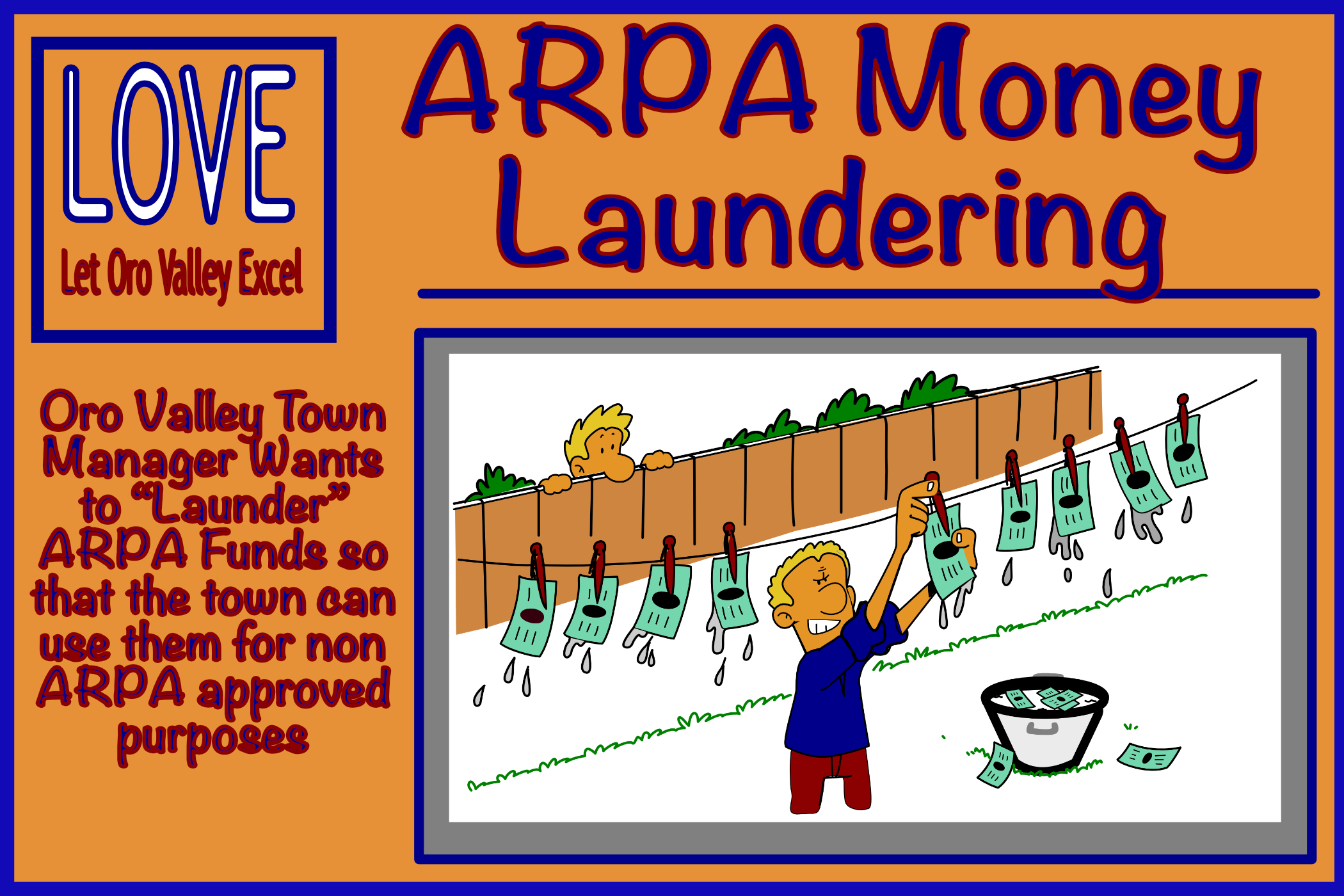
The Town Council has been terribly misinformed regarding the use of the unrestricted funds for water. Town staff, under the leadership of former town manager Mary Jacobs, current town finance director David Gephart and with some misinformation provided by the town’s independent auditor, suggested laundering these funds through the water utility so that the town can use the funds for non approved purposes. The scheme was to lend money to the water utility, have the utility use it for an intended purpose and then to pay the loan back to the town. Then, the town could use the funds paid back for a non approved use. This is called money laundering. It is illegal. It is chicanery.

As it turns out, LOVE was correct when we identified this as a laundering scheme when Jacobs proposed it to Council in September. In one of the responses to Bohen’s request, the independent accountant recognized that the funds must always be used for the intended purpose, even if they are paid back. The independent accountant concluded this after consulting with a third party organization with which they have recently become affiliated. Frankly, we question the competence of the independent accountant.

Big question still remains: How to spend $10.75 million in remaining ARPA funds?
The clock is ticking. At some point, the council will have to obligate these funds or return them to the federal government.

Monday, September 26, 2022

Town Manager Jacobs Resigns After Proposing "Laundering" ARPA Funds

Jacobs resigns
Town Manager Mary Jacobs resigned Friday. We do not know the reasons behind this. We do know that she proposed a money laundering scheme regarding $5.38million in ARPA funds. This happened at the Town Council meeting last Wednesday. You can read about this scheme in this article.

We do know that council conducted her annual review as scheduled after she had proposed this scheme. 
- - -
Jacobs proposed laundering ARPA funds 

Jacobs and her staff tried to “pull a fast one”. She put an item, Consent Agenda, item 2, on last week’s council meeting, which was an item that clearly needed discussion. Consent Agenda items are not discussed at the meeting unless a council member requests that the item be pulled for discussion. Otherwise, Consent Agenda items are voted on as a block.

The item called for the council to approve a loan of  $5.38 million from the General Fund to the Water Utility Fund.  These funds were received from the federal government as part of the ARPA award. ARPA required that the funds be used for water infrastructure projects. Under Jacobs’ scheme, the utility would pay back this money with interest over time. 

Rather than simply gifting the money from the town to the Water Utility to build infrastructure, Jacobs wanted to lend the money to the Water Utility so that the town can get it back and use it for another purpose, one not related to the federal allowable use of these funds.

As council member Steve Solomon pointed out at the council meeting, the scheme sounds like the town is trying to get around federal regulations for the use of the money because the town will get the money back and then use it for some other, non ARPA allowable purpose.

Solomon was exactly right.  

The Water Utility was the conduit for the sham transaction
Speaking in defense of the loan arrangement, Town Manager Mary Jacobs said that the money that the utility will be getting would be the ARPA funds which carry the restriction that be used for water infrastructure.  According to Jacobs, the money the town will get back in loan repayment and interest would be unrestricted. It will not get back ARPA funds. The funds would be from the general revenues of the Water Utility.

Attention all.

This is called “money laundering”.

Gephart: It's OK to do this because the Water Utility is an enterprise fund
Town Finance Director David Gephart justified the scheme because he felt that the town should not simply transfer the money to the utility.  Gephart said that the reason that a loan has been proposed is because the Water Utility is supposed to be a self sustaining (“An Enterprise Fund”) entity. Thus, anything that has to do with the Water Utility, including administrative services that are provided by the town must be paid by the utility.

The loan approach, according to Gephart, provides the appearance that the Water Utility is self-supporting. Gephart also explained that the town had no alternative but to use this money for the Water Utility system. That’s because any other allowable uses were just not feasible for the town.

So, why not just gift the money to the Water Utility Fund and be done with it? After all, these ARPA monies were gifted to the town by the federal government  The funds are intended to be used for water infrastructure projects.  In this case, the town’s general fund is merely a conduit to get the money to the town-owned Water Utility Fund because the Water Utility did not get the funds get directly from the federal government.

Jacobs tried to do this "in the dark of night" by putting the item on the “Consent Agenda” segment of the town council meeting
Jacobs claimed at the meeting that she wrote about this loan transaction in April. Council Member Bohen agreed that he found it buried in a document council received back then. The members never discussed it then because they were never really aware of it.

It would not have been discussed last week had it not been for the sharp eyes of Bohen, Jones-Ivey and Solomon. The former two asked for the item to be pulled from the Consent Agenda for discussion. Solomon identified the transaction for the “sham” that it is.

Former Town Manager Jacobs tried to put "one past them." 

Fortunately, she failed.
- - -