Showing posts with label George Pusch. Show all posts

Thursday, December 7, 2023

Capturing History: A Trunk For All To See

What a journey! Drockenburg, Germany to Tucson Arizona in 1879 by boat to the U.S. and then by train to Tucson. Arriving at the train station was relief not to be bouncing around on train tracks and bumping into whatever is close by! Of course, now in a strange city, quite unlike anyplace I have ever been before – dusty streets, animals roaming around everywhere, and very hot!
 
What is the next part of the journey? Well, history doesn’t say exactly where I ended up, but it must have been downtown Tucson somewhere and then, a year later, into a very nice house on South Jackson Street (where the convention center is now) and then, much later, out to Oro Valley where I am now.
 
No, I’m not a person. I am the steamer trunk that Mathilda Feldman Pusch used to bring her belongings to Tucson and Steam Pump Ranch where I can now be seen in the historic Pusch House Museum on Saturday mornings. And wait until you see me now! A lifetime member of the Oro Valley Historical Society, Joe Frannea, made me beautiful again. Don’t you agree?
 
Here’s what Joe knew about me so that he could make that transformation.
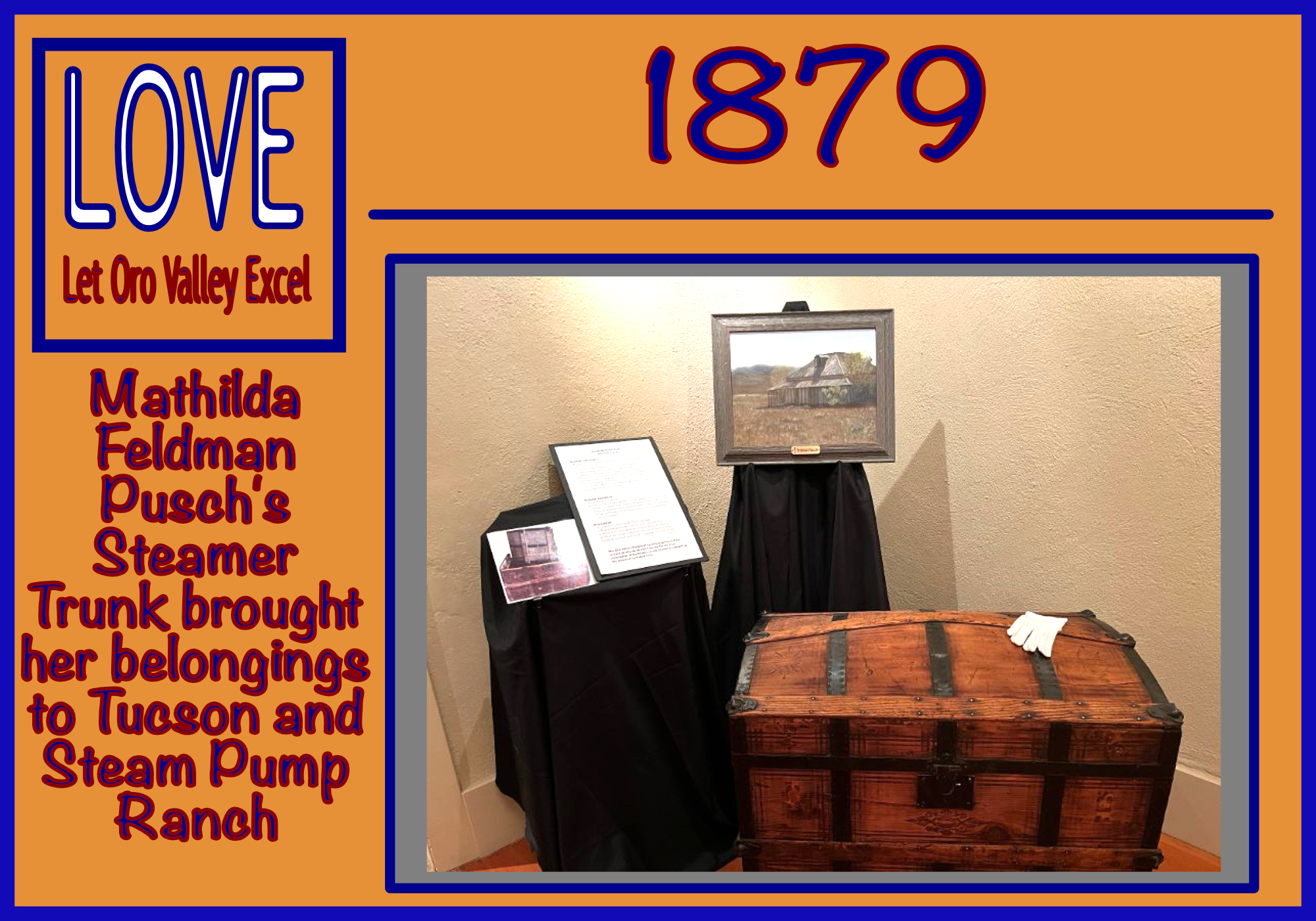
 
I’m a dome top trunk which made it hard to place something on top of me thus avoiding much damage during transport, and the shape also permitted rain to run off should I be placed outside in inclement weather. Plus, the dome shape made me much more attractive, so I could be used for storage even after a long journey and placed in a visible area of a home for decoration.

Come see me at the Pusch House Museum on Saturday mornings from 9 a.m. – noon (except for December 23), along with the detailed notes of the renovation that Joe did to make me a safeguard for valuables again – items that could be transported from Germany to America in the 1800’s.
 
And on December 9, meet Jim Williams, author of the new book Oro Valley: The First Fifty Years. Yes, Oro Valley is much younger than I am, and you will meet the author and be able to purchase his book to see how Oro Valley came about, and how we have matured.
- - -
WE WANT YOU! 
The Oro Valley Historical Society is a 501 (c) (3) non-profit volunteer organization, whose mission is “To promote research, preservation, education, and dissemination of historical information related to the greater Oro Valley area.” We invite you to become a supporter and/or a volunteer. Visit us at ovhistory.org and help keep Oro Valley history alive!


We are currently looking for enthusiastic volunteers who are interested in becoming docents at the Pusch House museum and for Steam Pump Ranch tours. Training sessions are being scheduled. We hope to hear from you. Contact: Tina at tinhow@comcast.net In addition, we could use some help with social media, fundraising, and gardening – there’s something for everyone because history loves company!
- - -

Thursday, May 25, 2023

Bits and Pieces

Henry Zipf, great-grandson of the Pusch Family has died
"The Oro Valley Historical Society Board members are saddened to announce the passing of our President Henry K. Zipf. Henry was the great-grandson of George and Mathilda (nee Feldman) Pusch, grandson of Gertrude (nee Pusch) and Henry W. Zipf, and son of Henry (Hank) G. and Ann (nee Lourie) Zipf. Henry is survived by sons Nolan and Stephen and his partner, Debra. 

The Pusch/Zipf family has long historical roots in both the Greater Tucson and Oro Valley areas. Henry was an active member and board member of the Society for many years. He dedicated much time and many resources to the organization. He had a great deal of local knowledge of Oro Valley’s early years. Henry was full of entertaining stories that included ranch life and his lifetime in the Tucson area. Henry could “spin a good yarn” and his chuckle was infectious!" (Source: Oro Valley Historical Society email)

Summer "Disc Golf" at Pusch View Course
Town of Oro Valley is offering disc golf on he Pusch Ridge Golf Course from June 6 through September 30. Tee times be begin at 7am and players will be able to play until 7pm.  There will be no conflict with regular golf as there will be time sufficient to overseed prep the course for its November 1 opening. The group Friends of Pusch Ridge Golf would like to see the course offered as a year-round traditional golf course. (Source: Friends of Pusch Ridge Golf Newsletter)

Crimefighter Newsletter focuses on Phone Scams
This month's issue of Crimefighter, a publication of the Oro Valley Police Department, focuses on phone scams. It details four scams. The article links to some fraud prevention tips. Both the newsletter and the tips are worth reading. One scam they did not list is the "pays us with a visa debit card" scam.  This is where the scammer wants to you to send the money through your purchase of a debit card. These cards are not traceable, thus they are ideal for scammers  By the way, there is no reputable organization that would request you to do so... so don't fall for this one.

Don't forget to take the town's housing survey by May 31
The town is conducting a housing survey.  You can complete the survey online. You can do this as many times you wish with as many different answers as you wish.  To date, there have be almost 1,000 responses. The town's Phoenix-Based consultant on this project, WestGroup Research, is using phone calls to conduct a statistically valid survey.  There have been 350 of these to date.  (We wonder how this works given that most people use cell phones as their primary contact and there are no cell phone directories. Also, many phone cell users do not answer calls from anyone they don't know.) There is also a survey of business owners on this matter. 75 have responded so far.

Some consider this to be a  biased  survey of housing needs. 

The result of the survey matters because they will be relied upon in the building of the 2026 General Plan. Also, developers and town staff will use the results to assess economic development requests.

Community Center "silver sneaker" members disadvantaged if they want to be premium members
There are two memberships to the community center: Regular and premium. Members use the senior sneaker program, a program that some health care insurance providers offer, can get a"paid for" regular membership. However, they are not allowed to be a premium member unless they pay the full fee. If they do so, they forego the "silver sneaker" benefit. The town is looking in to this.
- - -

Thursday, February 9, 2023

George Pusch and Arizona Statehood

George Pusch and Arizona Statehood 
Many Oro Valley residents are familiar with the historic Steam Pump Ranch and its original owner, George Pusch. Pusch, a German immigrant, along with his partner John Zellweger, a Swiss immigrant, established Steam Pump Ranch circa 1875. By 1902, Pusch Ridge was named after him because of his pioneering role in territorial ranching and his Tucson business endeavors. 

What isn’t as well known about George Pusch is that he was twice a member of the Arizona Territorial Legislature (1891 and 1899) and he served as a member of the Arizona Constitutional Convention in 1910.

Pusch refused to sign the finish Arizona Constitution

“Republican from Pima County”. “Cattleman and owner of a butcher shop. Partner in firm of Pusch & Zellweger whose cattle brand was well known throughout the area. Director of the Arizona National Bank. Member of the city council, Tucson. Served in the house of representatives 1891, 1899. Refused to sign the finished constitution. Died Tucson, August 20, 1921.” 

...Because it included a "recall" provision
Pusch’s refusal, noted above, to sign the Constitution is part of the broader picture of Arizona politics in the early 1900s. Arizona’s progress toward statehood was a lengthy one and the territory was not proclaimed a state until February 14, 1912, the last of the contiguous 48 states. Fifty-two delegates were elected to the 1910 Arizona Constitutional Convention held in Phoenix. Forty-one were Democrats and eleven were Republicans. The large majority of Democrats was attributed to voter dissatisfaction with a territorial government that gave considerable power to large corporations.  Pusch was one of the few Republicans at the Phoenix convention as were the other four representatives from Pima County.

...A provision that was rejected by the US Congress
The 1910 Constitutional Convention lasted 60 days. The Democrats wrote a constitution that contained measures for the recall of all public officials, including judges, who were often viewed as being controlled by large companies and the railroads. They anticipated that Congress would approve it. The Convention Republicans disagreed with the proposed state constitution and all except one refused to sign it. George Pusch and the other Pima County delegates went home so Pima County had no signatures on the state constitution document sent to Congress for ratification.
 
...A provision that was removed to gain approval for the 48th State
Congress did not approve the Constitution for two years, until Arizona removed the provision specifying that public officials, including judges, were subject to recall. Arizona voters finally complied. It was originally hoped that President Taft would sign the statehood document on Lincoln’s birthday, February 12. (Lincoln signed the Arizona Territorial Act, dividing Arizona from the New Mexico Territory in 1863.) Due to a delay in mail delivery, President Taft signed the proclamation admitting Arizona to the Union on February 14, 1912, Valentine’s Day. 

Later that year, Arizona voters amended their constitution to reinstate the provision for recall of judges. 

An independent state from the beginning!

Patricia Spoerl (2019)
- - -

George Pusch’s records of his participation in the 1910 Constitutional Convention were donated to the Oro Valley Historical Society by his grandson, Henry Zipf. They are displayed at the Pusch House Museum at Steam Pump Ranch on Saturday, Feb. 11, 18 and 25 from 9 to Noon.

Thursday, March 31, 2022

Daughters of Oro Valley: Gertrude Pusch Zipf

In March, the Oro Valley Historical Society heralded “Wonder Women of Oro Valley and Beyond” in the Pusch House Museum at Steam Pump Ranch. 

Our next four LOVE articles are a brief history of the daughters of Mathilda Pusch. This article is brief biographies of Gertrude, Future articles will feature Henrietta, Wilhelmina, and Maybelle. 

All attended the University of Arizona and were quite prominent in Tucson social circles.
- - -
Gertrude Pusch Zipf
Gertrude (nicknamed Tootsie) was the first (surviving) child of Mathilda and George Pusch. She was born on April 4, 1883 at the Pusch family home on Jackson Street, in Tucson. Gertrude was one of the first students to attend the University of Arizona which at the time was on the outskirts of Tucson. 

Gertrude married Henry W. Zipf of Hopedale, Illinois. Henry was the Post-master of Tucson between 1930 and 1935. Gertrude and Henry had two sons, Henry G., an Army Airman, attorney and politician; and Frank, a Navy veteran. A third son (the eldest), Walter, editor of the Douglas Dispatch, was a half- brother to Henry G. and Frank.
 
Gertrude was integral to assisting in the management of the Pusch Land and Cattle Company along with her brother, Walter, when both her mother and father passed away. She was an avid horse rider.  It is said that she never drove an automobile.

Gertrude was a life-long resident of Tucson and well-known throughout the community. She died at the age of 90 on March 9, 1974.
- - -
Our thanks to Pusch family decedents:
*Barbara McIntyre is an OVHS lifetime member and docent and has kindly provided the Pusch family history and many heirlooms to OVHS. She is the great- granddaughter of Mathilda, and granddaughter of Henrietta.
*Henry G. Zipf is the current President of the OVHS, the great-grandson of Mathilda and grandson of Gertrude. His family has kindly donated many family heirlooms, documents and oral history to the OVHS.
- - -
In April the Oro Valley Historical Society will celebrate the Town of Oro Valley’s birthday. In conjunction with the Town of Oro Valley’s “Celebrate Oro Valley, As Our Story Grows”, we will focus on horses in the Southwest and the history of Steam Pump Ranch residents. The Pusch House Museum at Steam Pump Ranch is open on Saturday,
 
April 2 from 9 to noon and Saturday, April 9 from 9 to 2.
 
April 9 will be the last exhibit date for the spring/summer season. 

The Oro Valley Historical Society will resume exhibits and tours in September. Until then we are “gone fishing” for the summer. Hope to see you when we return but keep up to date with future activities and announcements on our website: www.ovhistory.org or our Facebook page.
- - -

Thursday, December 16, 2021

Oro Valley Was A Part of the "Arizona Narrow Gauge Railroad"

This article is part of our continuing series by the Oro Valley Historical Society. Future OVHS articles will appear every other Thursday.
---

What is a “narrow gauge” railroad?
As the saying goes, “It’s complicated.” To say that about the Arizona Narrow Gauge Railroad ("ANG") would be an understatement.

As railroads were getting established it was important for the Transcontinental Railroad to have a standard rail width. President Lincoln established the standard rail width of 4’ 8 ½“, so that the many railroad companies working on the project would all have a common standard.

When the Transcontinental Railroad was finally completed, many secondary or branch lines (especially those in the Southwest) used a “narrow” railbed ranging from 2’ to 3 ½'. This allowed for a substantial cost reduction in preparing the railbed, in the cost of equipment and materials, and managing the mountainous terrain of the west. Another benefit was that narrow gauge rail cars could make tighter turns, affording somewhat safer operating conditions in the difficult topography.

Politics, personalities, and money got involved

As railroad expansion continued west, the need to connect Arizona towns with each other became of vital interest to those seeking opportunity and wealth. Tucson had its eye on becoming a major shipping center based on nearby mineral and coal mining from Globe and beyond. Needless to say, politics, personalities and money got involved and stalled the progress of the ANG project time and time again.

Finally, the ANG was approved by the state legislature on February 16, 1883 and construction began on July 6 of that year. The line started at the (then) Southern Pacific Depot in Tucson and traveled north along what is now known as Fairview Ave, where it crossed the Rillito.

Six miles in 45 minutes!
There were a variety of stops and starts in the construction, but finally on July 24, 1886 the train took a trip to the end of the, thus far, established line. The train left Tucson at 8:15 a.m. and traveled to the end of the track; a distance of six miles in 45 minutes.

Financial difficulties lead to a reorganization
Financial difficulties and bond issue problems forced the railroad company to restructure. In November 1887 the company reorganized as the Tucson Globe and Northern Railroad and made a proposal to convert the line to a standard rail. A prospectus was issued showing the route from Tucson to connect with the Denver & Rio Grande Espanola. Other lines would serve Globe and Deer Creek. The total length of the project was to be 430 miles. The line north (what is now Oro Valley) was proposed to follow the valley of the Cañada del Oro.

Notable on the prospectus of the newly formed company, were the names of Directors George Pusch and John Zellweger. George, in fact, was the Treasurer. At the edge of Tucson, the company owned 17 acres of land suitable for the terminal. It also had a storehouse, blacksmith shop and two handcar houses and other amenities making it an attractive site. The reorganization seemed to be very promising.

The end of the line
Despite the new optimism for the company, investors for construction never materialized. The tracks ended about four miles short of Steam Pump Ranch somewhere in the vicinity of Magee and Oracle, though some think it may have gone as far as Hardy. When it was determined that the money for the project was not forthcoming, the Tucson Globe and Northern Railroad sold off their assets. The laid rails were removed and shipped to Los Angeles. Other material and train equipment was sold to railroad companies in an effort to pay off investors.

And that was, literally, the end of the line!
- - -
Citations: Prospectus of Tucson Globe and Northern Railroad Co. of Arizona; Railroads of Arizona Vol I and II by David F. Myrick; and A Chapter in Early Arizona Transportation History by Howard A. Hubbard.

Thursday, October 21, 2021

George Pusch – A Mountain of a Man


Oro Valley is bordered to the east by the Santa Catalina Mountains/ Coronado National Forest. The well-known landmark that we pass when driving on Oracle is Pusch Ridge. What do you know about George Pusch, the namesake of the ridge?

In past articles we highlighted George’s career as a politician and his involvement as a member of the Constitutional Convention in 1910. This month at the Pusch House Museum, our new exhibit highlights German-American Heritage and the Legacy of George Pusch.

George Pusch emigrated to the United States from Germany in 1865 at the age of 18
George was born in Echzell, in Hesse Germany in 1847 and travelled to the United States on the ship the Tireland. He arrived in New York on October 28, 1865. According to records, his trade was “butcher.” After a circuitous route of travel throughout the United States, George found his permanent home in Tucson in 1874. George established Steam Pump Ranch with Johann Zellweger sometime around 1876.

I
n 1881, George married Mathilda Feldman who was also a German immigrant

George and Mathilda and their seven children (twin girls survived only a few days after their birth) lived full-time in Tucson since much of the business operation was there. The family frequently visited Steam Pump ranch and used it as a stopover on the way to a property they also owned further north.

George and Zellweger were partners in a variety of businesses
First was the Pioneer Meat Market at 34 East Congress. They then established the Tucson Ice and Cold Storage company on Toole Avenue. This operation included the sale of ice, coal, and even beer. Little by little their real estate, businesses, and ranching endeavors expanded fulfilling their hopes of finding prosperity in America a reality.

George Pusch’s great-grandson is the President of the Oro Valley Historical Society
Henry Zipf, the great-grandson of George (his grandmother was Gertrude, one of George and Mathilda’s daughters) is the current President of the Oro Valley Historical Society. Henry’s cousin, Barbara MacIntyre, (a great-granddaughter) is an active member and docent of the Historical Society. Both have been invaluable sharing stories and artifacts with the Society.

If you would like to learn more about other German immigrants settling in Tucson and more about George Pusch, stop by the Pusch House Museum at Steam Pump Ranch on Saturday, October 23 from nine to noon and visit the exhibit. We hope to see you!
- - -

Source for article: Claiming the Desert; Settlers, Homesteaders, and Ranchers in Oro Valley, Arizona 1865-1965 by James A. Williams. The book can be purchased at the Pusch House Museum or at the Oro Valley Historical Society tent at the Heirloom Farmer’s Market on Saturday October 23 or on Amazon.

The Oro Valley is a 501c3 volunteer organization whose mission is to “promote research, preservation, education and dissemination of history related to the greater Oro Valley area. For more information visit: www.ovhistory.org

Friday, May 7, 2021

Oro Valley Historical Society Heritage Guide: History and Art on the Wall ~ Part 2.

Part 1 was published yesterday. If you missed it, you can find it by scrolling down below today’s article.
---
The Steam Pump Ranch Ledger Book
Records were kept at Steam Pump Ranch and a ledger book listing transactions remained with the Pusch family. George Pusch's grandson, Henry Zipf, donated the book to the Oro Valley Historical Society. The ledger book, entitled “Ranch Provisions and Cattle,” includes entries from 1898 until 1921.

All of the brands registered by George Pusch appear in the Ranch ledger. The “PZ” brand is the best known of his brands. John Zellweger, sold his interest in the brand to Pusch in 1883 and the Pusch family continued to use it for over 40 years.

Pusch’s son, George Jr., owned a similar brand, the "PZ connected". This brand remained in the family until 2010 when Pusch’s grandson sold it to the Oro Valley Historical Society to preserve as part of the historical record of Steam Pump Ranch and the Pusch family. 

The brand images depicted on the Oracle Road sound walls were obtained from the Steam Pump Ranch ledger book. The brands are listed in sales records for George Pusch. They all represent brands registered by the early 1900s.

Reading brands
Reading brands involves a special system. Brands are read from left to right, top to bottom, and outside to inside. Capital letters, numbers and characters are among the combinations used to create brands. Letters can be vertical, sideways, reversed, or hanging.

Other notable brands
One brand illustrated on the roadway walls was owned by Henry Feldman, brother of Pusch’s wife, Mathilda. He managed some of the Pusch holdings in the San Pedro Valley near its junction with Aravaipa Creek. The Pusch family reportedly grazed cattle throughout the open range between Steam Pump Ranch and the San Pedro Ranch.

The "JE" brand was owned by Noah Bernard and John Bogan who ran cattle in the Arivaca area southwest of Tucson. Pusch was a partner with them in the Arivaca Land and Cattle Company.

Another brand illustrated on the Oracle walls is the "7-6". It was owned by W.O. Ramsey who lived in Tombstone, Arizona.

The story of livestock brands and their uses is much more complicated than a single ranch and a single owner. There are stories still to be uncovered that will help tell the history of cattle ranching associated with the historic Steam Pump Ranch.

Text and photographs by Patricia Spoerl, 2019. Along with Jim Kriegh and Dick Eggerding, Pat is a founder of the Oro Valley Historical Society.

---
WE WANT YOU! The Oro Valley Historical Society is a 501 (c) (3) non-profit volunteer organization, whose mission is “To promote research, preservation, education, and dissemination of historical information related to the greater Oro Valley area.” We invite you to become a member or volunteer. Visit us at ovhistory.org and help keep Oro Valley history alive!

We are currently looking for enthusiastic volunteers who are interested in becoming docents at the Pusch House museum and for Steam Pump Ranch tours. Training sessions are being scheduled for the fall season. We hope to hear from you. Contact: Teri at tcolmar@comcast.net

Thursday, May 6, 2021

Oro Valley Historical Society Heritage Guide: History and Art on the Wall


Livestock Brands along Oracle Road (St Route 77/Historic Route 80)
As one drives along Oracle Road between the El Conquistador Tucson, Hilton Resort and the Oro Valley Marketplace (Village Center) at the intersection with Tangerine Road, it is hard to miss the unusual letters and marks depicted on the sound walls on both sides of the highway. They are historic livestock brands and marks associated with George Pusch who established the Steam Pump Ranch in the 1870s.

You’ve probably passed by these “markings” more than a few times when you drive along Oracle Road/Historic Route 80. Their location reminds us of a time when the foothills of Pusch Ridge allowed open range grazing. The Oro Valley Historical Society Heritage Guide (revised 2019) explains what these markings are!

The historic Steam Pump Ranch, now owned by the Town of Oro Valley, and the livestock brands placed on the highway sound walls by the Arizona Department of Transportation, are closely connected, not only within the few short miles of road but also in terms of their shared history.

Origins of the “PZ” brand
George Pusch, immigrated from Germany to the United States as a young man in 1867. After living in New York, San Francisco and places in between, he came to Tucson in 1874. Here, with his friend, John Zellweger, an immigrant from Switzerland, he established a ranch along the Cañada del Oro drainage.

The two men registered the "PZ" brand and began cattle ranching enterprises that lasted for decades. Today, part of one of their ranches is preserved in public ownership -- Steam Pump Ranch. The name "steam pump" was acquired after the men installed a well and pump driven by steam to provide a dependable source of water for cattle.

By the 1880s the Territory of Arizona had a long history of open range grazing. The branding of cattle was the main means of determining ownership during the era when pioneer ranchers developed their cattle operations in southern Arizona.

Pusch registered eight brands
George Pusch registered eight brands, individually or with partners, before 1898. They appear in the first "Territorial Book of Brands and Marks…Cattle, Horses, Sheep and Hogs" (1898) issued by the Live Stock Sanitary Board of Arizona. Livestock branding became law in the Territory in 1897 and a brand tax was instituted in 1903. Over 11,000 brands were recorded in the Territory prior to Arizona statehood in 1912. George Pusch was Chairman of the Live Stock Sanitary Board in 1908.

The Brand Tax
Ranchers typically kept records of their livestock transfers because they needed an accurate count of the number of stock owned for the assessment of taxes. Payment of the brand tax was serious business. Each year a brand owner had to submit a sworn statement containing the number of head of stock for which he would be assessed. If these requirements were not met and the tax not paid, a brand was no longer considered evidence of ownership of the animals so marked.

Part 2 of this article will be published tomorrow. Read about what was written in the Steam Pump Ranch Ledger Book, how to read brands, and more!

Thursday, February 11, 2021

Arizona Statehood and the Oro Valley Connection

This is the first in a series of articles written by The Oro Valley Historical Society. Future OVHS articles will appear on LOVE every other Thursday.

Happy Birthday, Arizona!

On February 14, 1912 the Arizona Territory was finally admitted to the Union as the 48th state. The road to statehood began in 1863. In that year on February 24th, President Lincoln signed the Organic Act dividing Arizona into a territory separate from New Mexico. The efforts for statehood took shape in earnest in 1904 when to the dismay of Arizona, Congress attached an amendment to the statehood bill calling for Arizona and New Mexico to be admitted as one state. In 1905, the Arizona (Territorial) Legislature passed a resolution objecting to joint statehood. It read in part:
“We believe that such is without precedent in American history. It threatens to fasten upon us a government that would be neither by, nor for the people of Arizona. It would be a government without the consent of the governed. It humiliates our pride, violates our tradition and would subject us to the domination of another commonwealth of different traditions, customs and aspirations...”

Bills in the U. S. Congress were written, amended and rejected several times before both political parties included platform statements favoring separate statehood for Arizona and New Mexico. Finally, a bill was passed in 1908 allowing Arizona to hold elections for delegates to a constitutional convention.

The Oro Valley Connection
In 1910, cattle rancher and businessman, George Pusch, was elected as one of the 5 constitutional convention delegates from Pima County. George, an immigrant from Germany, had already set up successful businesses in Tucson (ice storage and a butcher shop) as well as Steam Pump Ranch. (Steam Pump Ranch is on the National Register of Historic Places and is located in Oro Valley at 10,901 Oracle Road). He was a member of the 1891 and 1899 Territorial Legislature and was also on the Tucson City Council.

“The 1910 Constitutional Convention lasted 60 days. The Democrats wrote a constitution that contained measures for the recall of all public officials, including judges, who were often viewed as being controlled by large companies and the railroads. They anticipated that Congress would approve it. The Convention Republicans disagreed with the proposed state constitution and all except one refused to sign it. George Pusch and the other Pima County delegates went home, so Pima County had no signatures on the state constitution document sent to Congress for ratification.” (Source: Patricia Spoerl, Oro Valley Historical Society Heritage Guide: George Pusch and Arizona Statehood).

The original state constitution reached President Taft’s desk after passing both houses of Congress, but Taft (like the Pima County delegates) vetoed it due to the inclusion of the recall proviso. Arizona relented by taking it out. Again, it passed both houses of Congress and Taft signed the proclamation granting Arizona statehood on February 14, 1912. Incidentally, Arizonans were hoping for Taft’s signature on February 12th, Lincoln’s birthday, but instead Taft signed it on Valentine’s Day. (Later that year the Arizona constitution was amended to allow for the recall of judges!)

Interested in local history?
Stop by Steam Pump Ranch on the second and fourth Saturdays in February, March and April. The Oro Valley Historical Society presents docent-guided tours from 10 a.m. to Noon. No reservations are required for the 50-minute tour that leaves on the hour and every fifteen minutes thereafter. Tours leave from the OVHS tent that is located just south of the Farmer’s Market ramada. Suggested donation is $5 to assist in the cost of our displays and exhibits and ongoing programs. We hope to see you!
---
Resources for article:
Oro Valley Historical Society Heritage Guide, Patricia Spoerl
Claiming the Desert, James A. Williams
Arizona: An Illustrated History, Patrick Lavin
AZ Admission to Statehood by Archa Malcom Farlow

The Oro Valley Historical Society is a 501 (c) (3) non-profit volunteer organization, whose mission is “To promote research, preservation, education, and dissemination of historical information related to the greater Oro Valley area.” We invite you to become a member or volunteer. Visit us at ovhistory.org and help keep Oro Valley history alive.