Showing posts with label CAP Water. Show all posts

Wednesday, August 12, 2026

Water Utility Reports Strong Year.... In Every Way

Monday night, Town Water Utility Director Peter Abraham and his staff updated the Water Utility Commission. They provided several interesting and useful pieces of information.

Water Utility had another financially successful year in 2026
The Water Utility ended fiscal year 2025-26 with revenues above budget and expenses below budget. Revenue totaled $22.34 million, approximately $371,000 more than projected. Expenses totaled $20.29 million, approximately $1.47 million below budget. Staff attributed the savings to vacant positions, lower operating and maintenance costs, capital-project timing and careful spending as the Utility works to complete the $52 million Northwest Recharge, Recovery and Delivery System.

Abraham credits the favorable results to good planning, accurate forecasting and a sound rate-setting model.

CAP water continues to reduce Oro Valley’s reliance on groundwater
Abraham presented the water-use report for the first six months of the year. Oro Valley’s main service area produced 4,211 acre-feet of water: 2,110 acre-feet of groundwater, 1,127 acre-feet of CAP water and 974 acre-feet of reclaimed water. Total production was approximately 120 acre-feet lower than during the same period in 2025, even as the number of customer connections continued to grow. In the much smaller Countryside service area, increased CAP deliveries allowed the Utility to reduce groundwater production from 114 acre-feet during the first half of 2025 to just 38 acre-feet this year.

Yes. CAP reservoirs are very low, but the practical effect on Oro Valley is limited for now
Colorado River reservoir levels are near historic lows, but Oro Valley has not yet been told that its CAP allotment will be reduced. Abraham explained that a moderate reduction would most likely mean less water placed into storage for future use—not an immediate reduction in water delivered to customers. For now, the Town plans to request its full annual allotment. “Come October 1st, if no one says anything, I’m ordering 10,305 acre-feet again,” Abraham said.

Next Winter...CAP Water begins its direct flow to Oro Valley... Slow build up
The Town plans to begin introducing CAP water through the Northwest Recharge, Recovery and Delivery System in January. Although NWRRDS will eventually have capacity to deliver as much as 4,000 acre-feet annually, the Utility will not move that amount into the system immediately. Abraham said deliveries may begin at approximately 500 acre-feet during the first year and increase to about 1,000 acre-feet during the second. The gradual approach will give operators time to manage changes in water temperature, flow direction and water chemistry. 

Although NWRRDS water and Tucson-wheeled water both originate as CAP water that has been recharged and recovered from an aquifer, they come through different wells and delivery systems. The new supply may therefore have a different mineral content, hardness and temperature than the water Oro Valley customers currently receive.  Staff will flush lines, monitor water quality and adjust operations as customers and the distribution system become accustomed to the new supply.

Oro Valley’s strong water position does not guarantee protection from future cuts... but it does help
Responding to a commissioner’s question, Abraham said Oro Valley’s strong water position does not necessarily make it a target for the state or other communities seeking a larger share of the available supply. However, he acknowledged that no one yet knows how future reductions will be allocated. Any attempt to penalize Oro Valley for conserving and storing water would likely produce a significant legal and political fight, particularly because other southern Arizona communities have made similar investments.

As we wrote last week, decades of planning and investment have put Oro Valley in a stronger position

As LOVE reported in last week’s articles, Oro Valley’s present water position was not created by a single project or decision. It is the result of decades of planning, investment and regional cooperation. Town leaders and Water Utility professionals secured CAP rights, developed a reclaimed-water system, built delivery infrastructure and stored water for future use. Those decisions have given Oro Valley greater flexibility as conditions on the Colorado River worsen. They do not eliminate the risk, but they place the Town in a far stronger position to manage it.
- - -

Thursday, August 6, 2026

Building Oro Valley's Water Supply... A Team Effort Over Many Years (Part 2)

CAP Water becomes essential to Oro Valley's Water Supply
Oro Valley’s water supply was not created through a single project or decision. It is the result of decades of planning, investment and regional cooperation. In this two-part series, LOVE examines how that system developed. Today, we look at how Central Arizona Project water became an essential part of Oro Valley’s supply.

First came the water rights
The Central Arizona Project canal reached the Tucson area in 1991, but CAP water did not begin flowing into Oro Valley’s system for another 21 years. Before that could happen, the Town had to secure the right to receive it. Oro Valley obtained its current annual allocation of 10,305 acre-feet through four transactions: 1,652 acre-feet with the 1996 purchase of the Cañada Hills Water Company; 642 acre-feet when it assumed management of the Oro Valley Water Improvement District in 1999; 4,454 acre-feet through a 2002 settlement with Tucson at a cost of approximately $5.96 million; and another 3,557 acre-feet through a federal and regional reallocation agreement in 2007.

Tucson Water provided the delivery route
Owning CAP rights did not solve the delivery problem. Building a separate treatment plant and pipeline system would have been enormously expensive, so Oro Valley reached an agreement with Tucson Water. Under that arrangement, Tucson Water recovered and treated CAP water and moved an equivalent amount through its existing system to connections with Oro Valley, a process commonly called “wheeling.” The first connection was completed in 2012, when approximately 1,283 acre-feet of CAP water were delivered to Oro Valley customers and groundwater pumping fell by approximately 1,573 acre-feet—more than 500 million gallons—compared with the previous year. Additional connections completed in 2014 and 2018 increased the amount of CAP water the Town could receive.

Click to enlarge
CAP water changed how the system was managed

Oro Valley did not have to deliver its entire CAP allocation directly to customers. Water not immediately needed could be sent to regional recharge facilities and stored underground. Some could be recovered during the same year to offset groundwater pumping, while water stored for more than a year generated long-term storage credits. Those credits give the Town the legal right to recover an equivalent amount from permitted wells in the future. By the end of 2025, Oro Valley had accumulated an estimated By the end of 2025, Oro Valley had accumulated an estimated 39,908 acre-feet of long-term storage credits. That is equivalent to approximately 13 billion gallons of water, enough to supply about 144,500 typical households for one year, based on the Town’s estimate of 7,500 gallons per household per month.  For customers, the credits function much like a water savings account: a shared reserve for droughts, emergencies and possible reductions in CAP deliveries.

Groundwater remains a key part of the system
CAP water did not eliminate Oro Valley’s use of groundwater. Wells remain an important part of the Town’s water portfolio. The difference is that groundwater is no longer the Town’s only major supply. Oro Valley now relies on a combination of groundwater for drinking-water service, CAP water delivered through Tucson Water or stored and recovered from regional recharge facilities, and reclaimed water [see note] used primarily for golf courses and other large irrigated areas. According to the Town, groundwater pumping declined approximately 56 percent between 2005 and 2022, even as the community continued to grow.

CAP water did not end Oro Valley’s water challenges. It changed them.
The transition took two decades. During that time, Oro Valley created its Water Utility, acquired CAP rights, negotiated delivery through Tucson Water and invested in the infrastructure needed to reduce groundwater pumping and store water for the future. That planning gave the Town a more diverse and resilient supply, but it also tied Oro Valley’s water future to the Colorado River. The Town must now protect both its local aquifer and the distant reservoir system that supports its CAP water. 
- - -
Note: Reclaimed water reduced demand before CAP deliveries began
Between 2003 and 2008, Oro Valley invested $21.8 million in a two-phase reclaimed-water delivery system, financed through what was then the Town’s largest bond issue. The separate “pink pipe” network brought treated wastewater to golf courses, parks and school fields, replacing groundwater and drinking water previously used for irrigation. 

Oro Valley began negotiating with Tucson for wastewater-effluent rights in 2000 and entered a cooperative agreement in 2002. Reclaimed-water deliveries began in 2005 and later expanded through a the newly created and separate network of reservoirs, pumping facilities and signature purple pipes serving golf courses, parks and school athletic fields. Because the reclaimed-water system is completely separate from the drinking-water system, its principal value is replacing potable water that otherwise would have been used for large-scale irrigation. The Town estimates that reclaimed water reduced the use of drinking water for turf irrigation by 26 percent.
- - -

Wednesday, August 5, 2026

Building Oro Valley's Water Supply... A Team Effort Over Many Years (Part 1)

Oro Valley’s water supply was not built through a single project or decision. It is the result of decades of planning, investment and cooperation by Town leaders, utility professionals, regional partners and residents—an effort we examine in this two series. Today we discuss life before CAP and what led up to its introduction in the Oro Valley Water System.

Before CAP: Oro Valley ran on groundwater alone

Our recent article explained why Lake Powell’s decline matters to Oro Valley. That connection did not exist when the Town created its Water Utility 30 years ago. At the time, Oro Valley relied entirely on groundwater. Every gallon delivered to a home or business came from a well. There was no CAP water in the system, no reclaimed-water network serving golf courses and no large reserve of stored water credits. That system supported the community for years. It was not sustainable indefinitely.

The Town inherited a groundwater-dependent system
Oro Valley created its Water Utility in May 1996 by purchasing the private Cañada Hills and Rancho Vistoso water companies. The new utility had approximately 9,800 connections serving about 26,000 residents. It also inherited separate water systems, different rate structures and wells of varying age and condition. Those systems had to be integrated while continuing to provide reliable water service.

Most importantly, they all depended on the same source: groundwater. That dependence became more concerning as Oro Valley grew. The Town’s population increased from approximately 6,670 in 1990 to nearly 30,000 by 2000. New homes, businesses, schools, parks and landscaped areas placed greater demands on the aquifer beneath the community.

By 1999 aquifer was showing the strain
Former Oro Valley Water Utility Director Alan Forrest later recalled that water levels in the Town’s wells were falling by an average of approximately six feet a year. A well failure during the summer of 1999 demonstrated how vulnerable the system could be. One of the two wells serving the Countryside area suffered a major failure during the hottest part of the year, when water demand was near its peak.
The Town arranged a temporary connection with Tucson Water to help maintain household service and the water needed for fire protection. The immediate crisis was resolved, but the larger problem remained.

Oro Valley needed to diversify its water supply.
Oro Valley had the legal right to pump groundwater. That did not mean the aquifer could sustain unlimited pumping. A 2007 groundwater study later estimated that the aquifer could sustainably provide approximately 6,360 acre-feet annually. Continued growth based almost entirely on wells would increase the risk of falling water levels, declining well production and higher pumping costs.

Reclaimed water came first
The first major step was to stop using drinking water for purposes that did not require it. Oro Valley negotiated with Tucson Water to obtain treated wastewater for irrigation. The Town then developed a two-phase reclaimed-water system costing approximately $21.8 million. Beginning in 2005, reclaimed water was delivered through a separate system of “purple pipes” to golf courses and other large turf areas. That change reduced pressure on the aquifer because water used on golf courses, parks and school grounds no longer had to come from the potable groundwater supply. 

Tomorrow: Reclaimed water helped. But, it did not provide another source of drinking water. For that, Oro Valley needed access to Central Arizona Project water.
- - -

Tuesday, August 4, 2026

Lake Powell's Low Water Level Matters to Oro Valley

Low water level is sending Oro Valley a warning
Oro Valley is not facing an immediate water shortage, but the weakening Colorado River system could reduce the Town’s future flexibility and increase water costs.

Lake Powell’s decline is becoming more serious
Lake Powell is again moving in the wrong direction. The Bureau of Reclamation projects that the reservoir will end the 2026 water year at about 22 percent of capacity. The expected inflow for the year is just 36 percent of average. The reservoir is not merely a recreation destination hundreds of miles from Oro Valley. It is one of the two major storage reservoirs supporting the Colorado River system and the Central Arizona Project water delivered to communities across central and southern Arizona. 

CAP water changed Oro Valley’s water future
Oro Valley began receiving CAP water through the Tucson Water system in 2012. In 2023, the Water Utility purchased its full annual CAP entitlement of 10,305 acre-feet. Of that amount, 2,573 acre-feet were recovered and delivered through the potable water system, representing 27 percent of the utility’s total water production. Other CAP water was used to replace groundwater pumping or stored for future use. By the end of 2023, Oro Valley had accumulated an estimated 34,493 acre-feet of long-term storage credits. Credits are an accounting right, administered by the Arizona Department of Water Resources, that allows the Town to recover an equivalent amount of water from permitted wells when needed.

There is no immediate Oro Valley water shortage

The present situation does not mean that Oro Valley residents are about to turn on their faucets and find no water. Arizona is operating under a Tier 1 Colorado River shortage, but the reductions have fallen primarily on agricultural and other lower-priority CAP users. Municipal and industrial users continue to receive most of their allocations. Oro Valley also has groundwater wells, reclaimed water, storage credits and an annual CAP entitlement of 10,305 acre-feet. That diversified portfolio gives the Town protection against a near-term interruption. 

The first loss may be water stored for the future
The more immediate risk is not necessarily a reduction in water delivered to existing customers. It is a reduction in the CAP water that Oro Valley can recharge and save for later. Water Utility Director Peter Abraham told the Town Council in June that the utility was preparing for a possible 20 percent CAP allocation reduction. He said current customer deliveries could be maintained, but less unused CAP water would be available for storage. That would gradually reduce the reserve Oro Valley has built for future droughts, growth and emergencies. 

NWRRDS improves delivery but does not create water
The Northwest Recharge, Recovery and Delivery System will strengthen Oro Valley’s ability to recover CAP water stored west of Tucson and move it into the Town’s water system. The regional project is expected to provide Oro Valley with capacity to recover and deliver as much as 4,000 additional acre-feet annually. That should reduce groundwater pumping and give the Town greater control over its water deliveries. NWRRDS does not create another source of water. It provides a better way to deliver CAP water, and CAP water still depends on the condition of the Colorado River. 

Lake Powell is a warning, not an immediate crisis
Oro Valley has prepared better than many communities for water uncertainty. It has reduced groundwater dependence, accumulated storage credits and invested heavily in regional infrastructure. Still, Lake Powell’s decline cannot be dismissed as someone else’s problem. A smaller CAP allocation could mean less water stored for the future, greater reliance on groundwater and storage credits, and higher costs for purchasing, transporting and recovering renewable water. Oro Valley is not running out of water. However, the renewable supply on which the Town increasingly depends is becoming less certain and more expensive. That makes conservation, reclaimed-water expansion and careful growth planning just as important as ever. 
- - -

Friday, September 12, 2025

Bits and Pieces

Colorado River Reservoirs Still Strained
As of August 10, the seven major reservoirs in the Colorado River system are only 39% full, holding 22.5 million acre-feet of water. That’s slightly less than a year ago, when they were at 41%. The two largest reservoirs, Lake Mead and Lake Powell, remain at just 31% of capacity each. Since the Colorado River is Oro Valley’s primary source of water, these persistently low levels highlight the continuing challenges of long-term water supply. (Source)

Community Academy returns this fall
The Town of Oro Valley’s Community Academy begins October 2 and runs through November 5. This year’s program offers nine classes, including new sessions on water and tourism. The Academy gives residents an inside look at how the Town operates, and many graduates later go on to serve on boards and commissions. Registration is available here.

Community Center Fund: Financial results for year even stronger than anticipated
In our September 3 report, we noted that town staff projected that the Community Center Fund was on track to add about $750,000 to reserves, ending fiscal 2025 with a $2.6 million balance. Final year-end results came in even better. Revenues reached $12.1 million, or 113% of budget, while expenses were 2% over plan. The fund added $1.1 million to reserves and closed the year with a $2.9 million balance. (Source: Parks and Recreation Commission Meeting of September 9, 2020)

Oro Valley Welcomes New Economic Development Manager
Sarah Denman has been introduced as the Town’s new Economic Development Program Manager, following Margie’s retirement. In her role, Denman will oversee the Town’s Business Retention and Expansion Program, co-manage the Shop Oro Valley campaign with the Chamber of Commerce, and assist businesses with site analysis, permitting, and resources. She brings experience from working with the City of Tucson, Pima County, Sahuarita, and AmeriCorps. Denman, who moved to Southern Arizona in 2020, holds a Master of Public Administration from the University of Arizona and looks forward to supporting Oro Valley’s business community. (Town of Oro Valley Media Release)

Jankowski Named Outstanding Professional of the Year
Deputy Parks and Recreation Director Matthew Jankowski has been honored as the 2025 Outstanding Professional of the Year by the Arizona Parks and Recreation Association. The award recognizes his leadership and innovation since joining Oro Valley in 2018, where he has overseen major growth at the Community Center and Aquatic Center, secured nearly $1 million in upgrades, and helped bring a $1 million grant to develop a skate and bike park at Naranja Park. Jankowski also serves as Vice President of APRA and was recently appointed by Governor Katie Hobbs to the Arizona Outdoor Recreation Coordinating Commission. (Town of Oro Valley Media Release)

Council Approves Broadband Partnership
Last week, the Oro Valley Town Council approved an intergovernmental agreement with Pima County to join the Regional Middle Mile Broadband Infrastructure Project. The initiative will build a countywide fiber optic ring that enhances public safety communications, supports next-generation 911 services, and opens the door for expanded broadband access. Oro Valley will contribute $200,000 in FY 26–27 and provide in-kind support such as permitting and inspections. In return, the Town gains access to more reliable fiber infrastructure, improved digital equity, and long-term opportunities to attract businesses and expand internet service. (Source: The Oro Valley Town Council meeting of 9-03-25)

RTA Next Plan of $3Billion Vote scheduled for March
The Pima County Board of Supervisors has unanimously referred the Regional Transportation Authority (RTA) Next plan to the March 2026 ballot. The plan is the result of years of meetings and negotiations among community and business leaders, including contributions from Oro Valley Mayor Joe Winfield, who served as chair of the RTA Board, and Town Manager Jeff Wilkins, who provided technical input. Supporters describe the measure as a balanced plan that will benefit Oro Valley as well as the broader Pima County community. More information about the projects included in the plan is available at the RTA Next.

Wednesday, February 14, 2024

Bits and Pieces

When it comes to legal advice, Oro Valley is looking more like Tucson
Oro Valley was established with the explicit intention of maintaining independence from the City of Tucson. It is ironic the Town Council reengaged the services of Jonathan Rothschild and his firm. Rothschild, a two-time former Mayor of Tucson, previously demonstrated lack of regard for Oro Valley, as seen in a video clip we posted when he, at one of his Tucson council meetings, he said: "You guys are going to turn into F..ing Oro Valley." 

Despite this, the current council has chosen to involve him in various matters, including the Oro Valley Village Center Economic Development Agreement, the Oro Valley Church of the Nazarene rezoning request, and negotiations for the entitlements at Ross Rulney's Vistoso Highlands Drive upcoming apartment project.  Additionally, either Jonathan or his son serve as a parliamentarian at council meetings and provide legal advice during Council meetings. 

With the arrival of a new town manager, one might have expected that the town council also would have taken a fresh look at outside legal advice alternatives. But they did not do so.

July 30 is now the primary date
The primary date for voting in the Oro Valley Town Council election is July 30th. This is a state-mandated change from the August election date. If you are a registered Independent, you need to order a ballot by calling 520-724-6830; otherwise, you will not receive a ballot. Additionally, you can use this number to have your ballot sent to you if you are an Oro Valley registered voter, regardless of party affiliation, but will not be available to vote in person. 

It is likely that the election will be decided in the primary, so there will be no November general election for the council.

Candidates must make sure that signature petitions signatures collected on or after February 9, 2024 have the July 30 Primary Election date and not the original August 6 date. If signatures are challenged, the court [not the Town of Oro Valley] will make any determination about the validity of those signatures. Be safe: Only sign nomination petition forms with the July 30, 2024 Primary Election date so that your signature will count.

Larceny-Theft is Oro Valley's most serious crime by far
A ten year(2013-2022) look at Oro Valley serious crimes shows that Larceny-theft is more than 82% of all Oro Valley serious crimes. They are the bulk of "Part One" crimes (These crimes include both violent and property crimes). This category encompasses a wide range of theft activities including, but not limited to, thefts of bicycles, motor vehicle parts and accessories, shoplifting, pocket-picking, or the stealing of any property or article that is not taken by force and violence or by fraud.

Fortunately, personal crimes such as home burglary, home invasion, housebreaking, and car theft are much less in occurrence, comprising 9% of all violent crimes.  Still, there is an average of 57 of these each year. So... do keep your home and car locked with nothing of value in it.

Lake Meade and Lake Powell water levels improving
Two years of normal winter monsoons in the West have improved the water levels in both Lake Meade and Lake Powell. Both lakes are at about 35% capacity. The entire system sits at 43% capacity. This is before the winter snow melt from the Rocky Mountains.

The system is a long way from recovering from the 20 year drought.  However, this is a start.

Tucson Bicycle Classic is back this month
The Town of Oro Valley is pleased to announce the return of the Tucson Bicycle Classic to our community on Sunday, Feb. 25, from approximately 7:30 a.m. to 4:30 p.m. The Oro Valley race route will be around Naranja Park (810 W. Naranja Drive) and is expected to bring more than 500 professional riders. Some street closures and traffic restrictions will be in effect to ensure the safety of both participants and spectators. Click here for a map.
- - -

Friday, March 10, 2023

Bits and Pieces

Kneaders says "Thanks for your support"
The parent company and operator of the Kneaders Restaurant located in the El Corredor Center on Oracle Road has permanently closed this location. According to the owner, the store did not meet its operating objective. We will miss it since we conducted the majority of our interviews there.

This, from Kneaders management: "We thank our loyal guests for their continued support and apologize for the inconvenience of our recent store closing in Oro Valley. We are dedicated to success in every market and this particular site did not meet the anticipated expectation in the region. We remain committed to offering the best service possible to our guests. While we know our next closest location is a ways away, we would love to see our faithful guests visit our other Arizona locations when they are in the area." (Source: Kneaders email to LOVE)

Classical Music Sunday at Riverfront Park
"The Town of Oro Valley and the Southern Arizona Arts and Cultural Alliance have partnered to bring classical music to residents since 1997. The Oro Valley Riverfront Park Classical Concert Series supports some of the finest classically trained musicians with the opportunity to perform monthly in the community’s largest outdoor amphitheater.” The next concert is Sunday from 4-5:30 pm at Riverfront Park. Bring chairs and blankets. There will be a food truck. (Source: Town of Oro Valley Economic Development March Report)

Colorado River reservoirs at 34% capacity
The Arizona Department of Water Resources has posted a dashboard of information regarding Colorado Water. We have added a link in the right panel for it. Another source of future river water status is the amount of snowfall in Grand Lake Colorado. (See our report on this).  Good news: "22/23 snowfall [in Grand Lake] is 11% higher than the historical average this far into the winter." That should improve the rather bleak current situation [panel right].

Oro Valley housing growth continues to slow… should impact construction sales tax revenues
The town issued one permit for a single-family residence (SFR) in February. This continues a the three year downward trend in SFR permits issued that we noted in February. The most recent decrease in SFR permitting activity is not unique to Oro Valley. Oro Valley’s permit issuance results mirror the slowdown in new home growth nationally. Economic “experts” tell us that the slowdown is the result of increased mortgage interest rates. The baseline interest rate is being increased by the Federal Reserve in an attempt to combat rising inflation (caused by increased government spending).  An increase in this base rate increases all interest rates. Experts expect the Federal Reserve to increase the base rate quarterly for at least another year, thus further increasing mortgage lending rates; which, in turn, will depress new home buying. That will result in a decrease in an important piece of Oro Valley’s continuing income, construction sales tax revenues.

Property Taxes: Pima County Sends out "Notice of Value" with massive FCV increased.. but property tax base up much less
If you a home in Oro Valley, you should have received a "Notice of Value" from Pima County. The notice gives you the county's determination of your property value for 2024. The full cash home value (FCV) for one neighborhood increased 27%. It increased 20% last year. We suspect that it's the same throughout the county. For many years prior to that, the FCV had increased from 2 to 3%.  The good news is that property taxes are based on the limited cash value (LCV) which is also shown on the notice. By law, the LCV can not increase by more than 5% per year.  Want to see the FCV and LCV for others in your neighborhood? Visit this link.
 
La Cañada Drive asphalt replacement project begins March 13, drivers should expect delays 
"Construction on La Cañada Drive between Tangerine and Moore Roads will begin March 13, with contractor Sunland Asphalt removing and replacing the existing top two inches of asphalt. Road restrictions will be in place on La Cañada Drive with speed reduced to 25 mph. Drivers should expect delays. Please see details below. The majority of the work and delays will be through March 17 to align with Leman Academy’s spring break, so as to lessen construction impact on motorists. After March 17, ancillary work will continue until April 17 with minimal disruption to traffic." (Source: Oro Valley Media Release)
- - -

Monday, February 13, 2023

In Oro Valley, Water Is A Challenge But There Is Plenty For Which To Hope

Some hope for an increase Colorado River water
As you know, demand for Colorado River Water exceeds supply. One reason is that Colorado River Water is oversubscribed. There are seven states, Mexico, and various tribes that draw from it. That is a total of 40 million people and 5.5 million acres of farmland that rely on it. 

The second reason is a 23-year drought, some of which has been alleviated with the extensive precipitation this winter. "Colorado's current snowpack is at 128%. Some parts of Utah have reported over 200% of their snow-water equivalent compared to average. When the snow melts, it will eventually flow into the Colorado River and help alleviate reservoir stress." (source)

Keeping the power working is the main focus of efforts regarding CAP Water
This is good news but it will take many more years of extensive precipitation to make Colorado River Water a long-term reliably supply. Thus, the need for continued effort to ensure that the water levels of Lake Meade and Lake Powell stay high enough to allow continued electric generation. 

The seven states have been given a deadline by the US Bureau of Land Management (BLM) to develop guidelines to do just that. This effort is called "reclamation."  Six of the seven states have submitted a plan. California, the big dog in the Colorado River water take, has not yet agreed to anything. Essentially, the plan reduces the water take of each state when the water levels of the two lakes reach specific levels.  Arizona continues to take big hits even under this plan.

Purified reclaimed water is a potential source of drinking water...Scottsdale is an example
During a discussion with Council last June, Oro Valley Water Director Peter Abraham mused at the possibility of purifying reclaimed water and putting it back in the drinking water supply. That is what Scottsdale does with some of its reclaimed water.  They call it "indirect potable water use." (Not “toilet to tap”)

The Scottsdale Advanced Water Treatment Plant ".. takes tertiary effluent from the city’s conventional water reclamation plant and further treats it through ozonation, membrane ultrafiltration, reverse osmosis and ultraviolet photolysis."  Scottsdale built the plant in 1998. The plant created 1.7 billion gallons of purified water last year. It comes from treating reclaimed water. (Source) That water is recharged into the aquifer. It is not directly put into the water system, though a 2018 Arizona statute allows them to do so. The drinking water treatment plant is part of the Scottsdale Water Campus.

Desalinated water is also on the horizon
Oro Valley Council Member Mo Greene discussed desalinated water at February 1 council meeting. "All of us have been following water pretty closely." Referring to the map at left: "If you follow the blue track, It goes down to Rocky Point (Puerto Penasco), where they are beginning to look at a desalinization plant, which could be brought by pipe up to Phoenix...this is something you may want to keep an eye on." According the Greene, speaking at this past Friday’s Council strategy session: “Desalinated water is in our future whether you like it or not.”

The "they" to which Greene referred is the State of Arizona. "Arizona officials voted to advance a $5.5-billion plan to build a water desalination plant in Mexico, as well as a 200-mile pipeline and associated infrastructure as part of a state effort to address its drought-driven water uncertainty" The State will finance this through a new organization called the Water Infrastructure Finance Authority (WIFA).  Desalinated water can be made available by 2027.

The plan is to pipe water to two new reservoirs west of Phoenix. From there, the water would enter the CAP canal, flowing to Phoenix, Pinal County and Tucson. Some of the desalinated water would go though a separate pipeline to Hermosillo. The plant, constructed and operated by IDE Technologies, would provide 300,000 acre feet annually at a cost of about $2,500 per acre foot. That's less than a penny a gallon. The cost is about two times the cost of non desalinated water.

...but what to do is fraught with politics and environmental "concens" and cost concerns....
The problem with all this is that it is fraught with politics. The Puerto Penasco plan is merely an idea at this point. There is no commitment to do anything.There is only a commitment to study it.  There are other alternatives, like using the water to swap with Mexico's Colorado river take. And the water is costly. And there are environmental impacts. And the desalinization process uses lots of electricity. Here's a CNBC report on why desalinization is a "bad idea".

Still, it's a start at resolving a long term water issue that will plagues our desert communities. 
- - -


Wednesday, June 8, 2022

Water Rate Hikes Coming...Reclaimed Water Use Becomes A Strategic Decision

Potable water rates and wastewater use in forefront
Two items on last week's Town of Oro Valley Town Council agenda related to water. One is a water rate increase. The second is a discussion the potential for extending the towns reclaimed water system to those parks currently use potable water for irrigation.

Potable water rates will increase in August
The council unanimously (6-0, Jones-Ivey absent) approved it's annual increase in water rates. An annual increase is part of Water Director Peter Abraham's plan to gradually increase rates to compensate for increased cost. This year, the cost of CAP water went up, causing the need for this year's increase cost. The rates schedules were accepted as presented. 

Mayor Winfield would like to see the town increase the cost of water to those homes that use more than 3,000 gallons of water a month.  Council Member Solomon disagrees. He noted the unfairness of this increase in subsidization by larger homes for smaller homes. The current rate schedule already does this.  The average use of water for Oro Valley homes is 7,000 gallons per month.  Winfield's suggested change further increase water cost to most resident.

Reclaimed water system to stay as is for now...further discussion needed
Council members Nicolson and Bohen had asked that a discussion of the wastewater system be on the agenda. They wanted to know: Can the system be extended to those town parks that use potable water? If so, what would it cost to do so?  What would be the impact on the town's potable water supply?

Abraham sees multiple uses of Oro Valley's reclaimed water allotment
Oro Valley Water Director Peter Abraham framed his response in a broader context. "When I started diving into this my mind was going to some amazing places that might be of better benefit to the community than just extending the reclaimed water system. We have an opportunity here to further ensure our sustainability. We have the resource. Let's take our time and wrestle with it."  One possibility is that reclaimed water can be treated and injected into our current potable water system.

Town Manager Jacobs: Future use of reclaimed water is a major policy issue
Oro Valley Town Manager Jacobs agrees that "this is a major policy issue. It is something we need to figure out in terms of what is right for this community. This should be incorporated into the strategic leadership plan."

Yes. The reclaimed water can be extended to the southern area of town
The cost of doing so depends on the route and the engineering challenges along the way. Abraham guesses that it could be $8 million dollars. But then again it could be $10 million or $6 million. Since Abraham doesn't know the route, he can not give a firm estimate of the cost of extending the route.  

Yes. The town does have enough capacity of reclaimed water to be able to supply those parks that are currently using potable water
These parks used 6.4 million gallons of drinking water in April [panel left]. That is the equivalent use for 917 single family residential home.

Jacobs will present a motion to the town council at next week’s meeting to “…analyze and develop policy options for the cost-effective and efficient long-term use of the Town’s unused reclaimed water entitlement.” (Source) This is to be completed by June 30 2023.
- - -

Thursday, May 12, 2022

Some Relief... But No Solution To The CAP Water Problem

Cesare: We're working diligently to address the problem
Yesterday, we wrote about the dreadful Colorado River Basin situation and its importance to the town of Oro Valley. What we did not report is what’s being done to “work the problem.” 

We communicated with Karen Cesare, CAWCD Board Member Representing Pima County. Cesare updated the Oro Valley town Council last November on Water. 

Cesare wrote to us: “You’re right in that things within the Colorado River Basin are still getting worse not better - and what I want people to know is that everyone involved, in Arizona, the Lower Basin States and the Upper Basin States, along with the Bureau of Reclamation, is working diligently and cooperatively to address rapidly changing scenarios in real time. The recent Drought Response Operations Plan (aka DROA) is an example of this cooperation.”

Some relief to Lake Powell
In April, the representatives of the seven states that use CAP water sent a letter to US Department of Interior Assistant Secretary Trujillo. The letter is “legalese” in its structure. Essentially, the letter confirms the commitment of the seven states to work cooperatively during this crisis. 

The letter also confirms that the bureau will release 500,000 acre-feet of water from one of the reservoirs that fees Lake Powell. This measures come on top of emergency releases last year from Flaming Gorge and two other upstream reservoirs, totaling 161,000 acre-feet. Will allow the electric turbines that Glen Canyon Dam to continue to operate.

Pray for an end to the drought
All of these efforts continue. Of course, there is the hope that the drought will end soon and normalcy will be restored. There's also the prediction for another active monsoon season here in Arizona. Unfortunately, much of that "runs off" but let's capture as much as we can!

Opinion: Time for Town of Oro Valley to budget to reduce outdoor drinking water use in it's facilities and more by converting use to reclaimed water
All of this points to the need for the Town of Oro Valley to step up and take action regarding its wasting drinking water on two outdoor facilities: Pusch Ridge Golf Course and Kreigh Park. We're not talking about closing them. We're talking about using reclaimed water instead. 

And, while the town is at it, why not negotiate with well-water users, like the Oro Valley Country Club, to get them into the town's reclaimed water system. It's in the same area.  As is CDO high school and Pusch Ridge Christian Academy. All use drinking water. 
- - -

Wednesday, May 11, 2022

CAP Water Crisis Worsens... Efforts Underway To Further Reduce Use

All data points point down
We wish we could present a more encouraging report on what's happening with CAP water. But we can't; certainly not after listening to Tom Buschazke, Director of the the Arizona Department of Water Resources (ADWR) at last week's briefing. "All the trending of the data points to a need for us to take serious action."

What happens to CAP water matters to Oro Valley because the town uses it to replenish the groundwater supply. This replenishment makes Oro Valley's water supply sustainable. 

Lake Powell at historically low levels
There are two Colorado River Basin reservoirs. Both are now at historically low water levels. One is Lake Powell. It is on the Arizona/Utah border. Water from Lake Powell feeds the second reservoir, Lake Mead. 

Lake Powell is at its lowest level since it was filled. This fall, it is possible that the system will rely on an untested alternative method of delivering water downstream to Lake Mead. The water level in Lake Powell will be so low that there won't be enough water to flow over the dam. Even if that alternative method is successful, it is likely that it will lack the capacity to meet water inflow needs of Lake Mead.

Therefore... Lake Mead, the source of CAP water, is at historical low levels... more action needed
The news on Lake Mead was equally discouraging. Lake Mead sits at 31% of total capacity. In fact, it is so low that barrels and dead bodies being discovered in the dry lake bed. The expectation is that further significant actions are going to be needed to reduce water use. Large reductions in use could be required in the by 2024. We will feel it here in Oro Valley. Lake Mead’s projected water level possibly will trigger a Level 2 shortage by year end.

A four-fold problem
The problem is a combination of a 22 year historic drought (“We’re being piled on by mother nature”), over allocation of water among the states that draw from Lake Mead, extensive growth in population, and user conservation that simply is not sufficient to make up the a huge difference between demand and supply.

Statewide, Arizona trying to make a "dent" in CAP water consumption
ADWR contends that statewide CAP water consumption will be reduced by almost 812,000 acre-feet this year. This is the result of a several actions. One is the Tier 1 reductions in usage. This took water allocated to farming. Another is a State program ("500 + Plan") for voluntary consumption reduction. Part of this plan has had cities in the Phoenix area reduce consumption by 35,000 acre feet. 

"Significant action needed to avoid a crisis"
Even with all of these efforts, Lake Mead was projected to decrease in elevation by 23 feet as of the end of this year. [panel above left] That is significant.”Even with the actions being taken in the lower basin, the result is a significant difference between supply and demand. These numbers might be relatively alarming to some…. but it is merely to point out that we need to take significant action moving forward to avoid a crisis.” Fortunately, there is no imminent threat to water inside our homes, according to ADWR Director Buschazke. 
- - - 
Note: Both Lake Powell (Glen Canyon Dam) and Lake Mead (Hoover Dam) have hydroelectric power plants. The operation of both of these power plants is threatened by the low water levels. "The hydroelectric power generated by the [Hoover] dam is allocated between the states of Nevada, Arizona, ten cities in Southern California, the Metropolitan Water District of Southern California and Southern California Edison Company. The latter two and the city of Los Angeles account for nearly half of the electric power received."(Source)

Wednesday, December 8, 2021

Six Percent Drinking Water Rate Increases Being Discussed

Consultant: Future Water Rate Increases Needed
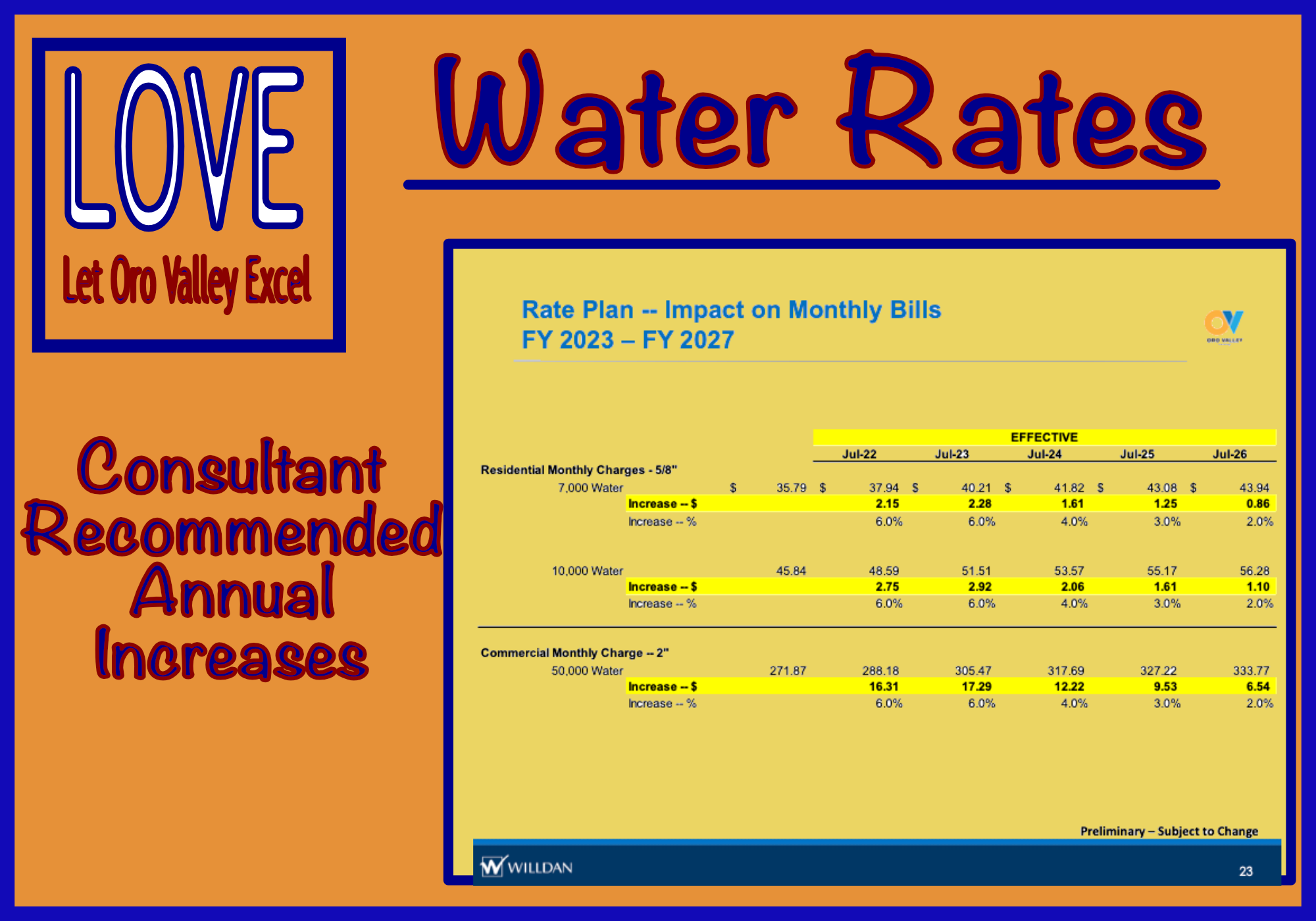
The town council will consider a drinking  rate increase in June. This will be the result of a process that started in October, with a consultant's study of the cost of water service. It continued Monday night when the Town of Oro Valley Water Commission will review a report prepared by the consultant,  Willdan

The study, “Water Rate Study and Long-Term Financial Plan”. recommends that the town implement water rate increases each July from 2022 through 2026. The rate of increase this year and next would be 6% (See panel right). This would be a 

... to cover increase cost and investment
According to the study, the increases are needed to cover expected personnel and operating expense increase, increases in the cost of CAP water and funding of $18.9 million in capital improvements during these years. Two thirds of the capital improvement spending is for the NWRRDS project that will bring and added $4,000 acre feet of CAP water to Oro Valley.

Most of the improvements will be funded either by the add on tax, the Groundwater Preservation Fee, and through $8million bond issuance in 2023.

Would result in a 6% increase next July
A residential user of 7,000 gallons per month would see an increase of $2.15 on their water bill in 2022. That is a 6% increase over their current billed used at this level.

Four reasons the increase benefits the community
The consultant provides four reasons why the 6% rate increase will be beneficial to Oro Valley:
  • Will enable utility to continue operating on a stand-alone basis and independent of general fund assistance
  • Will result in financially-healthy utility that has ability to fund operations and capital needs
  • Ensures that ratepayers pay only what it costs to provide water service
  • Will allow $18.8 million of capital investment to improve quality of service and provide a well-functioning system for future generations

Monday, November 29, 2021

CAP Confirms: Oro Valley Will See No CAP Water Reduction

No impact on Oro Valley's CAP allocation from CAP tier one reduction
Oro Valley water will not be impacted by the tier one reduction in Colorado River water. This reduction goes into effect in January. 

In a briefing to The Oro Valley Town Council on November 17, Karen Cesare, elected representative for Southern Arizona on the state's CAP water board, stressed that Oro Valley and all municipalities  "..will see no reduction in your CAP." Later in the discussion she emphasized to Council Member Jones-Ivey  "We’re trying to do everything we can to protect it or minimize the impact on municipalities."

Summer Monsoon had no effect on CAP water levels
This summers wet monsoon season has not impact on CAP water levels. This is because CAP water comes from the snow melt in the Colorado Rockies. "We look at snow pack and what's happening in the Rocky Mountains," Cesare noted. According to her, if you want to follow the snowfall and the melt you can follow the weather in Grand Lake, Colorado. "If it's snowing in Grand Lake Colorado that’s a good thing," 

Oro Valley water use restrictions are not on the radar
Oro Valley Water Director Peter Abraham does not foresee a time when restrictions will be put in place. Speaking to council in June, he stated that the only time he thinks a significant water restriction would happen is if there is a breakdown to a part of the system, such as a major water break in a portion of the water system that does not have sufficient redundancy to switch to an alternate supply." 

The town reaffirmed its confidence in its ability to deliver a reliable water supply to the community regardless of what happens with CAP water: "To ensure the perpetuity of a safe and reliable water supply for Oro Valley, the Town is well positioned to meet the challenges presented by the supply shortages on the Colorado River water system." This appeared in the November issue of the Town Manager Executive Report To Council (p14).

One day, perhaps by 2025, a CAP Tier 3 emergency will be declared. This will reduce CAP water allocation to Or Valley. Even if this happens, CAP has no authority to mandate how the local water can be used.  Oro Valley's has detailed is water restrictions by threat level level. The council approved these in June. The levels and the restrictions for each are based on water demand in relation to water production capacity. They are not related to CAP water deliveries. You can Oro Valleys emergency restriction plan here.

Good News: Reconsultation is in Progress
The current CAP water use agreement was created long before Arizona was part of program. California, with its enormous political clout, has priority to the Colorado River Water, Arizona is a junior partner. California will see a reduction in CAP water only if further declines in the water level at Lake Meade happen. Even then, the amount of their CAP water reduction is only half of Arizona's. 

There will be a reallocation starting in 2026 that is to be negotiated. According to Cesare, reconsultation is "...an opportunity to reset and everyone’s take. We are dividing up a smaller pie. There’s a whole bunch of ways to do it and that’s what the process is about.... Arizona’s working right now to come up with our position so that we can go into the whole process as a unified state."
- - -

Friday, November 5, 2021

Bits and Pieces

Funding for Golf Course Irrigation Approved
Wednesday, The Oro Valley Town Council authorized the Town Manager Mary Jacobs to engage the services of Wadsworth Golf Construction Company to replace the irrigation on the town owned E; Conquistador and La Canada Courses. We reported about this project and the various options that were considered also on Wednesday. The town will fund the project using Parks and Recreation Bond Funds and Federal ARPA funds. The motion to approve was 6-1.  Council Member Bohen voted against the measure because he believed there are more important parks and recreation initiatives that serve the greater community that should be funded from the bond funds. 

Oro Valley To Manage A Portion of the NWRRDS Effort
The town has crafted an agreement between itself, The Town of Marana, and Metro Water to manage the construction and inspection of  the booster stations and discharge piping of the Northwest Recharge, Recovery, and Delivery System (“NWRRDS”). [See panel]. 

This is a 15 month project that will cost the three partners $65,500 each. The town will save itself and its partners more than $100,000 each because it will do the work that a consultant would be employed to do.

When completed, that project will recover Central Arizona Project (CAP) water stored underground at various locations in Avra Valley and deliver that water to the Northwest Recharge, Recovery and Delivery System (NWRRDS). From there, the water will be transported to the Oro Valley Water Service Area. It will increase the amount of Oro Valley  Water delivered to the town.
---
Town of Oro Valley launches new Adopt-A-Road/Trail website
"The Town of Oro Valley has launched a new website for the Town’s Adopt-A-Road/Trail programs, designed to save volunteers time and alleviate wait times with several new improvements. 

The Adopt-A-Road/Trail website is now a one-stop shop for volunteers to fill out forms and watch training information. In fact, volunteers no longer need to travel to Town buildings to watch a safety video or fill out paperwork. The process is 100% paperless, and the training video is available on the website." (Source:Town of Oro Valley Press Release)

Wednesday, June 23, 2021

As Things Stand Today, Oro Valley’s Growth Depends Solely on CAP

Two things struck us as different
…during last week’s Special Study session on potential changes to Oro Valley’s Water Conservation Code. You can see Monday’s post to read our report on that session.

There were two comments by Oro Valley Water Director Peter Abraham, a person who is bullish on Oro Valley’s water situation. Abraham was responding to questions from council.

Water conservation efforts have yielded all they can
First, Abraham stated that total water use has been increasing the past three years. This, after years of decrease due to resident water conservation efforts. This during years when Oro Valley added lots of new residences and water connections. Abraham said that it looks to him like resident conservation efforts have yielded all the water saving results they can.

Yes. We agree. That is possibly true. But we also think that the Hiremath years of rampant residential growth have overtaken resident ability to use less and less water. Abraham said he is going to “keep an eye” on the situation. We hope so.

Abraham sees NWWRDS as the solution to Oro Valley’s water needs
The second thing, one that is the first time we heard this from Abraham, is that an added “source” of water to the town’s water supply is needed to safely accommodate growth in users. This added supply will come “online” in 2024. It will come from the Northwest Recharge, Recovery, and Delivery System (NWRRDS). That is a joint project with Marana that is led by Metro Water. NWRRDS will deliver up to 4,000 acre feet of water per year to Oro Valley water from a new reservoir. Turns out that that reservoir is a transfer of more CAP water from one of the CAP reservoirs in Avra Valley that store CAP water.

NWWRDS is CAP water… It’s not a new source
Yes. CAP water. So it’s not a new source.

It’s the same water source that the State’s CAP water Czar thinks will be restricted at level 2 or 3 by 2024 or 2025. Just when NWRRD comes on line. These are levels that will reduce Arizona’s CAP water allotment further and eventually Oro Valley’s water allotment from CAP.  

Abraham is counting on NWRRDS to accommodate the growth in population. But this is hardly a long-term, reliable supply of water.

A real, sustainable alternative source must be developed
We’ve studied the CAP water situation for years. We were the first to report on possible restrictions of CAP water. We concluded long ago that the Oro Valley water future is far from bright if this drought continues (which experts suspect it will) and if Oro Valley continues its path of hell-bent growth (which we believe it will).

So, as agreements on CAP water allocation stand today, CAP is not long term solution to how to supply the big growth plans Oro Valley (and the rest of the Southwest) has.

“Desal” can make the Southwest water sustainable… but will politics derail it?
The Southwest and Oro Valley can become water sustainable by moving toward Desal plants. These plants can take the brine out of brackish underground water. They can take the salt out of the ocean. But they are many political barriers that will prevent this from happening until the water crisis is so dire that something simply must be be done. By then, many of us will be “long gone.”

Wednesday, June 16, 2021

Possible Water Use Restrictions Fail To Consider Regulating Future Connections

Council considers plans for possible future water restrictions tonight
The Oro Valley Town Council will study water restriction measures that might be required in the future if certain water system events happen. These events are embodied in a possible revision of Ordinance 15-18, Water Conservation. These events relate to water demand and supply.  

No restrictions are imminent
At present, the Oro Valley water utility has the ability to produce and distribute more water than demand requires. It has been that way for many years, especially once the town began accepting Central Arizona Water (“CAP”) in 2012. The town depends on CAP water to provide a sustainable water supply. CAP water has enabled growth.

CAP water restrictions are imminent. At some time in the future, these will impact the town’s water supply. Thus, the town is moving now to define the circumstances under which it would restrict water use; and how it would do so.

Possible restrictions paint a glimpse into a rather gloomy future
The draft Water Conservation ordinance has four water supply event levels. Each level has water use reduction actions the water department will require of users. These range from voluntary actions, in stage 1, to severe restrictions by phase 4. The following chart summarizes the events and the actions.


The draft ordinance includes penalties, the most severe of which is disconnection of services. Other actions include installing a water restriction device on the service to the property.

Restrictions fail to consider new connections
The draft ordinance does not mention new connections. Thus, based on the ordinance as drafted, new connections can be happening at the same time the current users are struggling to meet required water reduction measures. Imagine a 500 unit apartment going on stream during a level 2 restriction. Residents can’t wash their cars but apartment owners can fill their units. This makes no sense.

Monday, June 14, 2021

Oro Valley Plans Now For Potential Water Use Restrictions Later

The drought is 22 years and counting
The Southwest and the Western US is in a 22 year long drought. It is severe. It is the second longest drought in recorded history. There is no end in sight. Even one or two rainy years won’t solve the drought problem. 

The drought has impacted CAP water
The drought problem won’t be solved unless there are substantial continuing high snow pack, slow melt years in the Rockies. It’s the snow pack melt that provides the bulk of water to the Colorado River system (CAP). It is a system that has seen the slow, continuing decrease in water levels in its two primary lakes: Lake Powell and Lake Meade. 

Oro Valley is dependent on CAP water
CAP water was first introduced to Oro Valley in 2012. Given it’s extensive growth, Oro Valley has not become dependent upon it. By 2020, it was 33% of Oro Valley water. CAP water is used to replenish Oro Valley’s groundwater. Oro Valley’s ground water would not be sustainable without CAP Water.

Tier 1 CAP water system-wide restriction will start in January
As LOVE has reported, the US Bureau of Reclamation, the federal agency responsible for administering CAP, will implement Stage 1 CAP water delivery restrictions when water levels in Lake Meade 1075 feet above sea level. State CAP officials expect that the BLM will make this decision in August for January implementation. This will restrict agricultural water users in terms of the quantity delivered. 

The Tier 1 restriction will not effect Oro Valley’s CAP allocation
It may affect how that allocation is used since the Tier 1 restriction bans CAP water use for replenishment. If this is the case, then Oro Vally Water may have to used this water directly.

Town Council to consider changes to water conservation code “in light of drought…and in expectation of future CAP water delivery curtailments”
Wednesday, The Oro Valley Town Council will take a first step in recognizing the potential impact of the 21 year drought on Oro Valley’s water supply. Later stage CAP restrictions, if they occur, will reduce Oro Valley’s CAP water delivery. The council will discuss, in study session, possible changes to Oro Valley’s water conservation code (article 15-18) 
“In light of the 22-year drought experienced by Arizona, and the expectation of future Central Arizona Project (CAP) water delivery curtailments that could someday affect Oro Valley's CAP deliveries, the Water Utility Commission and staff recommend that now is a good time to update the water code with respect to prohibiting water wasting, the imposition of water restrictions during a Town declared potable water shortage and impose penalties for failure to comply with water conservation requirements during a Town declared potable water shortage.”
Proposed water conservation code change would make water wasting illegal... subject to fines
“Water wasting” (see panel above) would be illegal under the proposed code. The code defines four levels of enforcement regarding water wasting. Essentially, the property owner has six weeks to fix the problem before any fines are levied.The water department, not the police, are responsible for this enforcement.

Wednesday: Proposed code changes specify restrictions in declared water emergency
The bulk of the proposed ordinance regards when the water utility can declare a water emergency, the level of emergencies that it can declare, and the actions that it it will take. This is important because it tells us what to expect if the drought continues. This will be the subject of our posting Wednesday.